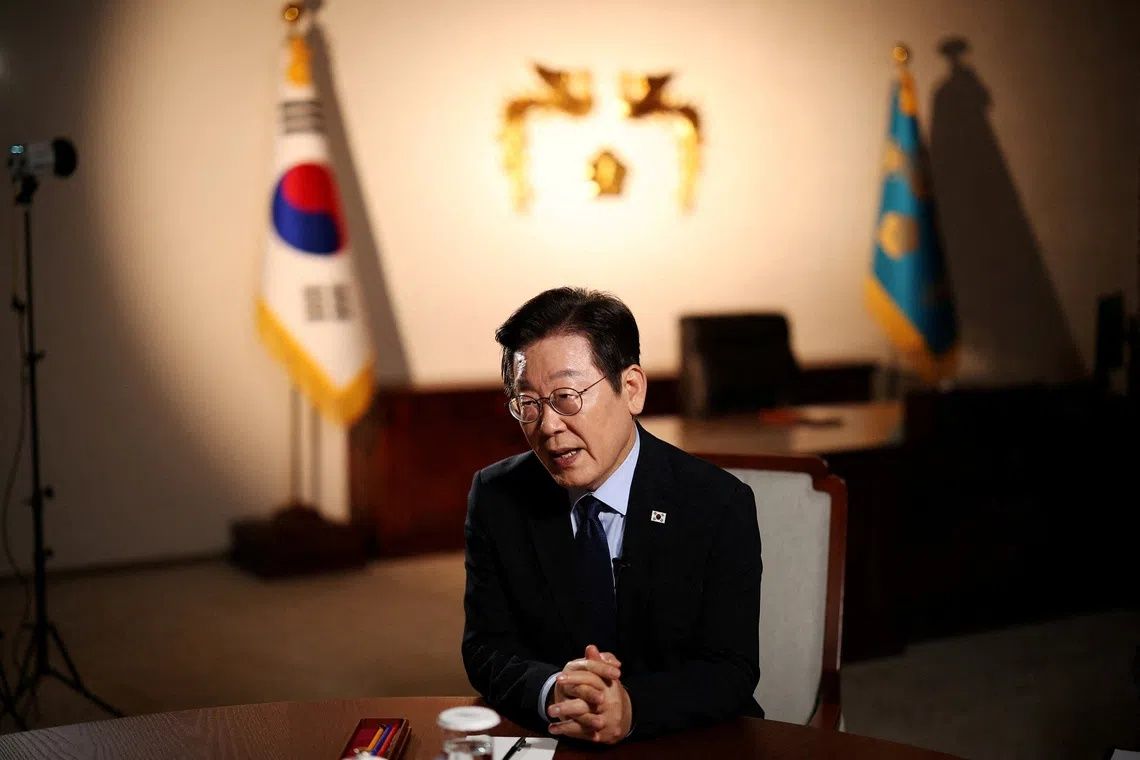
South Korean President Lee Jae Myung has indicated strong backing for a major constitutional overhaul that would permit presidents to serve four-year terms with the option to seek re-election, according to the Yonhap news agency, which cited statements from a Blue House official on Friday. The proposal represents a significant pivot from the current constitutional framework that mandates a solitary five-year presidential term with no possibility of returning to office once a leader's tenure concludes. The move addresses longstanding grievances within South Korean political circles regarding the concentration of executive authority and the vulnerabilities that arise when departing presidents become subject to legal jeopardy.
The presidential official underscored that this particular constitutional model has garnered the greatest degree of public backing among the various reform options under consideration. The characterisation reflects growing consensus that the present system, which vests enormous power in a single individual for a non-renewable period, creates structural imbalances that both observers and political leaders have termed the "imperial presidency" problem. This concentration of authority has generated recurring cycles of political turbulence in South Korea, where outgoing presidents frequently encounter criminal allegations or face attempts to undermine their legacies by successor administrations.
Crucially, Lee's preferred reform framework incorporates mechanisms designed to counterbalance enhanced presidential stability through strengthened parliamentary institutions. By extending the presidency to four years while permitting re-election, the proposal would theoretically reduce the incentive for presidents to exploit their final years in office for partisan purposes or personal protection. Simultaneously, the transfer of greater authority to the National Assembly would create institutional checks on executive overreach, establishing a more horizontal distribution of governance powers across the political system.
The Blue House official clarified that constitutional amendments represent matters requiring extensive deliberation within the legislative arena rather than executive prerogative. Any successful reform initiative would necessitate approval from at least 200 members of the 300-seat National Assembly, a threshold that demands cross-party cooperation and genuine political compromise. This requirement effectively prevents any individual party or faction from unilaterally rewriting the constitutional framework, thereby ensuring that structural changes reflect a degree of democratic consensus rather than partisan advantage.
For Malaysian observers monitoring regional political developments, South Korea's constitutional debate carries instructive implications. Both nations grapple with questions concerning executive authority, legislative balance, and mechanisms that safeguard against power concentration. The South Korean discussion demonstrates how democracies continually recalibrate institutional arrangements to address accumulated grievances and changing political realities. Malaysia's own constitutional framework, with its combination of hereditary and elected leadership alongside prime ministerial governance, reflects a distinct historical pathway, yet the underlying tensions between executive efficiency and legislative oversight remain universally relevant.
The emphasis placed by Lee's office on building political consensus rather than pursuing partisan advantage signals an awareness that constitutional reforms demand legitimacy beyond electoral victory. This stance contrasts with contexts where majority governments attempt to restructure fundamental governing architecture without broader buy-in, potentially delegitimising institutions themselves. The requirement for supermajority support within parliament effectively prevents this outcome by forcing negotiation and genuine dialogue across ideological divides.
The timing of Lee's public position announcement proves strategically significant within South Korea's current political environment. The statement permits the administration to shape ongoing constitutional discussions while establishing the parameters of what the executive considers optimal governance arrangements. Whether this preferred model achieves the necessary legislative support remains uncertain, given the complexities of coalition-building in South Korean politics and potential resistance from opposition factions concerned about strengthening any presidency, regardless of whether their preferred candidate might eventually hold that office.
The parallel commitment to parliamentary empowerment addresses criticism that reforms benefiting the presidency might simply entrench executive dominance under a different temporal arrangement. By coupling presidential re-eligibility with expanded legislative authority, the administration attempts to position its proposal as a systemic rebalancing rather than mere self-interested constitutional engineering. This framing becomes essential for securing the cross-party support necessary to translate discussion into actual constitutional amendment.
The broader South Korean experience with presidential succession reveals how a single-term, non-renewable presidency, while theoretically preventing perpetual power concentration, generates perverse incentives that undermine institutional stability. Outgoing leaders frequently become targets for legal action as successor administrations attempt to establish their own legitimacy through investigating or prosecuting predecessors. The cyclical nature of these confrontations has degraded public confidence in political institutions generally. A system permitting re-election while strengthening parliamentary oversight might interrupt this destructive pattern by establishing clearer separation between personal political survival and institutional governance.
For Southeast Asia's broader political landscape, the South Korean constitutional conversation illustrates how mature democracies continuously adapt institutional frameworks in response to accumulated experience. Rather than viewing constitutions as static documents, successful democracies treat them as living frameworks requiring periodic recalibration. Malaysia's own constitutional development, encompassing multiple amendments addressing federalism, religious authority, and electoral systems, reflects this evolutionary approach. The South Korean debate offers comparative insights into how nations balance stability with necessary institutional reform.

