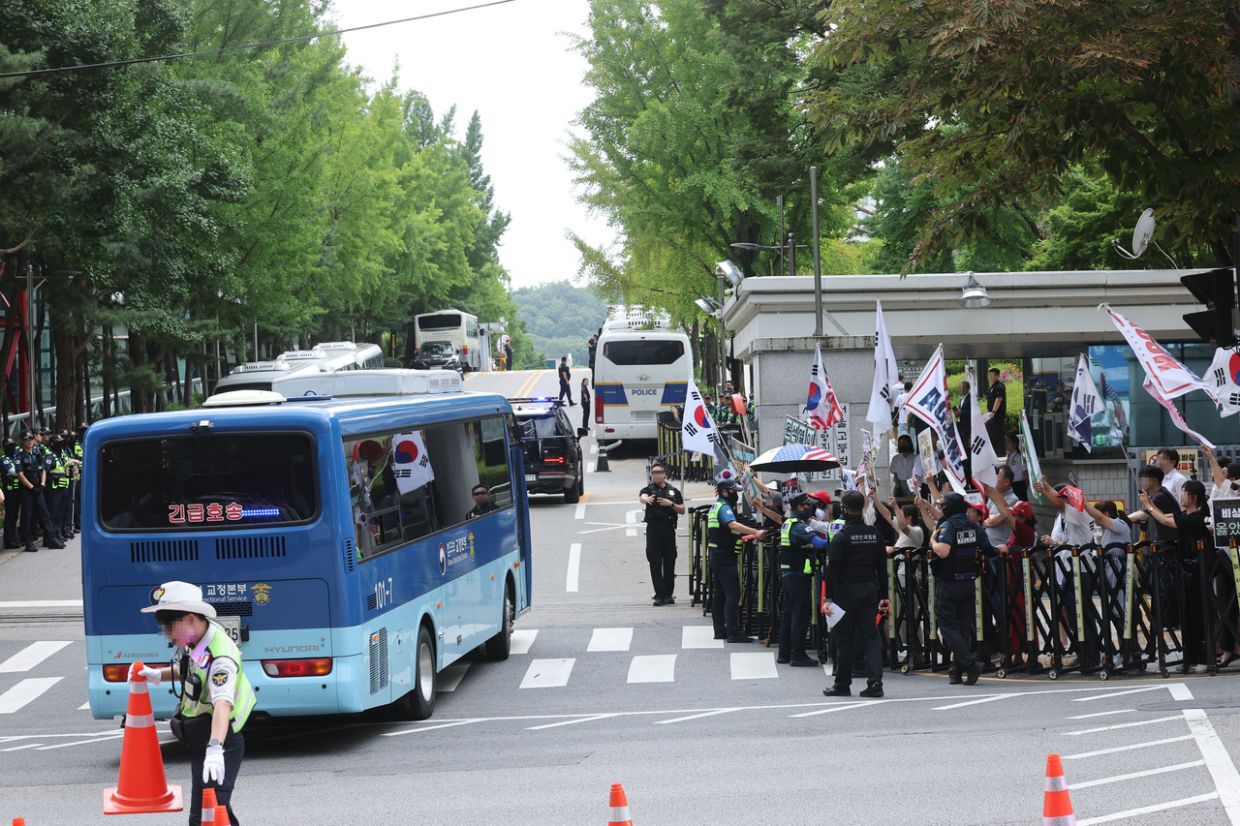
Former South Korean President Yoon Suk Yeol received a two-year prison sentence on Monday after a Seoul court found him guilty of breaching campaign finance regulations by accepting complimentary polling services worth millions of won during his path to the presidency. The conviction marks a significant moment in South Korean politics, where campaign finance violations have long been a contentious issue that has ensnared multiple leaders across the political spectrum. The ruling underscores the judiciary's determination to enforce electoral integrity rules regardless of a defendant's former status, a principle that carries particular weight in a nation still grappling with its democratic legacy.
The Seoul Central District Court determined that Yoon received 14 surveys valued at 27.92 million won (approximately $18,600) from political broker Myung Tae-kyun between June 2021 and March 2022, constituting an illegal contribution under the Political Funds Act. Rather than paying for these polling services through conventional channels, Yoon's campaign obtained them at no cost, creating an undisclosed financial advantage that prosecutors and the court viewed as corrupting the democratic process. The arrangement circumvented transparency mechanisms designed to prevent wealthier candidates from gaining disproportionate access to campaign intelligence and voter perception data.
Judge Lee Jin-gwan articulated the court's reasoning by emphasizing the foundational role that opinion polling plays in democratic contests. Public opinion surveys shape candidate strategies, message development, and resource allocation, meaning that free access to such information represents a tangible and substantial benefit in any electoral race. The judge noted that when politicians receive contributions outside the statutory framework and polling firms provide data in exchange, the entire edifice of fair electoral competition becomes compromised. This perspective reflects growing international concern about how informal campaign finance arrangements undermine public confidence in democratic processes.
Worse for Yoon, the court also established that he had not simply received the surveys but had promised something concrete in return. The evidence demonstrated that Yoon committed to securing the ruling People Power Party's nomination for former lawmaker Kim Young-sun, and subsequently used his influence through then-chief of staff Chang Je-won to advance Kim's candidacy within the party machinery. This quid pro quo arrangement added a layer of corruption to the underlying campaign finance violation, suggesting that Myung was not merely a generous data provider but rather someone investing in political influence with explicit expectations of returns.
The court's investigation revealed that Yoon's wife, former first lady Kim Keon Hee, played an intermediary role in the arrangement. She had authorized Myung to control the timing, substance, methodology, and even whether the polling results would be made public, giving the broker considerable discretion over an asset with genuine strategic value. Yoon demonstrated implicit knowledge of and agreement to this structure, according to the judges, meaning his lack of direct involvement in negotiations did not absolve him of responsibility. This finding is particularly notable because it suggests that spouses and family members cannot insulate candidates from liability by serving as buffers in illicit campaign finance transactions.
Political broker Myung Tae-kyun received a lighter sentence of 18 months in prison and was immediately taken into custody within the courtroom, a significant moment that signaled the gravity of the verdict and the court's commitment to enforcement. Despite being the supplier of the services rather than the consumer, Myung faced consequences comparable to Yoon's, reflecting the court's view that both parties to an illegal arrangement bear culpability for distorting electoral competition.
Interestingly, the court declined to find that establishing a formal quid pro quo agreement was necessary to prove a Political Funds Act violation. This interpretation expands the potential scope of prosecution in campaign finance cases, as prosecutors need not establish an explicit quid pro quo if they can demonstrate that an undisclosed financial benefit was received and accepted by a candidate. For Malaysian observers familiar with their own strict campaign finance regulations and recent enforcement actions, this approach aligns with how jurisdictions worldwide are tightening standards around what constitutes illicit campaign contributions.
The conviction of Yoon stands in stark contrast to the legal outcomes for his wife in a related case involving the same polling services. The lower courts acquitted Kim Keon Hee on the grounds that prosecutors failed to demonstrate she had directly received a financial benefit equivalent to the polling costs or that the surveys were specifically provided in exchange for Kim Young-sun's nomination. This divergence highlights the nuanced nature of campaign finance law and how courts must parse individual culpability based on who directly benefited from the arrangement and on what evidentiary standards apply.
The Supreme Court is scheduled to issue a final ruling in Kim Keon Hee's case this Thursday, potentially clarifying whether she bears any criminal liability despite her intermediary role. Should the high court overturn the lower courts' acquittal, it could significantly alter how Korean jurisprudence treats family members' involvement in campaign finance matters. Conversely, a confirmation of her acquittal would suggest that direct receipt of benefit remains a critical element in establishing criminal liability under the Political Funds Act.
Yoon's conviction arrives amid broader scrutiny of campaign finance practices across South Korea and throughout East Asia, where rapid economic growth has intensified the financial demands of modern electoral politics. The case demonstrates that even leaders who have exercised the highest executive authority face potential criminal consequences for campaign finance violations, though Yoon's legal team is widely expected to pursue appeals. For regional observers, the ruling reinforces that democratic institutions in mature Asian democracies possess the structural independence necessary to hold powerful figures accountable, even when doing so creates significant political turbulence.
The implications extend beyond South Korea's borders. As Southeast Asian democracies continue refining their own campaign finance frameworks and enforcement mechanisms, the Yoon case provides instructive lessons about how courts can interpret campaign finance statutes expansively to capture arrangements that lack formal quid pro quo language but achieve similar corrupt effects. The emphasis on protecting the integrity of opinion polling as a democratic institution also resonates in regional contexts where political consultants and data brokers wield increasing influence over candidate competitiveness and electoral outcomes.

