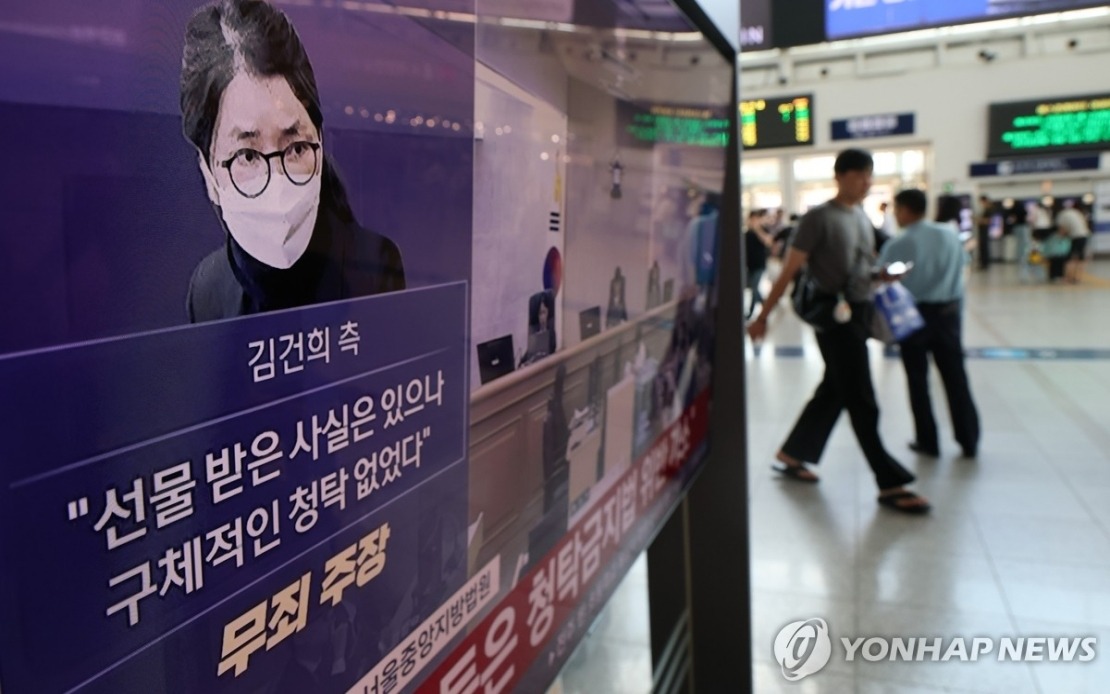
South Korea's former first lady Kim Keon Hee has been handed a seven-year prison sentence by the Seoul Central District Court on charges of accepting bribes in the form of luxury gifts in exchange for wielding her influence to secure government jobs and business advantages. The verdict represents a significant legal defeat for the wife of ousted former President Yoon Suk Yeol and marks another chapter in the unravelling of the presidential family's reputation following Yoon's dramatic removal from office.
Kim was convicted on all counts related to receiving approximately 300 million won in gifts, a figure that underscores the scale of the alleged misconduct during her time as first lady. The most prominent item among these gifts was a Van Cleef & Arpels necklace and other fine jewellery pieces provided by a construction company chairman between March and May 2022, specifically in exchange for securing a government position for the chairman's son-in-law. The Seoul court found that these transactions represented clear exchanges of value, with Kim leveraging the prestige of her position to facilitate personal gain for benefactors.
Presiding Judge Cho Sun-pyo issued a scathing assessment of Kim's conduct during the televised hearing, stating that she had fundamentally betrayed the responsibilities inherent in serving as first lady by treating the position as a personal vehicle for accumulating wealth and influence. The judge's remarks highlighted a breach of public trust that extends beyond simple financial corruption—the court viewed her actions as a systematic abuse of the ceremonial and symbolic authority that comes with being the president's spouse. This characterisation carries particular weight in South Korean society, where the role of first lady carries deep cultural significance and is traditionally expected to embody national virtue.
The evidence presented at trial detailed a pattern of gift-giving spanning multiple years and involving a diverse array of luxury items. Beyond the initial necklace, Kim received a golden turtle ornament in April 2022 from Lee Bae-yong, the former head of the National Education Commission, directly tied to securing her an appointment to that position. In the same year, a Dior bag valued at 5.4 million won was gifted to her by a pastor, and a Vacheron Constantin watch was provided by another businessman in September 2022. A further significant gift emerged in February 2023, when authorities discovered that Kim had received a painting by celebrated artist Lee Ufan from a former prosecutor in exchange for her assistance in securing him a nomination for electoral office.
The timing of these transactions raises serious questions about the nature of presidential governance during Yoon's tenure. The majority of the exchanges occurred between May 2022 and April 2025, precisely the period when Yoon held the presidency and Kim wielded maximum leverage in pursuing favours for her associates. This chronological overlap suggests that Kim's position as first lady was actively being monetised by third parties seeking to access governmental power and resources through her intermediation. The court's findings indicate a troubling symbiosis between corporate and political interests, with wealthy businesspeople and government officials viewing Kim as a valuable conduit for securing preferential treatment.
Kim's legal strategy during the trial ultimately undermined her defence. When investigators began scrutinising her financial arrangements, she attempted to diminish her culpability by returning certain gifts or claiming that she had personally purchased the items in question. Judge Cho interpreted these actions not as evidence of innocence but rather as proof of consciousness of guilt—an acknowledgment that Kim understood the illegality of her conduct and took deliberate steps to conceal it once her activities came under official examination. This finding of deliberate evasion strengthened the prosecution's case and likely influenced the court's decision to impose the full seven-year sentence rather than a reduced term.
The special counsel's office, led by Min Joong-ki, had sought an even harsher penalty of seven and a half years imprisonment, viewing the violations as serious breaches of public trust that warranted maximum deterrence. The prosecution's aggressive stance reflects growing concern within South Korean law enforcement circles about the normalisation of corruption at the highest levels of government and the perceived entitlement of presidential families to exploit their positions for private enrichment. By narrowly missing on their sentencing recommendation, prosecutors sent an implicit signal that they view even a seven-year term as appropriately severe.
Kim's legal team has indicated their intention to appeal the verdict, suggesting that the battle over her fate remains unresolved. Appeals courts in South Korea have sometimes reduced sentences in high-profile cases, particularly when concerns arise about proportionality or procedural fairness, though the comprehensive nature of this conviction and the court's detailed articulation of her guilt may make reversing the verdict difficult. The uncertainty surrounding potential appellate intervention means that Kim's prison time is not yet guaranteed, a factor that could influence public perception of South Korean judicial independence and the rule of law.
Beyond this particular sentencing, Kim faces additional legal jeopardy that extends the scope of her legal troubles considerably. An appeals court has already convicted her in a separate corruption matter and imposed a four-year prison sentence, meaning that even if her seven-year sentence is upheld, the cumulative period of imprisonment could reach over a decade when combined with other convictions. Furthermore, she confronts yet another trial concerning allegations of her involvement in orchestrating forced enrolment of Unification Church members into the ruling People Power Party prior to the 2022 presidential election, an effort allegedly designed to manipulate the party's primary process in favour of her husband.
This cascade of legal proceedings paints a portrait of systemic misconduct within the presidential administration and raises troubling questions about governance structures that permitted such extensive abuse of power. For Malaysian observers and other Southeast Asian audiences, the South Korean case serves as a cautionary illustration of how concentrated executive authority, coupled with weak institutional checks, can facilitate widespread corruption involving figures nominally outside the formal government apparatus. The willingness of the Seoul courts to prosecute and convict a former first lady—a role that in many Asian democracies enjoys considerable immunity from legal scrutiny—demonstrates South Korea's more robust institutional safeguards, though the lengthy appeals process ahead suggests those protections remain imperfect.
The broader implications of this scandal reverberate through South Korean politics at a moment of considerable turbulence. Yoon's own presidency has been marked by confrontation with legislative opposition and his subsequent impeachment has left the ruling party fractured and demoralised. The accumulation of corruption charges against Kim compounds the reputational damage to the conservative political movement that Yoon represented, potentially accelerating a shift in public sentiment toward alternative political leadership. As South Korea navigates this period of institutional strain, the judicial system's demonstrated capacity to hold powerful families accountable—despite their resistance—offers some assurance that no one, regardless of political status or proximity to former power, remains beyond the reach of the law.

