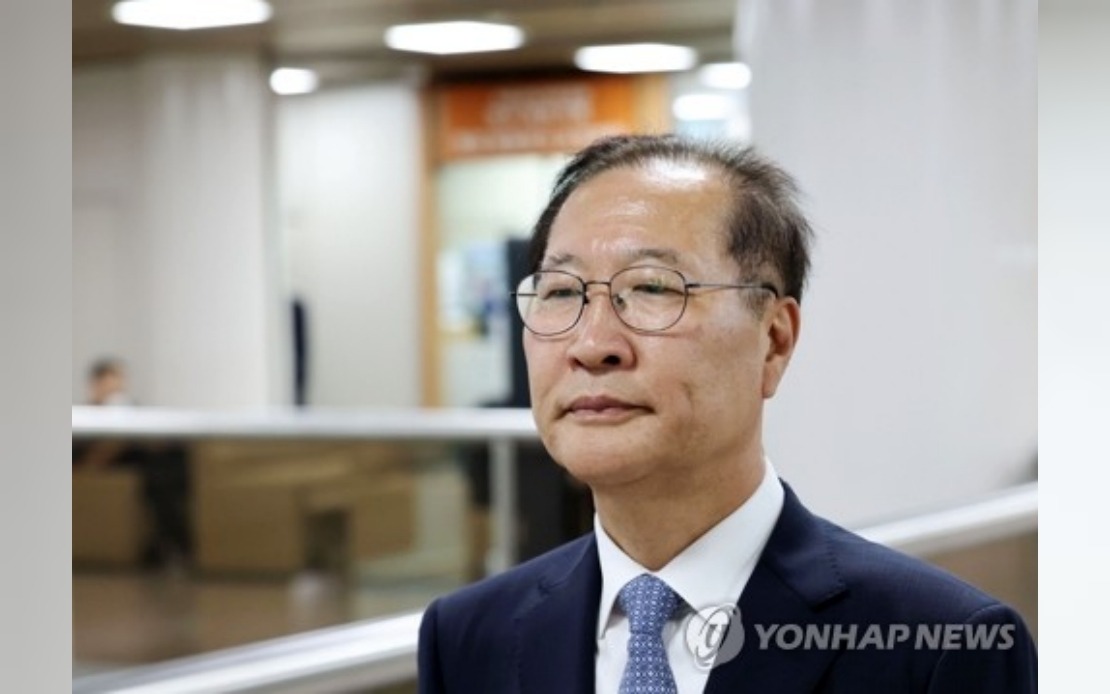
South Korea's former Justice Minister Park Sung-jae has been handed a 25-year prison sentence by Seoul Central District Court, marking another significant conviction stemming from the tumultuous events surrounding President Yoon Suk Yeol's martial law declaration last December. The sentence, handed down on Monday, exceeds the 20-year term recommended by special counsel Cho Eun-suk's investigative team and immediately resulted in Park's detention pending appeal, with the court expressing concern that he might attempt to destroy evidence linked to the case.
Park's conviction centers on his instrumental role in supporting the insurrection through actions taken immediately following Yoon's December 3, 2024 martial law proclamation. The former justice minister was found guilty of orchestrating a meeting of senior ministry officials as part of a coordinated effort to facilitate the extraconstitutional power grab. The court's acceptance of the prosecution's arguments reveals the degree to which Park leveraged his ministerial authority to actively participate in what the judiciary has determined constitutes an illegal insurrection rather than merely passive compliance with executive orders.
The substance of Park's culpability extends beyond symbolic gestures of support. The Seoul Central District Court established that during this critical meeting, Park directed ministry officials to examine the feasibility of dispatching prosecutors to bodies established to support the martial law regime. Additionally, he ordered assessments of correctional facility capacity, indicating planning for the detention of political opponents and other figures targeted for arrest under the martial law framework. These were not ancillary administrative matters but rather concrete preparatory measures designed to operationalize the insurrectionary scheme.
In its judicial reasoning, the court articulated a fundamental principle that would resonate across democratic societies: government officials hold a constitutional duty to resist illegal exercises of executive power. The bench explicitly stated that Park had abandoned his obligation to uphold the constitutional order, instead prioritizing his assessment that the insurrection might succeed. This framing transforms the case from one of mere political misjudgment into a question of conscious choice between lawful and unlawful conduct, with Park deliberately selecting the latter path.
Park's conviction does not stand in isolation within Yoon's cabinet. He joins former Prime Minister Han Duck-soo and former Defence Minister Kim Yong-hyun in receiving guilty verdicts for playing key roles in the insurrection. This pattern of high-level government complicity demonstrates that the martial law declaration represented not an isolated presidential action but rather a coordinated effort involving multiple state institutions. The convictions suggest a systematic attempt to mobilize government machinery—justice, defense, and administrative apparatus—in service of the constitutional violation.
At the apex of this judicial pyramid stands President Yoon himself, who received a life sentence in February for orchestrating the martial law imposition. Yoon's case currently remains under appeal, introducing uncertainty into South Korea's constitutional reckoning. The contrast between Yoon's life sentence and Park's 25-year term reflects judicial assessments of their respective roles in the hierarchy of responsibility, though both demonstrate the courts' determination to hold senior officials accountable for the extraordinary constitutional breach.
The special counsel team sought additional charges against Park under anti-graft legislation, claiming he had improperly responded to requests from First Lady Kim Keon Hee regarding investigations into her own corruption allegations. However, the court dismissed these charges on jurisdictional grounds, ruling that anti-corruption matters fell outside the special counsel's investigative mandate. This technical dismissal prevented a fuller examination of potential corruption within the justice system's response to first lady-related matters, leaving some dimensions of official misconduct unresolved.
Park's legal team has signaled their intention to appeal, characterizing the sentence as divorced from factual evidence and legal principle. This assertion sets the stage for appellate proceedings that will scrutinize both the factual findings regarding Park's specific actions and the legal characterization of those actions as constituting insurrection. The appeal process may extend South Korea's constitutional crisis resolution, with higher courts potentially reviewing the boundaries of executive authority and ministerial duty during periods of constitutional emergency.
Contrasting sharply with the defense's position, the special counsel team expressed satisfaction with the ruling and indicated they would not pursue appeal. Their public statements emphasized that the judgment clearly delineates the justice minister's constitutional obligation to prevent illegal martial law declarations and defend constitutional order. This prosecutorial perspective frames the verdict as establishing important precedent regarding state official accountability during constitutional crises, potentially influencing how other democracies approach similar scenarios.
For Malaysian observers and regional analysts, South Korea's handling of the martial law crisis provides instructive parallels and contrasts regarding constitutional governance and official accountability. South Korea's willingness to prosecute and convict sitting and former senior officials, including a sitting president, reflects a mature democratic system capable of self-correction through judicial processes. The systematic convictions across multiple cabinet positions suggest institutional mechanisms that function with relative independence from political pressure, even when addressing the nation's highest officials.
The Korean experience also illuminates the mechanisms through which coordinated insurrection occurs within ostensibly democratic systems. Rather than a dramatic military coup, the martial law attempt weaponized civilian institutional structures—the justice ministry, defense establishment, and administrative apparatus. This pattern warns that constitutional threats may emerge through institutional corruption rather than extragovernmental military action, a relevant consideration for any democracy monitoring its own institutional integrity.
Moreover, South Korea's criminal prosecutions of insurrection charges establish precedent for how democracies can address extraordinary constitutional violations through ordinary legal channels. Rather than retaliatory successor prosecutions or political vengeance, the Korean judiciary has applied existing legal frameworks—insurrection statutes and abuse of power provisions—to conduct systematic accountability. This approach, while imperfect, demonstrates that constitutional restoration need not require extra-legal mechanisms, though it does require judicial independence and public acceptance of controversial verdicts.