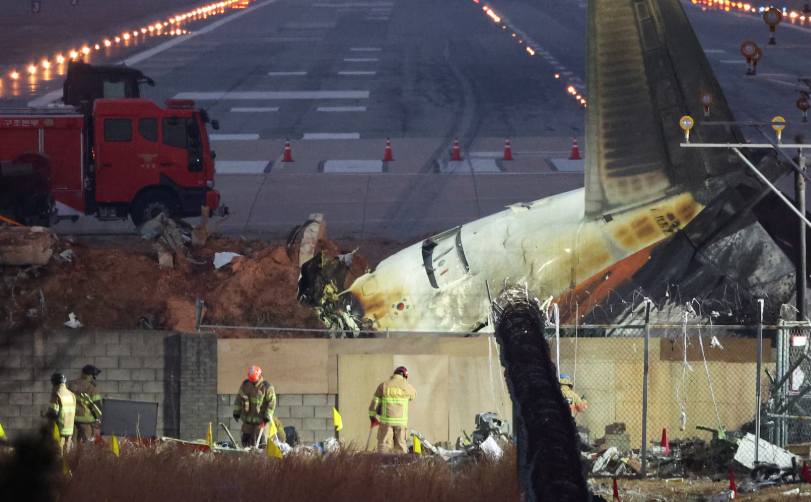
South Korean law enforcement has intensified its investigation into the catastrophic Jeju Air crash, conducting raids on the Korea Airports Corporation (KAC) and two other government agencies on Tuesday in search of evidence that could support criminal charges against aviation officials. The operation marks an escalation in the authorities' systematic examination of how the disaster unfolded and whether those responsible for airport operations and regulatory oversight failed in their duties.
Investigators descended on the offices of KAC, which manages most of the country's major domestic airports with the notable exception of Incheon International Airport, along with the transport ministry and the Busan Regional Office of Aviation. The coordinated raids underscore the prosecution's determination to establish accountability across multiple layers of the aviation sector's administrative structure. By targeting these three institutions simultaneously, authorities aimed to secure documentation and records that might demonstrate how decisions made at various administrative levels either contributed to or failed to prevent the tragedy.
The December 29, 2024 incident at Muan International Airport claimed 179 lives, making it one of South Korea's deadliest aviation disasters in recent memory. The scale of the loss has kept intense public and political pressure on investigators to determine precisely what happened and whether systemic failures or negligence played a role in the outcome. The crash investigation has become as much a public reckoning as a legal proceeding, with families of victims and the broader society demanding comprehensive answers about how such a tragedy occurred.
According to investigators leading the special task force, the raids were designed to gather additional material relevant to charges of professional negligence resulting in death or injury. These charges, among the most serious in South Korea's criminal code for administrative and professional conduct cases, already apply to 74 suspects who have been identified in connection with the incident. The breadth of the suspect list reflects the authorities' view that responsibility for the crash extends beyond individual pilots or mechanics to encompass broader institutional and supervisory failures.
The transport ministry has now been subjected to investigation three times, a pattern that suggests authorities believe the ministry's regulatory framework or specific decisions made by ministry officials warrant intense scrutiny. This repeated focus indicates investigators may be examining how oversight was conducted, whether safety protocols were properly enforced, and whether the ministry adequately supervised airport operations and safety standards. The repeated returns to the same institution signal that initial searches may have uncovered leads that required follow-up investigation.
Beyond the negligence charges already filed, police have indicated that additional charges involving causing a serious public disaster could potentially be applied. These more severe charges would carry harsher penalties and would characterize the incident not merely as a result of individual negligence but as a systemic failure endangering public safety. Such charges would represent a more expansive legal theory encompassing corporate responsibility and institutional accountability rather than limiting culpability to individual actors.
The investigation's dual focus—simultaneously determining the technical cause of the crash while examining whether relevant agencies handled their responsibilities appropriately—reflects a comprehensive approach to aviation disaster investigation. Authorities must establish not only what mechanical or operational failure triggered the crash, but also whether regulatory agencies, airport operators, or other government bodies failed to maintain adequate safety standards or implement proper oversight mechanisms. This broader investigative lens is particularly significant in aviation, where multiple systems and institutions share responsibility for passenger safety.
For Malaysia and other Southeast Asian nations, the South Korean authorities' rigorous investigation carries important implications. The region has seen its share of aviation incidents, and the approach taken by South Korea—holding not just operational staff but administrative and regulatory bodies accountable—offers a model for how regional nations might strengthen their own aviation safety oversight. The investigation underscores that responsibility for aviation safety extends well beyond pilots and maintenance crews to encompass the full spectrum of airport management and government regulation.
The involvement of the Busan Regional Office of Aviation in the raids suggests investigators are examining how local airport authorities at Muan specifically implemented safety protocols and whether local decision-making contributed to the incident. This focus on decentralized airport operations highlights how safety failures can originate at multiple administrative levels, from national policy-making through ministry oversight to local airport management decisions. The comprehensive nature of the investigation reflects a recognition that aviation accidents rarely result from single points of failure but rather from chains of decisions and oversights that accumulate into tragedy.
The progression from initial investigative steps to these more expansive raids indicates that the prosecution believes it has developed sufficient preliminary evidence to justify deeper examination of institutional records and decision-making processes. This trajectory is typical of major aviation investigations, where authorities first examine immediate circumstances before progressively broadening their focus to systemic issues. The coordinated nature of Tuesday's raids, targeting multiple agencies simultaneously, suggests investigators have developed a coherent theory about how institutional failures contributed to the disaster and are now moving to secure documentary evidence supporting that theory.
As the investigation continues, the 74 suspects already facing charges will be joined by additional individuals potentially implicated through the evidence gathered in these raids. The expanding scope of the legal proceedings reflects the authorities' determination to pursue accountability comprehensively rather than concentrating responsibility on a few individuals. This approach, while demanding significant investigative resources, reflects South Korean society's expectation that major disasters receive thorough institutional examination rather than serving as occasions for limited, token prosecutions.
The Jeju Air crash investigation stands as a reminder that aviation safety depends fundamentally on institutions, regulations, and systemic oversight rather than relying solely on individual professional competence. As South Korean authorities methodically pursue their investigation through successive raids and expanding charges, they are effectively sending a message to airport operators and aviation regulators that institutional accountability matters as much as individual responsibility in protecting public safety.

