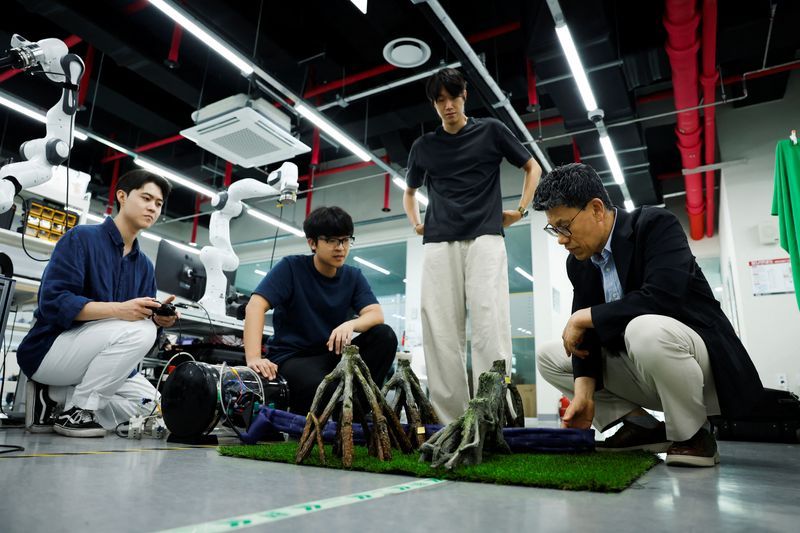
Scientists collaborating between South Korea's KAIST and Stanford University have introduced an innovative robotic system capable of dressing individuals independently, marking a significant advance in wearable robotics that could reshape personal protective equipment deployment and elderly care assistance. Unveiled in Daejeon, the technology employs soft, flexible pneumatic "vines" embedded within garments that activate when pressurised, smoothly pulling fabric against the wearer's body through a climbing motion similar to ivy scaling a wall. The breakthrough addresses practical challenges in contexts where rapid suit-up is critical, from semiconductor manufacturing to emergency response scenarios, whilst eliminating the need for manual dexterity or external help.
The engineering breakthrough emerged from an unexpectedly mundane observation. KAIST postdoctoral researcher Kim Nam Gyun, who led the research team, conceived the idea whilst cycling in unexpected rainfall, recognising the potential value of a raincoat that could deploy automatically during motion rather than requiring the wearer to stop and don it manually. This everyday frustration catalysed a multi-year investigation into how robotic systems could move with human bodies rather than demanding static positioning, fundamentally challenging assumptions about wearable technology design that had prevailed for decades.
The mechanism operates through an elegant biomimetic principle. Rather than employing rigid actuators or complex control systems, the vine robot grows progressively at its tip, advancing incrementally along the body's contours much like ivy naturally climbs architectural surfaces. As the pressurised vines expand and move, they simultaneously invert the clothing, drawing it upward and inward to embrace the wearer's form. This process completes for a full protective suit in approximately ten seconds, a timeframe that could substantially improve workflow efficiency in time-sensitive applications.
A crucial advantage distinguishing this technology from existing robotic dressing systems lies in its operational flexibility. The wearer need not remain stationary throughout the dressing process; movement and activity continuation are possible whilst the vine robot performs its function. This mobility preservation represents a meaningful quality-of-life improvement, particularly for elderly individuals or those with mobility constraints who might otherwise experience the indignity and physical strain of standing immobilised during suit-up procedures. The technology achieves this adaptability without demanding sophisticated algorithmic control, a factor that substantially reduces computational requirements and failure points.
Jee-Hwan Ryu, professor of civil and environmental engineering at KAIST, emphasised the technological flexibility inherent in the vine-climbing approach. The robotic system navigates narrow apertures, conforms dynamically to environmental conditions, and maintains traction across diverse surfaces regardless of whether terrain presents slippery, adhesive, or inclined characteristics. This versatility emerges from mechanical principles rather than software sophistication, enabling the system to function reliably in unpredictable conditions where digital adjustment might prove inadequate or delayed.
The immediate practical applications span multiple sectors with pressing operational needs. Semiconductor fabrication facilities maintain stringent contamination protocols requiring workers to don specialised cleanroom attire; the vine robot accelerates this process whilst maintaining precision in suit placement. Similarly, emergency responders—firefighters, hazmat teams, and paramedics—frequently require rapid protective equipment deployment under stress, environmental hazard, and time pressure. A system capable of dressing personnel within seconds whilst leaving hands available for equipment handling or victim assistance represents a tangible operational enhancement for these services.
Beyond emergency and industrial contexts, the technology holds profound implications for elderly care and disability support, addressing a demographic challenge increasingly relevant across East Asian and Southeast Asian societies experiencing rapid population ageing. Individuals with arthritis, reduced dexterity, or limited mobility often struggle with conventional clothing fastening systems; an automated alternative preserving personal independence whilst reducing caregiver burden addresses both practical necessity and psychological autonomy concerns. The technology thus operates at the intersection of healthcare delivery and human dignity.
Ryu articulated an important counternarrative within contemporary technological discourse. Amid concentrated attention on artificial intelligence and software engineering advances, the vine-robot project demonstrates that mechanical innovation remains equally consequential. The technology embodies sophisticated engineering principles—materials science, biomimetics, pneumatic systems design—deployed to solve tangible human problems without requiring artificial intelligence integration. This perspective challenges assumptions that robotics advancement must inevitably centre on computational complexity, suggesting alternative pathways toward meaningful technological progress.
The research findings underwent publication in IEEE Robotics and Automation Letters, a peer-reviewed journal maintaining rigorous standards for robotic systems research. This scholarly validation provides credibility whilst positioning the work within established scientific frameworks where further refinement and application development can proceed through collaborative investigation. The peer-review process ensures that subsequent teams attempting to build upon or commercialise these principles operate from verified foundational knowledge.
For regional stakeholders across Southeast Asia and the broader Asia-Pacific, this technology carries significant implications. Manufacturing economies increasingly reliant on semiconductor production, pharmaceutical manufacturing, and specialised industrial processing would benefit substantially from accelerated worker preparation protocols. Additionally, nations confronting acute healthcare workforce shortages and ageing population management—conditions prevalent throughout the region—may discover compelling applications for autonomous dressing systems that preserve elderly independence whilst reducing caregiver requirements. The technology represents intellectual property with potential commercialisation pathways and licensing opportunities that South Korean enterprises might leverage regionally.
The collaborative nature of this research, involving both South Korean and American institutional resources, exemplifies how scientific progress in advanced robotics increasingly demands multinational partnership. KAIST's engineering excellence combined with Stanford's research infrastructure created conditions enabling innovation that likely neither institution could have achieved independently. This model suggests future robotic systems addressing Asian-specific challenges—from tropical climate adaptation to high-density urban deployment scenarios—might similarly benefit from international research consortia drawing expertise from multiple contexts.
Moving forward, practical engineering challenges remain concerning durability, material biocompatibility for extended wear, scaling to accommodate diverse body dimensions, and adaptation to varied climatic conditions affecting pneumatic system performance. Industrial partners would need confidence in reliability across thousands of deployment cycles before widespread adoption. Nevertheless, the fundamental feasibility has been demonstrated, positioning the technology at the threshold between laboratory innovation and practical implementation, a transition likely to accelerate through commercial interest and subsequent refinement.

