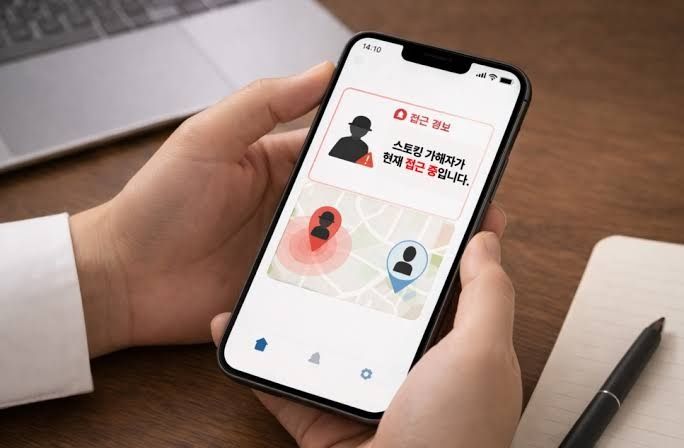
South Korea's government has taken a significant step in combating persistent stalking by rolling out a smartphone-based monitoring system on June 24 that gives victims direct access to location data of individuals suspected of harassment. Operated through the Justice Ministry, the application represents an escalation in technological approaches to intimate partner violence and stalking, allowing targeted individuals to track their suspected stalkers' current whereabouts and direction of travel in real time. The initiative marks a departure from earlier protection methods that relied primarily on victims alerting authorities when they felt threatened, shifting the burden of vigilance toward immediate, technology-enabled awareness.
The decision to introduce this surveillance mechanism follows years of mounting public concern about the inadequacy of South Korea's existing stalking prevention framework. Previously, the country had distributed smartwatch-type emergency alert devices to at-risk individuals, enabling them to call for help instantly when endangered. Yet these reactive tools proved insufficient in preventing tragedy. According to Democratic Party Representative Lee Gwang-hee, at least 23 stalking victims were murdered or subjected to attempted murder between 2021 and August 2025 despite possessing these emergency devices. Such cases generated headlines and public outcry, creating political pressure on lawmakers to expand protective mechanisms beyond alerting systems to include proactive monitoring capabilities.
The government's approach builds on electronic monitoring infrastructure that has evolved incrementally over recent years. Since 2024, South Korean courts have begun ordering high-risk stalking suspects to wear electronic ankle monitors in certain cases, representing a judicial acknowledgement that traditional restraining orders and police intervention alone cannot guarantee victim safety. This development positioned South Korea alongside several other democracies that have adopted electronic surveillance of offenders as a preventive tool. The Justice Ministry's new application simply extends existing monitoring data directly to the intended beneficiaries—the victims themselves—rather than channelling information exclusively through law enforcement intermediaries who may lack capacity for continuous oversight.
The transition from law enforcement-mediated protection to victim-controlled real-time monitoring reflects both the capabilities of modern mobile technology and a philosophical shift in victim advocacy. Malaysian readers will recognize this approach as aligned with evolving regional attitudes toward victim empowerment, particularly following high-profile femicide cases across Southeast Asia that have prompted governments to reconsider the balance between victim agency and state paternalism. The South Korean system acknowledges that victims themselves possess intimate knowledge of their stalkers' patterns and threats, making them valuable monitors of compliance and risk escalation.
However, expanding access to suspects' location data raises privacy concerns that South Korean policymakers have not dismissed lightly. In December 2025, the Justice Ministry revised regulations governing electronic monitoring specifically to address these tensions, signalling awareness that surveillance systems require robust safeguards against misuse. The regulatory framework presumably establishes protocols for data protection, defines access permissions, and establishes accountability mechanisms. For South and Southeast Asian countries considering similar systems, these regulatory protections will prove essential in gaining public and judicial support for victim-centered monitoring schemes.
The application's rollout does not represent the endpoint of South Korea's stalking prevention evolution. The Justice Ministry has committed to introducing an additional mechanism in April 2027 that would fundamentally restructure how victims engage with the judiciary. Currently, victims seeking court-ordered restraining orders must petition through police agencies or prosecutors who act as gatekeepers, filtering requests based on their assessment of evidence and merit. The planned system would permit victims to petition courts directly, bypassing law enforcement intermediaries entirely. This change carries profound implications for access to justice, potentially reducing delays and bureaucratic friction that currently prevent some victims from obtaining protective orders promptly.
Direct victim petitioning could accelerate the judicial timeline significantly. When law enforcement agencies serve as mandatory intermediaries, cases may be delayed by investigative requirements, resource constraints, or prosecutorial discretion regarding case prioritization. Police in major cities like Seoul undoubtedly handle staggering caseloads, and stalking cases—often lacking obvious physical violence in early stages—may not receive equivalent priority to other offences. By enabling direct court access, South Korea's government intends to empower victims to initiate judicial proceedings on their own timeline, fundamentally redistributing control over the protective process away from state authorities and toward individuals most affected by stalking.
The comprehensive approach emerging across South Korea's reformed stalking prevention framework reflects international best practices increasingly adopted across developed democracies. Victim-centered protection integrates technological monitoring, judicial efficiency reforms, and regulatory oversight designed to balance victim safety against suspects' privacy rights. This integrated methodology stands in contrast to earlier frameworks in many countries where stalking was treated as a low-priority police matter deserving minimal institutional attention.
For Malaysian policymakers and victim advocates observing South Korean developments, several lessons warrant consideration. First, technological solutions require accompanying regulatory frameworks that establish clear boundaries and accountability mechanisms. Second, victim empowerment through direct judicial access can complement technological protections by removing bureaucratic barriers to obtaining court orders. Third, evolving protection systems benefit from pilot phases that permit refinement before full-scale implementation. South Korea's staggered approach—introducing electronic monitoring during 2024, launching the victim-accessible application in 2025, and planning direct court petitioning for 2027—demonstrates institutional recognition that comprehensive protection systems require testing and adjustment.
The South Korean initiative also illustrates how persistent advocacy from affected communities and elected representatives can drive policy change. Representative Lee Gwang-hee's public documentation of victim deaths was not merely statistical reporting but political testimony that demanded response. Similarly, Malaysian civil society organizations working on intimate partner violence have been instrumental in advancing legislative reforms, suggesting that continued pressure and documentation may yield comparable protections in the region.
As South Korea continues refining its stalking prevention architecture, regional governments will likely monitor outcomes and implementation challenges. Questions remain regarding whether real-time location monitoring deters stalking behaviour or merely improves victim situational awareness, whether direct court access significantly increases the proportion of stalking victims obtaining restraining orders, and whether electronic monitoring systems function effectively across all demographic groups. Answers to these questions will inform policy discussions across Southeast Asia, where stalking and femicide remain persistent challenges demanding innovative institutional responses.

