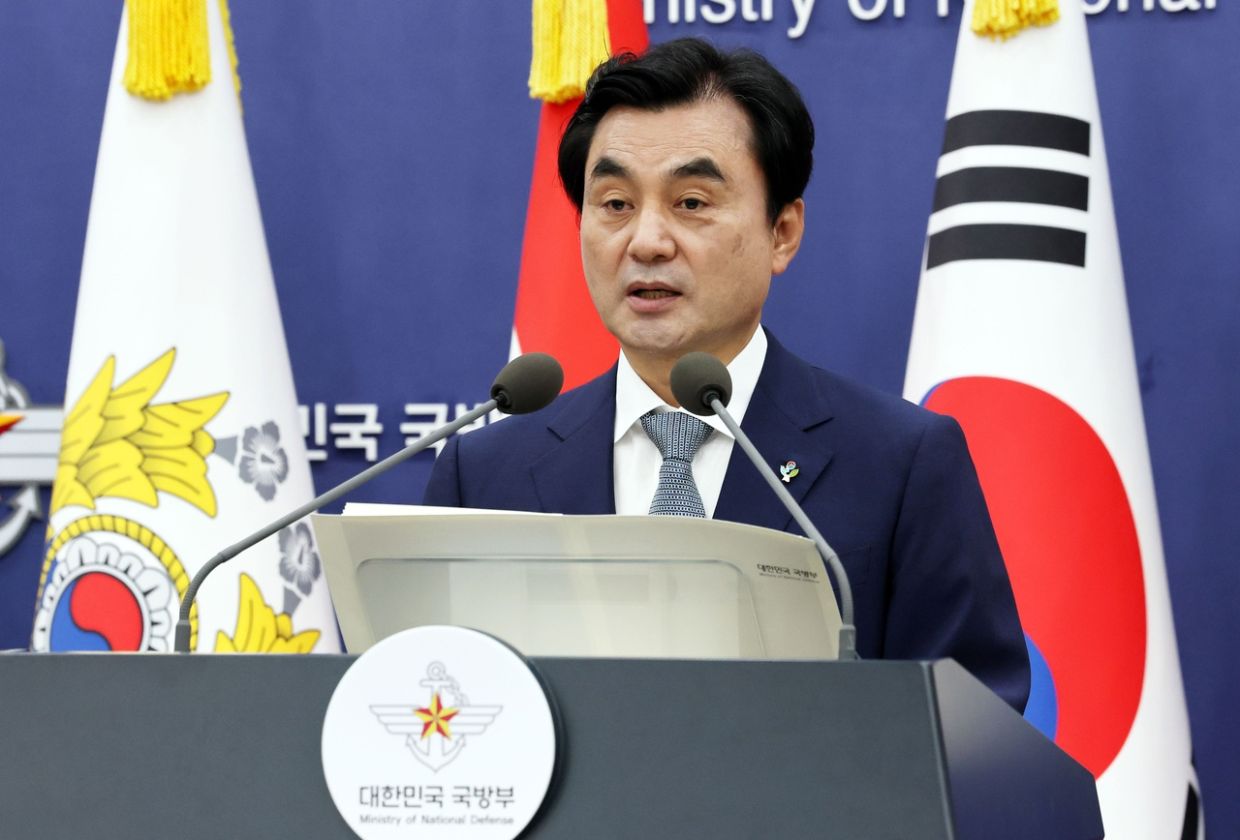
South Korea is embarking on a comprehensive transformation of its unmanned warfare capabilities, Defence Minister Ahn Gyu-back announced Friday, with plans to acquire more than 20,000 low-cost drones and expedite deployment of the domestically developed K-Lucas long-range loitering munition system. The sweeping initiative reflects Seoul's strategic pivot in response to evolving battlefield dynamics, particularly lessons drawn from Russia's ongoing war in Ukraine and recent military tensions in the Middle East, where drone proliferation has fundamentally altered conventional warfare doctrine.
The acceleration of low-cost drone procurement and the K-Lucas programme represents a deliberate shift away from reliance on expensive, high-end military hardware towards a volume-based strategy that emphasises distributed autonomous capabilities. Ahn stated that the widespread deployment of budget-friendly unmanned systems is fundamentally restructuring contemporary conflict, necessitating a rapid response from military planners. The K-Lucas system, once fully operationalised, will provide South Korea with the capacity to execute strategic strikes across extended ranges, a capability deemed essential as regional security tensions intensify and technological barriers to advanced weapons systems continue to lower globally.
Pyongyang's expanding arsenal of unmanned aerial systems presents a mounting challenge to South Korean defences, extending beyond traditional military installations to encompass critical infrastructure and civilian population centres. The North Korean drone threat encompasses reconnaissance platforms capable of penetrating sensitive areas and offensive systems designed to inflict damage on high-value targets. This multi-faceted threat environment has compelled Seoul's defence establishment to recalibrate its strategic calculus, moving beyond reactive countermeasures towards proactive capability development that prioritises early detection, rapid intercept, and force multiplication through swarm tactics and artificial intelligence integration.
The procurement roadmap targets deployment of over 20,000 expendable unmanned platforms by 2030, encompassing both short-range reconnaissance drones and compact loitering munitions that can be rapidly distributed across operational theatres. Beginning in 2025, South Korea will position counter-drone systems and small aerial defence platforms in forward-deployed positions proximate to the inter-Korean border, establishing a layered defence architecture designed to neutralise unmanned incursions before they reach population centres or military facilities. This forward deployment strategy reflects confidence in Seoul's ability to rapidly scale production and operational integration of drone technologies while acknowledging the asymmetric threat posed by economical unmanned platforms that an adversary can deploy in overwhelming numbers.
Longer-term capability development encompasses directed-energy weapons systems including laser and high-power microwave technologies, alongside acquisition of low-cost interceptor drones engineered to neutralise inexpensive aerial threats cost-effectively. Deputy Minister Kim Hong-cheol emphasised that traditional defence procurement methodologies have become inadequate for a sector experiencing explosive technological advancement, where decision-making timelines measured in years render systems obsolete before achieving operational status. The ministry is therefore pursuing legislative reforms that permit commercial drone systems to undergo accelerated military evaluation and deployment through streamlined certification protocols, fundamentally reshaping how Seoul acquires advanced unmanned capabilities.
A central pillar of the overhaul involves cultivating a massive cadre of trained drone operators, with Seoul targeting preparation of 500,000 "drone warriors" capable of operating unmanned systems as integrated weapons comparable to conventional personal armaments. This unprecedented investment in human capital reflects recognition that technological capability alone proves insufficient without corresponding operator expertise and tactical sophistication. The vision of drone operation as a standard skill across all military personnel represents a cultural and organisational shift, positioning unmanned systems as fundamental to twenty-first-century combat rather than specialised capabilities reserved for technical personnel.
Administrative restructuring accompanies the capability expansion, with the Drone Operations Command being transformed into the National Defence Drone Headquarters stripped of operational authority. The new entity will function as a policy-focused organisation concentrating on drone and counter-drone capability development, procurement coordination, and military-industrial partnerships, while operational planning and execution responsibility devolves to the Army, Navy, Air Force, and Marine Corps. This decentralisation permits each service branch to develop unmanned tactics aligned with its specific missions while benefiting from centralised capability oversight and procurement efficiency, potentially accelerating innovation through service-level competition and experimentation.
The reorganisation follows extended controversy surrounding the Drone Operations Command's role in October 2024 incursions into North Korean airspace, conducted allegedly as part of a broader strategy by former President Yoon Suk Yeol and former Defence Minister Kim Yong-hyun to justify the controversial martial law declaration implemented in December 2024. Investigations revealed personnel attempted to conceal evidence through deletion of flight documentation and disposal of operational equipment following the martial law declaration, raising questions about institutional accountability and oversight mechanisms. Despite these complications, the Defence Ministry determined that drone technology's expanding importance to modern defence requires retention of a centralised coordination body, provided operational independence is eliminated to prevent future misuse.
The strategic reorientation occurs within a broader context of accelerating technological competition in East Asia, where multiple nations are simultaneously expanding unmanned capabilities. Southeast Asian governments monitoring Korean developments recognise that Seoul's civilian drone sector generates technologies and expertise readily applicable to military applications, underscoring how advancement in commercial sectors directly influences military balance calculations. Malaysia and neighbouring countries will likely observe Korean progress closely, as drone proliferation presents both defensive challenges and opportunities for asymmetric capability development at lower cost than traditional defence acquisition programmes.
President Lee Jae Myung is scheduled to chair a separate meeting on advancing future security innovation companies, where officials plan to discuss mechanisms for strengthening South Korea's defence and space industrial bases amid shifting security circumstances. This parallel initiative underscores Seoul's conviction that sustained technological superiority and capacity-building across the defence industrial sector represent crucial national priorities requiring coordinated government intervention and commercial sector mobilisation. The integration of drone acquisition strategy with broader industrial development policy suggests the government views unmanned systems as central to both immediate security requirements and longer-term economic competitiveness.

