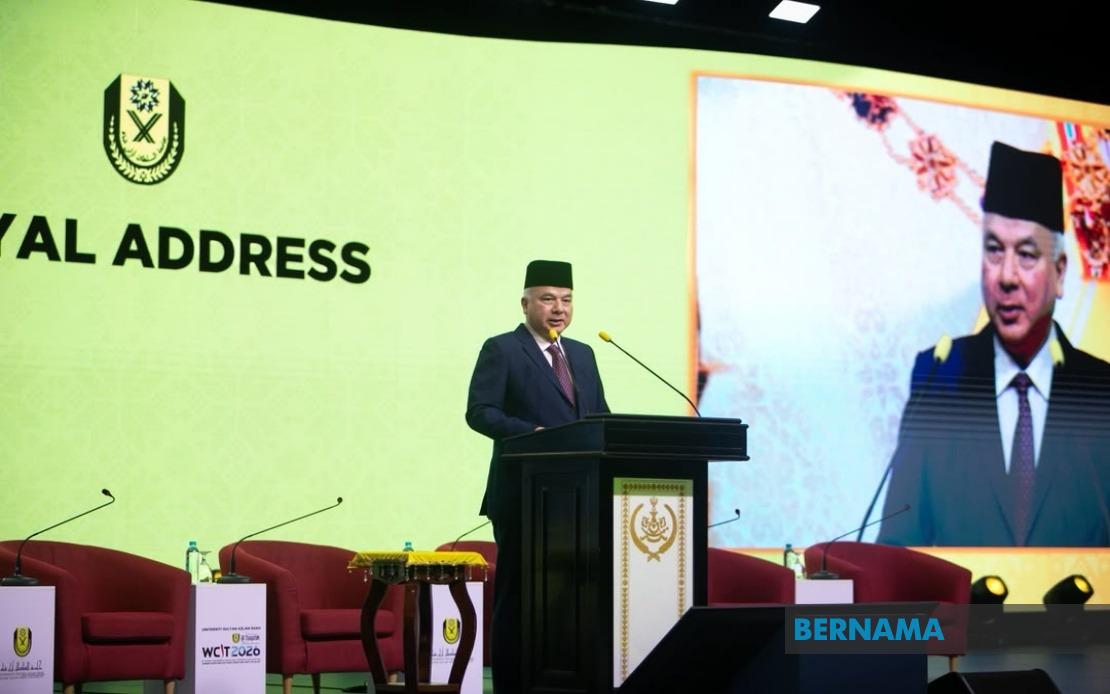
Sultan Nazrin Shah, the Sultan of Perak, has articulated a vision of national security that fundamentally challenges conventional thinking on defence and state protection. Speaking at the 8th World Conference on Islamic Thought and Civilisation in Ipoh on July 21, His Royal Highness contended that while traditional security measures—border defence, cybersecurity operations, and counter-extremism efforts—remain necessary, they cannot form the bedrock of lasting national stability. Instead, he positioned social cohesion as the primary guarantor of a nation's enduring strength and resilience, a perspective with significant implications for how Malaysia approaches its own security architecture and social development.
The Sultan's argument rested on a fundamental premise: that a state secure from external threats but corroded by internal division and injustice has achieved only a temporary reprieve rather than genuine security. This formulation distinguishes between the absence of external attack and the presence of authentic national integrity—a distinction increasingly relevant as Malaysia grapples with competing pressures of globalisation, economic inequality, and social fragmentation. His framing suggests that true vulnerability emanates not from foreign adversaries but from the erosion of the social compact that binds citizens to their nation and to each other.
Crucially, Sultan Nazrin identified the weaponisation of religious sentiment for partisan political purposes as a particular threat to this social cohesion. He highlighted the danger of manipulating faith narratives to justify division and exclusion, warning against those who distort religious teaching to serve narrow political interests rather than collective wellbeing. This observation carries weight in Malaysia's context, where competing narratives about Islam, national identity, and religious authority have repeatedly surfaced as flashpoints for political mobilisation. The Sultan's emphasis on preventing the hijacking of faith discourse for divisive ends suggests a need for greater institutional safeguards and clearer moral leadership from religious and political figures alike.
The prerequisite for this cohesion, in the Sultan's formulation, is the genuine inclusion of all citizens in the nation's economic, political, and social structures. He stressed that belonging cannot be granted through rhetoric alone but must be embedded in tangible structures—laws, economic systems, schools, and leadership representation. When communities perceive themselves as fairly reflected in these institutions and feel authentic stakes in national outcomes, unity becomes resilient rather than brittle. Conversely, when communities experience systematic exclusion or marginalisation, no amount of security apparatus can substitute for that lost sense of ownership. This diagnosis suggests that Malaysia's security challenges may be substantially rooted in questions of distributive justice and inclusive governance rather than external threats alone.
Speaking at an event attended by Deputy Prime Minister Datuk Seri Fadillah Yusof, Perak Menteri Besar Datuk Seri Saarani Mohamad, and Higher Education Minister Datuk Seri Dr Zambry Abd Kadir, the Sultan extended his analysis to the realm of human capital development. He argued that contemporary education systems must undergo substantial recalibration to meet the demands of an economy increasingly shaped by artificial intelligence, automation, and knowledge-intensive production. The Sultan's vision calls for simultaneous investment across multiple domains—strengthening foundational mathematics and sciences while elevating humanities and arts, embedding digital literacy while preserving deep reading and moral reflection. This integrated approach recognises that technological capability absent ethical reasoning produces hazardous outcomes, particularly in societies navigating rapid change.
The Sultan particularly emphasised the need to accord technical and vocational education parity of esteem with academic pathways. This emphasis addresses a persistent Malaysian challenge: the cultural and institutional devaluation of skilled trades relative to degree-holding professions. By arguing that a skilled tradesperson deserves equal societal recognition as a doctor or engineer, the Sultan challenged educational hierarchies that have contributed to skill shortages in crucial sectors whilst producing underemployed graduates. The implications for Malaysia's long-term economic competitiveness are substantial, as economies increasingly depend on both highly trained knowledge workers and highly skilled manual workers.
Most provocatively, Sultan Nazrin contended that traditional pedagogical methods—rote memorisation and standardised testing—are increasingly maladaptive to contemporary realities. In an information environment where data retrieval is instantaneous and nearly costless, the classical industrial-era emphasis on content memorisation misallocates educational resources. Instead, the Sultan identified critical thinking, ethical reasoning, creativity, and adaptability as the irreducibly human capacities that justify education investment in an age of artificial intelligence. These capacities, he noted, represent the precise focus of properly conceived Islamic intellectual tradition, which integrates revealed knowledge with rational inquiry and has long cultivated precisely these habits of mind.
The Sultan's framing of Islamic education as naturally aligned with contemporary pedagogical imperatives carries significant weight in Malaysian discourse. It suggests that authentic Islamic intellectual traditions need not conflict with modern educational philosophy but may instead offer resources for addressing contemporary challenges. This positioning potentially provides space for educational reform that satisfies both traditionalist concerns about preserving Islamic knowledge and moderniser aspirations to cultivate adaptable, critically engaged graduates. In the Malaysian context, where educational policy frequently becomes a proxy for broader ideological contests, the Sultan's synthesis may offer an escape from false dichotomies.
The broader implications of Sultan Nazrin's argument extend across multiple policy domains. If social cohesion genuinely constitutes the most durable form of security, then significant resources currently allocated to security apparatus might warrant reallocation toward justice systems, economic opportunity creation, inclusive governance structures, and inclusive education. This reorientation would not eliminate the need for border security or counter-extremism efforts but would subordinate them to a larger national project of creating conditions in which all citizens experience genuine belonging. For Malaysia, navigating religious pluralism, ethnic diversity, and significant economic inequality, such a reorientation could prove transformative—or deeply disruptive to established institutional interests.
The Sultan's diagnosis also carries warnings about the limits of security apparatus in addressing fundamentally political and social problems. No surveillance system, military capacity, or law enforcement agency can manufacture the sense of belonging that citizens require. Conversely, these systems, when deployed excessively or perceived as instruments of exclusion, may actually corrode the very social cohesion they ostensibly protect. Malaysia's experience with various security measures—from Internal Security Act provisions to counter-extremism initiatives—offers cautionary examples of security tools that, without embedding in genuinely inclusive governance structures, may generate grievance and alienation rather than confidence and belonging.
The conference itself, themed "Everyone Matters: Pride and Unity in Islam," provided an apposite forum for articulating this vision. The emphasis on inclusive belonging within Islamic frameworks suggests that religious identity need not be a source of division but can anchor genuine national unity when properly understood and taught. This positioning challenges both those who view Islam as inherently divisive and those who instrumentalise Islamic rhetoric for exclusionary purposes. Instead, it offers a vision of Islam as intrinsically committed to justice, inclusion, and human dignity—principles that align with both contemporary human rights discourse and traditional Islamic jurisprudence.
For Malaysian policymakers and regional observers, Sultan Nazrin's remarks offer both profound diagnosis and practical challenge. The argument that social cohesion exceeds military capacity as security guarantor requires rethinking fundamental assumptions about national defence and state priorities. It demands serious examination of whether current allocations of resources, institutional attention, and moral energy actually serve the construction of genuine inclusive belonging or whether they primarily serve sectional interests. And it insists that authentic security policy must address the just distribution of economic resources, fair representation in governance, and genuine inclusion in national narratives—challenges considerably more difficult than any military adversary.

