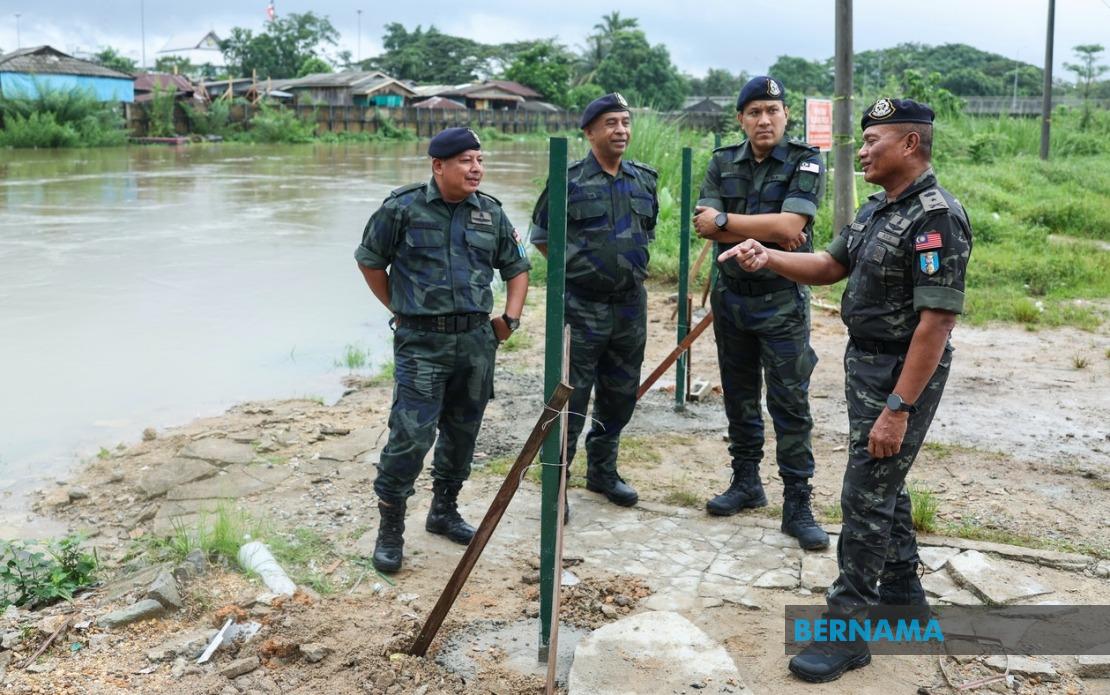
Security forces in Kelantan have exposed an evolving smuggling strategy employed by human trafficking networks operating across Malaysia's northeastern border. The General Operations Force discovered that criminal syndicates have fundamentally restructured their approach to moving undocumented migrants into the country, abandoning the traditional model of transporting large groups in favour of dispersed, staggered movements. This tactical adjustment represents an adaptation to heightened border security measures and demonstrates the sophistication with which organised trafficking networks respond to enforcement efforts.
The discovery came during a coordinated enforcement operation in Pasir Mas, Kelantan, on June 27, when GOF's 8th Battalion acting on intelligence information detected suspicious activity near Kampung Banggol Kemian. Southeast Brigade GOF commander SAC Ahmad Radzi Hussain detailed how a Proton Exora vehicle drew the attention of security personnel in the early morning hours. When the driver recognised the approaching GOF officers, he abandoned the vehicle and disappeared into a nearby forest, successfully evading capture despite an intensive search operation.
The vehicle inspection immediately yielded results, with four Myanmar nationals discovered in the rear seating area. These individuals possessed no legitimate travel documentation and were taken into custody for immigration violations. The initial arrest, however, only scratched the surface of a broader smuggling operation. Within approximately one hour of the first seizure, conducting further sweeps through the surrounding forested terrain led to the apprehension of an additional nine Myanmar nationals, bringing the total to thirteen individuals including five women ranging in age from twenty to thirty-seven years old.
According to SAC Ahmad Radzi's statement, the arrested migrants provided consistent accounts of their journey into Malaysia. They described being transported across the Golok River from Thailand by two unidentified facilitators who employed a deliberate strategy of dropping passengers at multiple locations within the forest rather than delivering everyone to a single destination. This fragmented approach served a specific operational purpose: minimising the visible profile of any single group to reduce the likelihood of chance detection by border security personnel conducting routine patrols or intelligence-led operations. The tactic reflects an understanding that large concentrations of irregular migrants present higher risks of exposure through accidental encounters or third-party reports.
The intended destination for these migrants illuminates the broader economic motivations driving the smuggling trade. The arrested individuals stated their expectation to find employment opportunities in the Kuala Lumpur area, indicating that Southeast Asian trafficking networks continue to exploit Malaysia's labour market demand. Whether motivated by genuine employment prospects or exploited under false promises, these migrants represent part of a continuous flow of undocumented workers feeding into Malaysia's informal economy across multiple sectors including construction, hospitality, and domestic work. The willingness to undertake dangerous journeys across international borders demonstrates the desperation of economic circumstances in their home regions.
The operational response by Malaysian authorities involved collaborative coordination between multiple security agencies. The GOF's 8th Battalion worked in conjunction with the Criminal Investigation Division of the Pasir Mas district police headquarters, pooling intelligence resources and investigative capacity. This inter-agency cooperation reflects Malaysia's recognition that effective border security and immigration enforcement require integrated responses rather than siloed departmental efforts. Beyond the arrests, authorities secured the Proton Exora vehicle utilised for transportation, valued at approximately RM30,000, representing a material asset loss for the smuggling network though hardly a deterrent against future operations given the economics of human trafficking.
All thirteen arrested Myanmar nationals have been transferred to police custody for further investigation and prosecution under Section 6(1)(c) of the Immigration Act 1959/63, which addresses the harbouring and transportation of undocumented foreigners. The formal charges and subsequent legal proceedings will follow Malaysia's established immigration enforcement protocols. However, the broader significance extends beyond these individual cases. The discovery of tactical adaptations by smuggling syndicates indicates that enforcement agencies must themselves continuously evolve their detection methodologies and intelligence-gathering approaches.
This incident occurs within the wider context of irregular migration pressures affecting Malaysia and the broader Southeast Asian region. Myanmar's ongoing political instability and economic challenges continue generating significant outflows of displaced persons and economic migrants seeking opportunities across borders. Thailand serves as a primary transit point for Myanmar nationals attempting to reach Malaysia, with the Golok River representing one of several porous entry points along the Thai-Malaysian border. The geographic accessibility of Kelantan and its proximity to Thailand make it a natural corridor for smuggling operations, a reality that necessitates sustained security attention and resource allocation.
The shift toward smaller group movements presents distinct challenges for conventional border security operations designed to detect and interdict large concentrations of irregular crossers. Intelligence-led operations, such as the one that succeeded in Pasir Mas, become increasingly critical when smugglers deliberately fragment their movements. Malaysian authorities must maintain sophisticated intelligence networks, cultivate informant sources, and analyse movement patterns to anticipate and intercept smaller flows that would escape detection through conventional checkpoint operations alone.
The smuggling networks themselves operate with considerable flexibility and organisational capacity. The use of identified routes across the Golok River, access to appropriate vehicles, knowledge of forest terrain suitable for concealing migrants, and mechanisms for coordinating complex multi-stage transportation suggest these are established criminal enterprises rather than ad hoc operations. The two unidentified men directly responsible for the river crossing remain at large, suggesting they will likely continue facilitating illegal movements unless apprehended through subsequent investigations or intelligence development.
For Malaysian policymakers and security officials, this operation underscores persistent vulnerabilities in border management despite significant investments in security infrastructure and personnel. The continued viability of smuggling operations, even as syndicates adapt their methods, indicates the fundamental economic pressures driving irregular migration remain unaddressed. Supply-side interventions targeting traffickers and smugglers, while necessary and important, operate within constraints imposed by persistent demand for cheap labour in Malaysian industries and the economic desperation motivating migrants from Myanmar and other source countries.
The discovery of evolving smuggling tactics also highlights the intelligence capabilities Malaysian security forces have developed regarding irregular migration patterns. The ability to monitor suspicious activity, act on real-time intelligence, and execute coordinated enforcement operations demonstrates operational competence at the tactical level. Sustaining and enhancing these capabilities requires ongoing investment in training, intelligence infrastructure, and cross-border cooperation with Thai authorities who control the Thailand-side portion of critical smuggling routes. Regional cooperation frameworks and information-sharing arrangements between ASEAN member states remain essential to effectively managing migration challenges that inherently transcend national boundaries.

