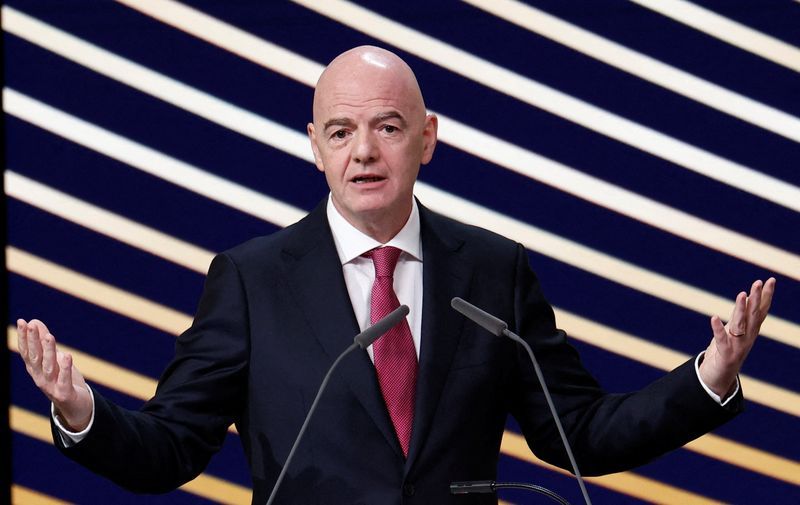
Gianni Infantino's prospects for securing another term as FIFA president have shifted dramatically away from the sport's traditional powerhouses toward the constellation of smaller and emerging nations that form the backbone of the world governing body's political coalition. Following the regional confederations UEFA and CONCACAF's declarations of no confidence over a failed proposal to introduce private equity into World Cup financing, the Swiss administrator now faces the most serious challenge of his decade-long leadership. The controversy has exposed the delicate balance underpinning FIFA's internal politics, where numerical equality among member nations creates an unexpected advantage for those football federations with the least economic resources but the greatest dependence on FIFA's institutional support.
Infantino formally announced his intention to pursue a fourth consecutive term when FIFA's Congress convenes next April, yet the timeline for his potential removal may accelerate considerably. Wales became the first national football association to formally rescind its backing for the embattled leader this week, while UEFA simultaneously notified Infantino that it was examining legal remedies regarding the failed equity proposal. The pathway to his ouster already exists within FIFA's constitutional framework: if 20 per cent of the organisation's 211 member associations formally request an Extraordinary Congress, such a gathering must convene within three months. This mechanism provides challengers with a compressed window to identify alternative candidates and mobilise support against an incumbent seeking re-election.
The mathematics of FIFA politics, however, present substantial obstacles to any removal campaign. While UEFA's 55 member nations could theoretically trigger an Extraordinary Congress through unanimous action, converting such procedural victory into an actual vote to unseat Infantino demands majority backing from FIFA's full membership. Here the structural reality of international football governance becomes apparent: despite immense variations in football development, economic capacity, and global sporting influence, all 211 nations possess identical voting power at FIFA congresses. This democratic principle, while seemingly equitable, fundamentally reshapes the political calculus that Infantino must navigate.
Rather than investing his political capital in reconciliation with football's established elite—nations such as France, Spain, and England with sophisticated professional leagues and deep footballing traditions—Infantino's survival strategy appears to centre on consolidating support among nations for whom FIFA represents an indispensable institutional patron. Countries like Bhutan and Vanuatu, which have never qualified for World Cups and operate football programmes with minimal domestic revenue, derive enormous benefits from the world body's financial interventions. During the current 2023-26 World Cup cycle, FIFA has made available up to three million dollars per member nation for soccer development initiatives, representing a one-million-dollar increase compared to the previous cycle. While such sums may constitute minor allocations for wealthy federations operating in established football markets, they function as transformative investments for smaller nations attempting to build basic infrastructure and nurture international participation.
Vanuatu exemplifies this dynamic with particular clarity. The Pacific island nation, home to approximately 340,000 people and ranked 160th globally, received a four-million-fifteen-thousand-dollar development grant from FIFA that financed construction of a 6,500-seat stadium in the capital Port Vila, completed in 2022. This investment permitted Vanuatu to occupy an influential position within FIFA's governance structure when its football association president Lambert Maltock secured appointment as one of eight vice-presidents on the organisation's Executive Council. For Brian Kaltak, Vanuatu's first professional footballer currently playing for Perth Glory, Infantino's patronage has represented transformative opportunity for his country and the broader developing world. Kaltak told Reuters this week that Infantino had not merely elevated Vanuatu's administrative status within FIFA but had implemented systematic policies to expand the sport across nations lacking significant commercial football sectors. The defender characterised these interventions as crucial to creating pathways for emerging footballing nations to compete internationally.
This distribution of FIFA resources extends across Asia, Africa, the Caribbean, and the Pacific region in patterns that have historically strengthened institutional loyalty among recipient nations. FIFA grants have financed training facilities, fitness complexes, and youth development programmes that national associations would otherwise lack capacity to construct or maintain independently. For federations operating in contexts of limited domestic sporting revenue and competing budgetary priorities, such funding represents not merely administrative support but essential infrastructure enabling basic participation in international competition. This financial dependency structure creates powerful political incentives for smaller nations to maintain backing for leadership that prioritises their development needs.
Critical observers identify in this funding mechanism a sophisticated system whereby FIFA leadership effectively trades financial and institutional resources for political influence and electoral support. The model reinforces itself across electoral cycles: federations benefiting substantially from development grants maintain voting alignment with leadership that directs such resources toward them, complicating efforts to assemble voting coalitions capable of removing sitting presidents. Any genuine campaign to unseat Infantino must therefore contend not merely with his personal political skills but with the structural architecture of FIFA's financial relationships, in which dozens of smaller nations have concrete material interests in his continued leadership.
The failed private equity proposal, while ostensibly concerning World Cup financing mechanisms available only to nations hosting that tournament, exposed fractures in Infantino's previously successful political coalition building. UEFA's unified rejection signalled that even established confederations could mount coordinated resistance when perceiving existential threats to traditional football governance. Yet translating European institutional opposition into sufficient member-state votes to trigger removal proceedings, much less achieve conviction at an Extraordinary Congress, requires mobilising nations accustomed to supporting FIFA leadership continuity. The numerical disparity between UEFA's population and economic resources and the collective voting power of developing nations fundamentally shapes the political terrain.
For Malaysia and other Southeast Asian nations, these internal FIFA dynamics carry significant implications for international football development and competitive participation. Southeast Asian federations, while more resourced than Pacific nations, nonetheless depend substantially on FIFA development funding for training infrastructure, coaching education, and participation in continental and global competitions. Any leadership transition at FIFA could reshape the allocation priorities and governance frameworks affecting regional football development. Current FIFA backing for initiatives within AFC territories, including Malaysia, reflects priorities established during Infantino's tenure. Leadership changes might redirect such resources or alter governance approaches in ways affecting regional federation autonomy and development planning.
The political arithmetic suggests Infantino retains advantages in any membership vote, provided he maintains coalition discipline among developing nations. However, the present crisis reveals vulnerabilities in his political position previously masked by football's concentration on sporting outcomes rather than governance structures. The Wales withdrawal, while individually modest, potentially signals that smaller nations within developed confederations may increasingly pursue independent voting strategies rather than automatic alignment with their continental confederations. Such fragmentation could gradually erode the unified voting blocs upon which FIFA's traditional political calculations depend, introducing unpredictability into congresses that typically proceeded with substantial predictability regarding incumbent leadership survival.

