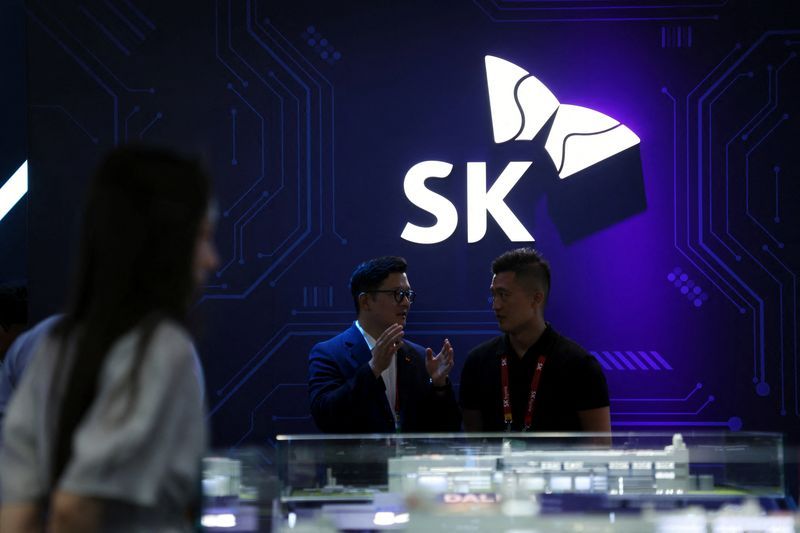
South Korea's SK Hynix, the world's second-largest memory chipmaker, unveiled plans to raise as much as 45.45 trillion won ($29.43 billion) through an American Depositary Receipt listing on the Nasdaq exchange, marking a decisive move to strengthen its global capital base and secure funding for aggressive expansion in the lucrative artificial intelligence chip sector. The listing, scheduled for July 10, underscores the company's confidence in sustained demand for high-bandwidth memory chips that power AI systems across the technology industry.
The offering will involve the issuance of 17.79 million new shares, with each ADR representing ten common shares of the company. SK Hynix cautioned in its regulatory filing that the final fundraising amount could shift following the bookbuilding process, a standard phase where the underwriters gauge investor demand and determine the pricing band. The structure mirrors typical international capital raises, though the magnitude signals the confidence major financial institutions place in SK Hynix's growth trajectory and market position.
The capital raised through this listing will fund multiple strategic initiatives designed to reinforce the company's manufacturing footprint and technological capabilities. SK Hynix intends to allocate proceeds toward constructing a new chip fabrication facility in Yongin, establishing an advanced packaging manufacturing plant in Cheongju, and acquiring specialized chipmaking equipment including Extreme Ultraviolet Scanner technology—critical tools for producing next-generation semiconductor products that meet the exacting requirements of artificial intelligence applications. These investments represent a tangible bet on sustained AI-driven demand over the coming years.
For Malaysian and Southeast Asian investors and stakeholders, SK Hynix's expansion carries significant implications. The region hosts substantial semiconductor manufacturing ecosystems, particularly in Malaysia, which has long served as a crucial hub for chip assembly, testing, and packaging operations. SK Hynix's investment in advanced packaging capabilities in South Korea may influence regional competition and reshape supply chain dynamics, potentially affecting employment and manufacturing partnerships across Southeast Asia. The company's growth also reflects broader shifts in technology investment patterns, with memory chip suppliers emerging as prime beneficiaries of the AI wave that has reshaped global capital markets.
The four underwriting banks—BofA Securities, Citigroup Global Markets, Goldman Sachs, and JP Morgan Securities—represent heavyweight financial institutions with deep expertise in technology sector capital raises. Their involvement signals confidence in the deal's successful completion and SK Hynix's valuation. If the offering reaches the upper end of its indicated price range, it would surpass the $21.8 billion raised by Chinese e-commerce giant Alibaba during its historic 2014 New York stock market debut, becoming the largest-ever ADR offering on record. This achievement would underscore the scale of capital flows into semiconductor companies positioned at the forefront of artificial intelligence infrastructure.
SK Hynix's ascendancy reflects the seismic shift in technology sector valuations driven by artificial intelligence adoption. The company supplies high-bandwidth memory chips to major technology giants including Nvidia and Alphabet's Google, both central players in AI system development and deployment. These partnerships position SK Hynix as a essential component in the global AI infrastructure buildout, creating a virtuous cycle of demand, revenue growth, and valuation expansion. The company's emergence as South Korea's most valuable enterprise, surpassing the long-dominant Samsung Electronics in market capitalization, represents a historic recalibration of industrial leadership within one of Asia's technology powerhouses.
The timing of SK Hynix's ADR listing reflects strategic calculation regarding market conditions and investor appetite for exposure to AI-related assets. Memory chip manufacturers have experienced unprecedented investor enthusiasm as artificial intelligence systems require vast quantities of specialized memory to function efficiently. This demand dynamics contrasts sharply with historical cyclicality in the semiconductor industry, prompting manufacturers and investors alike to reassess long-term growth prospects and capital allocation priorities. SK Hynix's decision to access international equity markets rather than rely solely on Korean capital sources demonstrates management's determination to accelerate growth while diversifying its shareholder base geographically.
The company's manufacturing expansion strategy reflects confidence that artificial intelligence adoption will sustain elevated demand for memory chips across multiple end-markets. Data centers housing AI models, autonomous vehicles, robotics platforms, and enterprise computing systems all require substantial quantities of high-performance memory. SK Hynix's investments in Yongin and Cheongju facilities position the company to capture market share across these expanding applications. The Extreme Ultraviolet Scanner technology represents a critical competitive advantage, enabling the production of chips with smaller transistor dimensions that deliver superior performance and energy efficiency—attributes increasingly essential for competitive viability in next-generation semiconductor manufacturing.
Southeast Asian observers should note that SK Hynix's capital raise and expansion plans carry indirect implications for regional technology ecosystems. Malaysian semiconductor assembly and testing facilities process memory chips for export to global markets. Changes in SK Hynix's manufacturing footprint or supply chain preferences could influence contract manufacturing opportunities for regional partners. Additionally, the successful execution of this capital raise could encourage other semiconductor manufacturers to pursue similar international listings, intensifying competition for both investor capital and talented engineering talent across Asia. The broader narrative suggests that memory chip suppliers will capture disproportionate value creation as artificial intelligence infrastructure development accelerates through the coming decade.
The completion of SK Hynix's ADR offering at the maximum price point would validate market enthusiasm for semiconductor stocks positioned in the AI supply chain. However, even at lower price points within the indicated range, the capital raise would represent one of the largest equity offerings globally in recent years, reflecting the magnitude of growth opportunities the company perceives. For Malaysian and Southeast Asian investors seeking exposure to artificial intelligence-driven technological transformation, SK Hynix's public international listing provides an alternative route to participating in semiconductor sector upside, complementing existing exposure through technology-focused equity funds and regional semiconductor manufacturers.