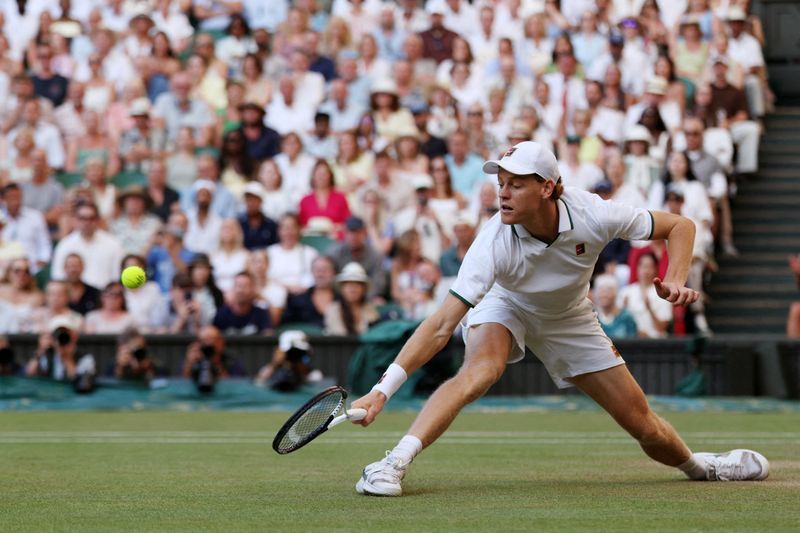
The withdrawal of world number one Jannik Sinner from the US Open due to a right knee injury has dramatically altered the landscape of professional tennis heading into the year's final Grand Slam championship. The 24-year-old Italian announced his decision on Friday through a statement posted on social media, citing insufficient recovery time following an injury sustained earlier this month. His absence represents a significant blow to a tournament already wrestling with the unpredictable nature of elite athlete availability and the physical demands of the modern game.
Sinner's decision to withdraw comes just days after his decision to skip both the Cincinnati Open and the Canadian Open, two prestigious hard-court tournaments traditionally used by players to fine-tune their preparation for Flushing Meadows. These were not casual omissions but strategic acknowledgements from the champion's medical team that his rehabilitation required prioritisation over competitive play. Despite intensive collaboration with his coaching staff and medical personnel, Sinner determined that returning to full competitive intensity so soon after sustaining the injury would compromise his long-term health and effectiveness on court.
The Italian's timing for withdrawal also reflects the realities of professional tennis scheduling, where tournaments are densely packed and recovery windows compressed. He had captured his fifth major title at Wimbledon just weeks earlier, exemplifying his extraordinary consistency at the sport's highest level. That achievement underscored his credentials as one of the sport's dominant forces, making his absence from New York particularly consequential for the tournament's competitive integrity and marketability.
Sinner's statement revealed that his medical team had only recently resumed controlled court work in Monte Carlo, suggesting the injury had imposed more significant restrictions than initially anticipated. The prudent decision to withdraw rather than risk further damage demonstrates a maturity often absent in professional sport, where financial incentives and pride frequently pressure athletes to compete while injured. This approach may ultimately serve Sinner's career better, preserving his physical condition for the remaining tournaments and the 2025 season.
The withdrawal immediately reshapes the men's championship contention at a tournament running from August 23 to September 13. The absence of the world's top-ranked player fundamentally alters tournament projections and betting markets, removing a player widely expected to mount a serious title challenge on hard courts, where Sinner's powerful baseline game has flourished in recent seasons.
Singer's withdrawal simultaneously enhances the prospects of world number two Carlos Alcaraz, who confirmed his return to competitive play following a four-month absence caused by his own injury troubles. The Spanish competitor now arrives at Flushing Meadows as the highest-ranked player in the draw, a significant positioning advantage that could prove decisive across a fortnight of intense competition. Alcaraz's return to competition after such an extended layoff carries inherent questions about match fitness and rhythm, yet his removal of Sinner from the equation substantially improves his pathway through the draw.
Alcaraz's credentials at the US Open remain impeccable, having defeated Sinner in the previous year's final to claim his fourth major title. That victory established him as a player capable of performing under pressure in the sport's biggest moments, and his technical arsenal translates effectively to the hard courts of New York. With Sinner absent, Alcaraz now pursues his eighth Grand Slam crown without facing one of his most formidable rivals during the early or middle rounds of the tournament.
The competitive dynamics now favour the Spanish star considerably, though the US Open remains unpredictable with numerous other accomplished players competing for the title. Jannik Sinner's injury-forced withdrawal represents one of professional sport's persistent challenges—the vulnerability of elite athletes to physical breakdown despite their extraordinary conditioning and resources. For Malaysian and Southeast Asian tennis fans who have followed Sinner's meteoric rise with great interest, particularly given the global reach of professional tennis and its growing following across Asia, his absence underscores the unforgiving nature of Grand Slam competition and the thin margins separating triumph from disappointment.
The tournament will proceed without its defending number one ranking, an unusual circumstance that paradoxically may generate storylines around Alcaraz's attempt to capitalise on his rival's absence, or alternatively, the emergence of an unexpected challenger from outside the traditional elite circle. Tournament organisers and broadcasters will contend with reduced star power, though the spectacle and unpredictability of Grand Slam tennis typically maintains audience interest regardless of specific player absences.
Sinner's withdrawal decision also sends important messaging within professional tennis about prioritising long-term athlete welfare over short-term competitive participation. His willingness to sacrifice the opportunity to defend rankings points and pursue a major title suggests a philosophical approach that may influence younger players' injury management strategies. The injury setback, though frustrating for a player at the pinnacle of his sport, represents merely one chapter in what promises to be an extended competitive career for the talented Italian.

