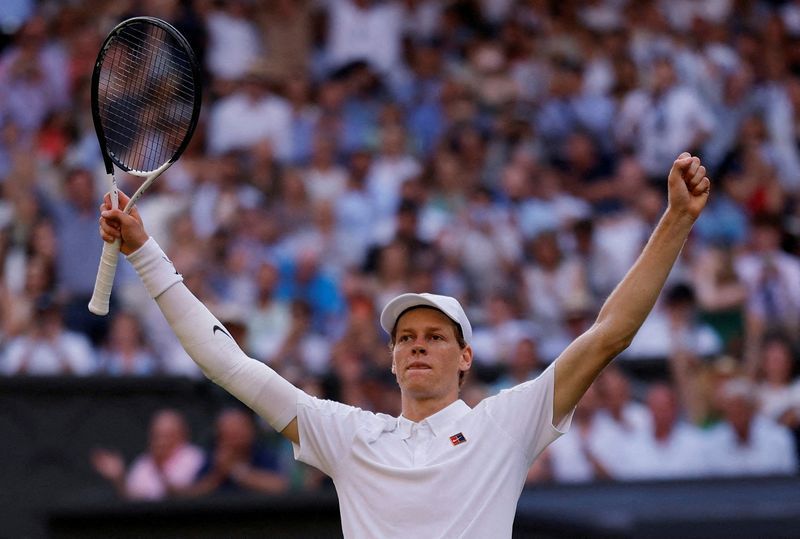
Jannik Sinner's coronation as tennis's dominant force has been interrupted at precisely the wrong moment. The defending Wimbledon champion returns to the All England Club this week as world number one, yet the Italian's recent trajectory tells a more complicated story than rankings suggest. After a remarkable 30-match winning streak spanning February through late May, Sinner's invincibility shattered spectacularly at Roland Garros last month when physical issues forced a second-round exit. As the sport's elite gather for grass-court warfare beginning Monday, the defending champion must prove both to rivals and to himself that his imperious form remains intact, and that he can navigate the unique demands of Wimbledon's fastest surface without the fatigue that undid him in Paris.
Mats Wilander, the seven-times Grand Slam champion, attributes Sinner's Paris collapse to overextension rather than fundamental fragility. The Swedish legend contends that Sinner played extensively in the two months preceding Roland Garros with insufficient recovery time and limited opportunity for intensive training blocks. This relentless schedule left him depleted precisely when Grand Slam pressure peaks. Wilander suggests the Italian has used the intervening weeks to restore his energy reserves, and expects Sinner to return to peak condition at Wimbledon. However, Wilander's cautionary note proves revealing: while clay may have offered Sinner a superior title chance, grass presents its own capriciousness. The surface punishes defensive lapses and rewards aggressive, dynamic movement in ways that advantage Sinner's rivals.
The absence of Carlos Alcaraz through injury removes the one player most capable of matching Sinner's athleticism on grass. The Spanish champion won Wimbledon in 2023 and 2024, demonstrating an ability to impose his will across rallies with a consistency few contemporaries match. Without Alcaraz's presence, the draw widens significantly. Whereas previous years saw a clear hierarchy with perhaps two plausible winners, this year's field features multiple legitimate contenders capable of capitalizing on any early stumbles from the top seeds.
Novak Djokovic emerges as perhaps the most dangerous beneficiary of Alcaraz's absence. The Serbian veteran, now 37, will pursue his eighth Wimbledon title, which would equal Roger Federer's all-time record. More pressingly, Djokovic remains one Grand Slam victory short of 25 majors, a milestone that would represent an unparalleled standalone record. At 37, Djokovic's window for achieving this ambition narrows with each passing tournament. Crucially, his expertise on grass remains formidable; his movement patterns and return-of-serve mechanics suit the surface's demands perfectly. Former finalist Andy Roddick, analyzing the tournament on his podcast, emphasizes that Djokovic's early exit at Roland Garros need not diminish his Wimbledon prospects. Roddick suggested the Serb has calculated that this represents his optimal opportunity to add another major, and that grass conditions play directly to his strengths despite approaching the twilight of his career.
Alexander Zverev's unexpected French Open victory represents another significant shift in the title picture. The German sixth-times major winner captured his maiden Grand Slam title just weeks ago, and Boris Becker, himself a German six-times major champion, contends this momentum makes Zverev the authentic favorite. Becker's assessment proves striking: with Alcaraz unavailable and Sinner's fitness uncertain, Zverev's serve provides an invaluable asset on grass, a surface where dominant serving essentially guarantees semifinal progression. Becker notes that while Zverev requires adaptation to grass-court patterns, his fundamental skill set positions him advantageously.
Zverev's credentials on grass warrant examination beyond Becker's endorsement. The German possesses perhaps the most consistent serving motion in professional tennis, delivering regularly above 120 miles per hour with exceptional placement. On grass, where service games are disproportionately important, this capability becomes almost determinative. Zverev's baseline game, while solid, carries less destructive power than Alcaraz or Sinner, yet his serve compensates significantly. Moreover, Zverev's recent psychological breakthrough through winning a major may provide intangible advantages; confidence visibly impacts performance at this level.
The chasing contingent adds unpredictability to the draw. American trio Ben Shelton, Taylor Fritz, and Frances Tiafoe each possess the attacking firepower to trouble established champions across individual matches. These players thrive in rapid-fire rallies favoring explosive athleticism over grinding consistency. Flavio Cobolli, who reached the French Open final, leads the emerging secondary wave of contenders. Cobolli's youth and court craft suggest he could surprise traditional favorites, particularly if seeded players encounter tactical challenges early.
Singer's training decisions preceding Wimbledon offer a telling indicator of his mindset. The Italian skipped tune-up tournaments that typically precede major competitions, opting instead for extended preparation and recovery. This choice reflects either supreme confidence or lingering caution regarding his physical state. Players historically skip warm-up events only when confident their conditioning requires no validation or when nursing concerns that necessitate conservative programming. Sinner's coaches will have assessed his fitness rigorously before endorsing this approach, yet skeptics might interpret the decision as suggesting incomplete recovery from the French Open trauma.
The grass-court environment itself introduces variables distinct from clay surfaces where Sinner thrived recently. Wimbledon's courts demand earlier preparation for attacking shots; the ball travels faster and lower through the court, offering fewer opportunities for defensive recovery. Sinner's game relies partly on exceptional defensive retrieval, moving opponents laterally across the baseline, and then punishing weakened returns. Grass compresses rally duration, rewarding players who commit aggressively to first-strike opportunities. Djokovic's movement patterns and Zverev's serve thrive in this environment; Sinner must adjust his strategic approach within the tournament's two-week timeframe.
Historical precedent suggests defending champions carrying injury concerns onto grass face elevated difficulty maintaining their titles. The surface offers no comfort for players managing physical limitations; recovery windows between matches compress, and the constant movement demands exact different muscle groups than clay. Sinner's coaching team presumably consulted tournament physicians and recovery specialists before confirming his readiness. Yet the question persists: can a player recovering from French Open exhaustion sustain peak performance across seven matches within fourteen days on tennis's most demanding surface?
For Malaysian and Southeast Asian observers, Sinner's Wimbledon challenge carries broader significance. The Italian's emergence as tennis's undisputed number one marks a generational shift; his playing style emphasizes aggressive athleticism and court coverage rather than serve-and-volley skills or technical perfection. Should Sinner successfully defend his title despite recent setbacks, it reinforces that consistency and athleticism dominate contemporary professional tennis. Conversely, should challengers like Djokovic or Zverev seize the opportunity, it suggests that grass-court tennis retains sufficient unpredictability to reward players willing to embrace aggressive tactical approaches and capitalize on perceived vulnerability.
The tournament beginning Monday will illuminate whether Sinner's dominance represents a durable principle of modern tennis or a temporary ascendancy vulnerable to the specific demands of grass-court competition. His rivals smell opportunity in his recent struggles, sensing that the defending champion, while formidable, carries genuine questions about fitness, adaptation, and mental resilience heading into his most significant test since Paris. The All England Club's manicured lawns will provide definitive answers.

