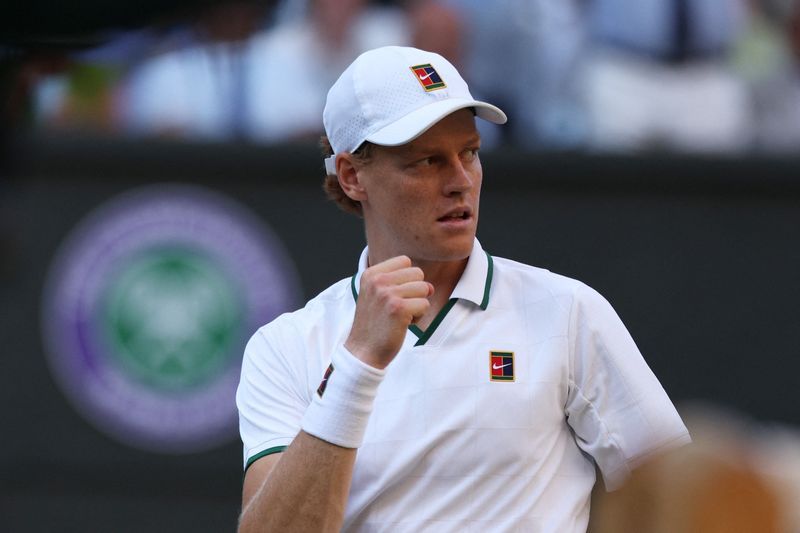
Jannik Sinner has cemented his position among tennis's elite by successfully defending his Wimbledon championship, dispatching Alexander Zverev 6-7(7) 7-6(2) 6-3 6-4 in a drama-filled final at the All England Club on Sunday. The victory marked Sinner's fifth Grand Slam title and extended a remarkable personal dominance over his German rival, who has now lost ten consecutive matches to the Italian. With this achievement, Sinner joined an exclusive group of only nine other men in the professional era to win back-to-back titles at the grass court major, a feat that underscores his emergence as one of the sport's most formidable contemporary competitors.
The significance of Sinner's triumph extends beyond the trophy itself. At 22 majors, he continues his pursuit of world number one Carlos Alcaraz, who leads with seven Grand Slam titles. The gap between Sinner and Alcaraz in the major championships race has tightened considerably, with Sinner's consistent performances across different surfaces demonstrating a versatility that rivals the Spanish sensation. For Malaysian and Southeast Asian tennis enthusiasts following the sport's evolution, Sinner's trajectory represents the rise of a new generation intent on reshaping the competitive landscape dominated in recent years by Novak Djokovic, Rafael Nadal, and Roger Federer.
The match itself provided the kind of high-tension drama that Centre Court crowds crave. The opening set unfolded as an extended tactical battle, with both competitors trading powerful strokes over twelve games in warm, windy conditions. Zverev ultimately seized control of the tiebreak, striking a commanding forehand winner and displaying the aggressive tennis that had carried him into the final. His celebration, marked by an emphatic crouch and shout, suggested a player believing he could mount a credible challenge to the defending champion.
However, momentum proved fleeting in the second set. Sinner gradually asserted himself, particularly in the tiebreak where his precision under pressure proved decisive. The Italian levelled the match as Zverev's frustration began mounting visibly, a shift in emotional equilibrium that often presages a turning point in tennis matches at this level. The contest had settled into a test not merely of technical proficiency but of composure and mental fortitude.
The third set became the match's pivotal moment, marked by a dramatic incident that altered its complexion. More than two and a half hours into their encounter, Zverev earned a break point opportunity at 2-1, only to lose his footing attempting to retrieve a delicate Sinner drop shot. The German fell heavily, his right knee taking the impact as the Centre Court crowd audibly gasped. Though Zverev continued playing after regaining his composure, the physical toll appeared evident in his subsequent performance. Sinner, sensing opportunity, immediately broke serve in the following game to establish a 5-3 advantage, prompting Zverev's frustrated racket slam.
Sinner's aggressive positioning intensified in the fourth set, where he broke again for a 4-3 lead as Zverev's performance visibly declined. The defending champion's consistency and nerve in closing stages proved decisive, allowing him to maintain his advantage and secure victory after nearly three hours of sustained competition. His collapse onto the court at the final point symbolised the emotional and physical investment required to capture and defend tennis's most prestigious titles.
For Sinner, the victory represented more than individual achievement. His comments immediately following the win reflected an awareness of Wimbledon's unique place in tennis culture. Standing with the distinctive pineapple-topped Challenge Cup, he acknowledged the special character of Centre Court and the privilege of defending a title at a venue steeped in tennis history. His acknowledgement that future opportunities to win at Wimbledon remain uncertain, despite his current dominance, demonstrated the perspective of a competitor who recognises the rarity of such accomplishments.
Zverev's loss marked his fourth defeat in a Grand Slam final, a statistic that will weigh upon the talented German despite his gracious post-match demeanour. His self-deprecating remark to Sinner about disliking him hinted at frustration with a rivalry that has become decidedly one-sided. With ten consecutive defeats against Sinner now recorded, Zverev faces the considerable challenge of rediscovering the form and confidence necessary to break this streak and finally claim a major title.
The broader implications for tennis globally, and particularly for Asian markets following the sport's development, centre on Sinner's emergence as a sustained force across all surfaces. Unlike players who traditionally dominated one particular court type, Sinner has demonstrated capability on grass, clay, and hard courts. This versatility suggests he may establish a lengthy period of dominance reminiscent of the 'Big Three' era that shaped tennis for the previous two decades. As the Italian continues adding to his major tally and establishing himself as the clear number two in the contemporary rankings, the sport's competitive landscape appears set for considerable reshaping in coming years.
For tournament organisers and broadcasters across Southeast Asia, Sinner's rise represents an opportunity to engage audiences with a compelling narrative of rising talent challenging established hierarchies. His youthful energy, combined with remarkable consistency, provides the storylines necessary to sustain fan engagement across diverse markets. As Wimbledon now passes into memory and the tennis calendar moves forward, Sinner's successful title defence stands as a statement of intent from a champion determined to establish himself among the all-time greats of the sport.

