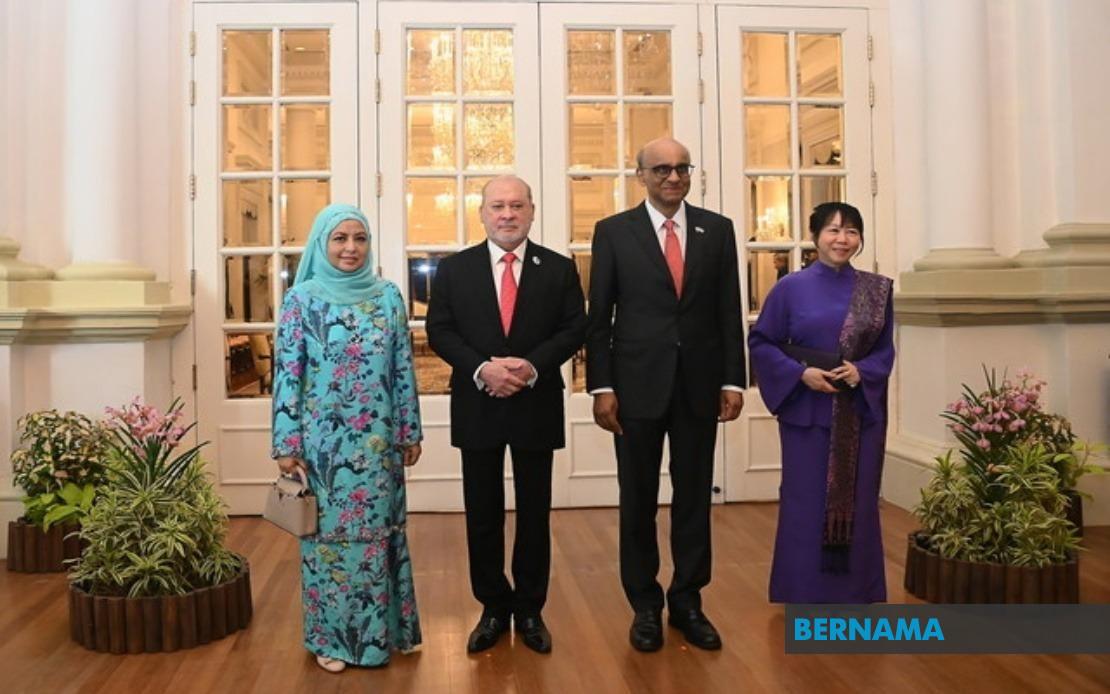
Ahead of his three-day state visit to Malaysia beginning July 13, 2026, at the invitation of His Majesty Sultan Ibrahim, King of Malaysia, Singapore President Tharman Shanmugaratnam has articulated a vision for bilateral relations rooted in trust, mutual respect, and strategic alignment on regional issues. Speaking in an exclusive interview, the Singapore leader framed the Malaysia-Singapore partnership as uniquely positioned to navigate an increasingly complex geopolitical landscape by leveraging decades of accumulated goodwill and institutional cooperation.
The foundation for this relationship, according to President Tharman, rests on centuries of shared cultural and historical bonds that have created deep people-to-people connections transcending governmental frameworks. The Johor-Singapore Causeway, acknowledged as the world's busiest land border crossing, serves as a tangible symbol of this integration—facilitating hundreds of thousands of daily crossings that underscore the economic and social interdependence between the two nations. This physical manifestation of connectivity extends to cultural spheres, with both governments recently celebrating their joint UNESCO recognition of the kebaya alongside Brunei, Indonesia, and Thailand, a designation highlighting the region's multicultural heritage.
Beyond heritage preservation, President Tharman highlighted ongoing collaborative efforts to secure UNESCO recognition for Chingay, the vibrant street procession that epitomises the evolving multicultural landscape shared by both nations. These cultural initiatives serve a dual purpose: they sustain living traditions while intentionally transmitting them to younger generations increasingly navigating globalised environments. For Malaysian readers, this emphasis on cultural preservation signals Singapore's commitment to maintaining Southeast Asian identity amid broader internationalisation pressures—a concern resonating across the region.
The Singapore leader acknowledged that disputes inevitably arise between neighbouring states, particularly those sharing complex historical trajectories. However, he positioned disagreements as manageable through established frameworks of dialogue, mutual respect, and adherence to international law, contrasting this approach with the confrontational dynamics characterising some contemporary regional relationships. This stance carries significance for Malaysian policymakers assessing how to balance sovereignty assertions with practical cooperation, suggesting that dispute management need not derail broader partnership objectives when grounded in institutional trust and leadership familiarity.
Economic integration emerges as a cornerstone of President Tharman's strategic framework, with particular emphasis on two flagship initiatives. The Johor-Singapore Special Economic Zone represents a model for win-win cooperation combining respective competitive advantages, while the Rapid Transit System Link promises to revolutionise cross-border commuting for hundreds of thousands of daily travellers. These projects extend beyond infrastructure development; they represent deliberate efforts to bind the two economies closer whilst generating tangible benefits for ordinary citizens navigating their working and personal lives across the border.
Amidst fragmenting global trade systems and intensifying great-power competition, President Tharman articulated a compelling case for deeper regional integration. Singapore and Malaysia, he argued, must maximise their collective value proposition by joining markets, developing energy and supply-chain resilience, and collaborating on emerging technologies and the digital economy. This regional prioritisation reflects a pragmatic assessment that smaller nations can better protect their interests through coordinated rather than atomised approaches, a lesson with broader relevance for ASEAN member states navigating superpower rivalries.
Climate and energy cooperation received particular attention as an area where tropical nations share common vulnerabilities and opportunities. Both countries have announced sustainability and energy transition targets, yet realising the full potential of renewable energy and carbon credit markets requires coordinated approaches. President Tharman's emphasis on this dimension reflects growing recognition across Southeast Asia that environmental challenges transcend borders and demand regional solutions, positioning climate cooperation as both a moral and economic imperative.
The digital economy presented another frontier for ambitious cooperation. ASEAN's recently concluded Digital Economy Framework Agreement, slated for signing at the 49th ASEAN Summit in Manila in November 2026, could theoretically double the region's digital economy from US$1 trillion to US$2 trillion by 2030 if implemented effectively. Singapore and Malaysia's embrace of this framework signals readiness to align domestic digital governance regimes, a technically complex undertaking with implications for data protection, intellectual property, and cross-border commerce affecting Malaysian businesses and consumers.
President Tharman situated bilateral initiatives within ASEAN's broader institutional trajectory, acknowledging Malaysia's successful 2025 Chairmanship and welcoming Timor-Leste as the organisation's eleventh member. He framed Singapore and Malaysia's role as custodians of ASEAN's foundational principles—centrality, unity, and rules-based ordering—particularly important given recent geopolitical turbulence. This institutional framing suggests both nations view their relationship as model-setting for ASEAN cohesion, with their ability to manage disputes constructively carrying lessons for other member states wrestling with sovereignty tensions and external pressures.
The Singapore leader emphasised that sustained partnership requires deliberate cultivation of people-to-people ties, particularly among younger generations for whom cross-border familiarity cannot be assumed. He advocated for expanded exchange programmes, joint internships, youth leadership forums, and collaborative community projects as mechanisms for organically building the mutual understanding that earlier generations acquired through natural interaction. This recognition that relationship maintenance has shifted from organic to deliberately facilitated engagement reflects broader demographic and technological changes affecting regional connectivity.
President Tharman's framing of bilateral cooperation as non-transactional, grounded in accumulated trust and shared regional interests rather than immediate quid pro quo calculations, represents a distinctive philosophical positioning. In an era of rising protectionism and geopolitical realignment, this emphasis on relationship depth and institutional stability offers counternarrative to zero-sum competitive frameworks. For Malaysian observers, it suggests Singapore's preference for deepening interdependence rather than hedging against Singapore's rise—a choice that carries implications for Malaysia's own regional positioning and partnership strategies.
Looking toward Singapore's Chairmanship year in 2027, President Tharman positioned Malaysia-Singapore cooperation as vital for maintaining ASEAN's relevance and convening power. The two nations' ability to work closely on regional integration, rules-based ordering, and expanded partnerships could provide the institutional foundation for ASEAN to navigate contemporary challenges while preserving its central role in promoting regional peace, stability, and growth. This forward-looking agenda, grounded in pragmatic recognition of shared interests and validated by six decades of cumulative experience, reflects the Singapore leader's conviction that Malaysia and Singapore's relationship will remain consequential for Southeast Asia's collective future.

