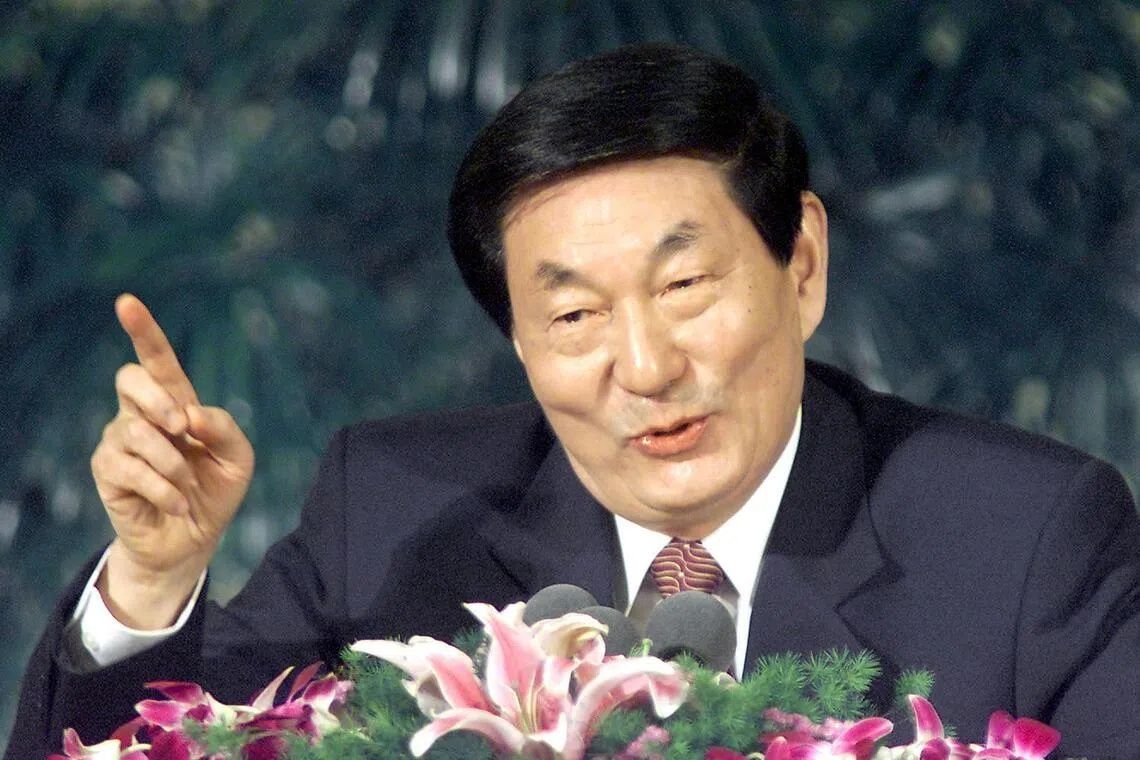
Prime Minister Lawrence Wong has expressed Singapore's condolences following the passing of former Chinese premier Zhu Rongji, one of the key architects of China's economic transformation over the past three decades. Zhu died in Beijing on Wednesday, 12 August, just two months before what would have been his 98th birthday, according to China's state news agency Xinhua. In a letter to current Chinese Premier Li Qiang dated 13 August, PM Wong recognised Zhu's monumental contributions to reshaping China's economy and positioning the country as a major player in global trade.
During his tenure as premier from 1998 to 2003, Zhu distinguished himself as a pragmatist committed to modernising China's economic structure at a critical juncture in the nation's development. PM Wong's tribute underscored Zhu's instrumental role in shepherding China's accession to the World Trade Organization in 2001, a milestone that fundamentally altered the trajectory of global commerce and cemented Beijing's integration into the international trading system. This achievement represented years of complex negotiations and domestic reforms, positioning China to become the manufacturing powerhouse that would define the early 21st century's economic landscape.
Beyond his domestic economic achievements, Zhu cultivated a forward-thinking vision for China's relationship with its Asian neighbours, a perspective that resonated deeply with Singapore's own development strategy. PM Wong characterised Zhu as an old friend of Singapore, emphasising the former Chinese leader's numerous encounters with Singapore's founding Prime Minister Lee Kuan Yew and his successor Goh Chok Tong. These relationships transcended ceremonial courtesy, reflecting genuine strategic alignment between Beijing and the island nation at a time when regional architecture was being reconfigured following the Cold War's conclusion.
A defining moment in Zhu's engagement with Southeast Asia came in 1999 when he became the first Chinese leader invited to deliver the Singapore Lecture, the prestigious public forum organised by the ISEAS – Yusof Ishak Institute. This invitation itself symbolised Singapore's confidence in Zhu's vision and his credibility as a serious economic thinker beyond China's borders. During that address, Zhu articulated a compelling narrative about how China's economic development would generate prosperity across Asia and globally, a message that departed from zero-sum geopolitical framings prevalent at the time.
Crucially, during that 1999 lecture, Zhu proposed the establishment of a free trade area between the Association of Southeast Asian Nations and China, a bold proposal that would reshape regional commerce. This initiative, though unconventional for its era, anticipated the deepening economic interdependence that now characterises China-ASEAN relations. PM Wong observed that Zhu's strategic prescience has been vindicated by subsequent developments, noting that China has evolved into an essential economic partner not only for Singapore but for countries throughout Southeast Asia, fundamentally altering regional trade patterns and investment flows.
The relationship between Singapore and China advanced substantially during Zhu's years in power, particularly through flagship infrastructure projects that symbolised mutual confidence and long-term commitment. PM Wong highlighted Singapore's pioneering involvement in the China-Singapore Suzhou Industrial Park, one of the first major government-to-government economic cooperation initiatives between the two nations. Zhu's early and enthusiastic backing of this project demonstrated his recognition that structured economic partnerships could serve mutual developmental interests while building trust across different political systems.
Prior to his role as premier, Zhu served as Shanghai's mayor, during which time he actively cultivated exchanges and collaborative learning between Shanghai's officials and their Singapore counterparts. These city-level interactions proved instrumental in establishing personal relationships and institutional knowledge-sharing mechanisms that would facilitate smoother cooperation once Zhu assumed national leadership. PM Wong's acknowledgment of this dimension reveals how foundational groundwork laid at the municipal level helped construct the robust architecture of bilateral relations that persists today.
The cumulative effect of these varied initiatives was to establish a template for pragmatic, mutually beneficial engagement between China and Singapore that transcended the suspicions and ideological tensions that might otherwise have constrained cooperation. PM Wong emphasised that the institutional friendships and exchange mechanisms cultivated under Zhu's stewardship created enduring foundations for the depth and breadth of contemporary Singapore-China relations. These frameworks have survived leadership transitions and shifting regional geopolitics, testament to their structural durability.
For Malaysia and other Southeast Asian nations, Zhu's legacy carries particular significance as the regional architect of China's outward economic engagement strategy. His willingness to envision China not as a threat to regional stability but as a partner in shared prosperity helped reshape perceptions that might otherwise have been more defensive or exclusionary. The ASEAN-China Free Trade Area that eventually materialised built directly upon the conceptual foundations Zhu articulated in 1999, facilitating the extraordinary growth in regional trade volumes that followed.
Zhu's approach to economic diplomacy embodied a recognition that in an increasingly integrated world economy, prosperity was not zero-sum but rather expandable through cooperation. His emphasis on transparency, institutional frameworks, and sustained official exchanges provided a model for how nations with different governance systems might nonetheless achieve substantial economic collaboration. This pragmatism contrasted with earlier phases of China's foreign relations that placed greater emphasis on ideological alignment or strategic competition.
The passing of Zhu marks the conclusion of an era when China's economic transformation was still being actively shaped by individuals who had witnessed the pre-reform period and could therefore appreciate the magnitude of change required. PM Wong's tribute appropriately emphasises not merely Zhu's administrative accomplishments but his strategic vision in recognising that China's development and regional prosperity were intrinsically linked. As Southeast Asia navigates contemporary great power competition and economic uncertainty, the principles of pragmatic cooperation and institutional stability that Zhu championed remain instructive for regional leaders seeking sustainable pathways forward.

