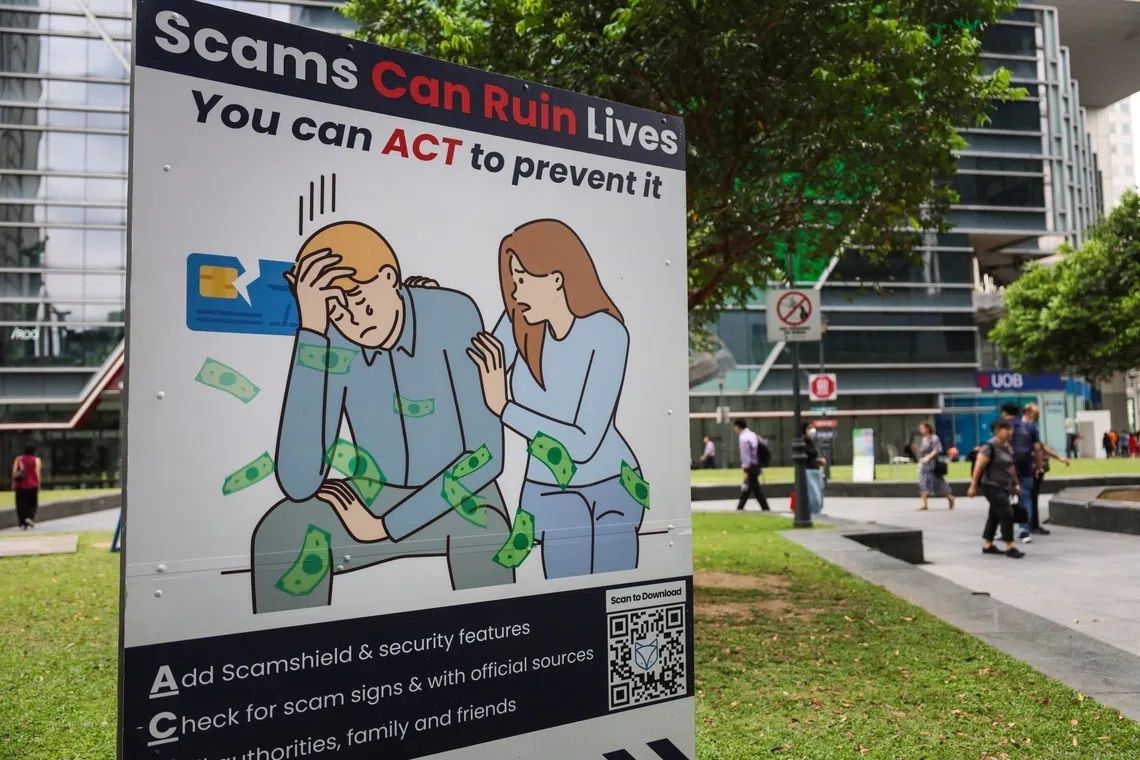
Singapore is moving decisively to close legal gaps in its anti-scam framework by criminalizing the supply and use of online account mules across major digital platforms. The Scams (Countermeasures) and Other Matters Bill, tabled in Parliament on August 4, represents a significant escalation in the government's response to fraud that has consumed billions in losses and overwhelmed law enforcement resources across the region.
While Singapore already prosecutes traditional money mules and those who traffic in SIM cards and Singpass credentials, no specific offences currently exist to target individuals who trade in accounts on Carousell, TikTok, Telegram, Facebook, Instagram and WhatsApp. This legislative blind spot has allowed vast networks of account providers to operate with relative impunity, facilitating the rapid deployment of infrastructure that scammers rely on. The proposed changes would make it illegal to supply, receive, possess or provide personal information to establish such accounts for criminal purposes, filling a critical enforcement vacuum.
The penalties for those convicted of facilitating online account fraud would be substantial: fines reaching S$10,000, imprisonment of up to three years, and caning of up to 12 strokes. These consequences reflect the seriousness with which Singapore views participation in scam ecosystems, even at the lower end of the criminal hierarchy. The caning provision is particularly distinctive to Singapore's legal framework and underscores the government's determination to deter involvement in account mule networks.
The legislation also represents a sharp recalibration of enforcement against non-compliant online platforms. Maximum fines for service providers that fail to meet codes of practice and implementation directives will jump from S$1 million to S$10 million, a tenfold increase. Daily penalties for continuing offences will rise from S$100,000 to S$300,000. This escalation directly targets major corporations like Meta, which has already faced two implementation directives—in September 2025 and January 2026—requiring strengthened anti-scam safeguards on Facebook and Instagram. Police credit these directives with reducing impersonation scams, though government official impersonation cases more than doubled from 1,504 in 2024 to 3,363 in 2025, becoming the fifth most prevalent fraud type.
The scale of Singapore's scam problem cannot be overstated. Fraud accounted for three of every five police reports in 2025, with losses totalling S$913.1 million that year alone. Since 2019, scams have cost victims more than S$4 billion, creating a humanitarian and economic crisis that extends beyond individual financial harm to broader erosion of public trust in digital commerce and financial systems. The contagion effect is particularly acute in Southeast Asia, where coordinated fraud networks often operate across borders and overwhelm the capacity of individual governments to respond.
Innovation in scam operations is outpacing traditional law enforcement responses. Criminal syndicates now deploy artificial intelligence to generate vast numbers of fraudulent websites, accounts and advertisements in compressed timeframes, rendering manual review processes obsolete. The Bill directly addresses this asymmetry by authorizing the police to issue anti-scam directions through automated computer programmes, including those powered by AI. This represents a philosophical shift toward algorithmic governance in fraud prevention, with built-in safeguards intended to ensure accuracy and fairness. The approach acknowledges that human-scale interventions can no longer keep pace with machine-scale threats.
The legislation introduces three novel enforcement orders that expand police authority over service providers. A disclosure order will compel banks, telecommunications companies and online platforms to furnish information about specified accounts and scam-related activities. An account disabling order will allow police to force providers to suspend suspect accounts for up to 30 days, extensible once for a further 30 days. These mechanisms feed into a National Scams List under development, designed to enable real-time automated information-sharing between government agencies and private partners. The potential here is transformative: banks and telcos could halt scam-related fund flows and suspend compromised accounts before money moves, representing a paradigm shift from reactive investigation to proactive disruption.
The third novel order—a service limitation order—extends police power to restrict access to financial, telecommunications and Singpass services for up to three years, bringing enforcement beyond sporadic interventions to sustained service deprivation. This builds on the facility restriction framework rolled out in October 2025, which has already placed 1,423 money mules, 1,439 SIM card mules and 53 corporate mules under restrictions as of June 30. The framework operates largely on a voluntary basis or through sector-specific mechanisms, but the new order would formalize and strengthen enforcement where cooperation has been lukewarm.
For Malaysia and other Southeast Asian nations grappling with similar challenges, Singapore's approach offers instructive lessons. The strategy combines criminal sanctions against individual mules with escalated corporate penalties, automated enforcement mechanisms and real-time inter-agency coordination. The regional implications are significant: scam networks routinely exploit jurisdictional gaps, routing money through multiple countries and using mules recruited across borders. Singapore's tightening of the chain could displace criminal activity into neighbouring jurisdictions unless coordinated regional responses develop in parallel. Malaysian authorities monitoring these developments may find themselves under pressure to harmonize their own anti-scam frameworks or risk becoming conduits for fraud fleeing more stringent regimes.
The Bill signals that Singapore views scam proliferation as a threat to financial system integrity and public confidence that justifies extraordinary measures, including algorithmic decision-making and three-year service restrictions for individuals merely suspected of involvement in fraud schemes. Whether these enhanced powers prove proportionate and effective, or whether they set a template for excessive surveillance and restriction that spreads regionally, remains to be observed once the legislation takes effect.

