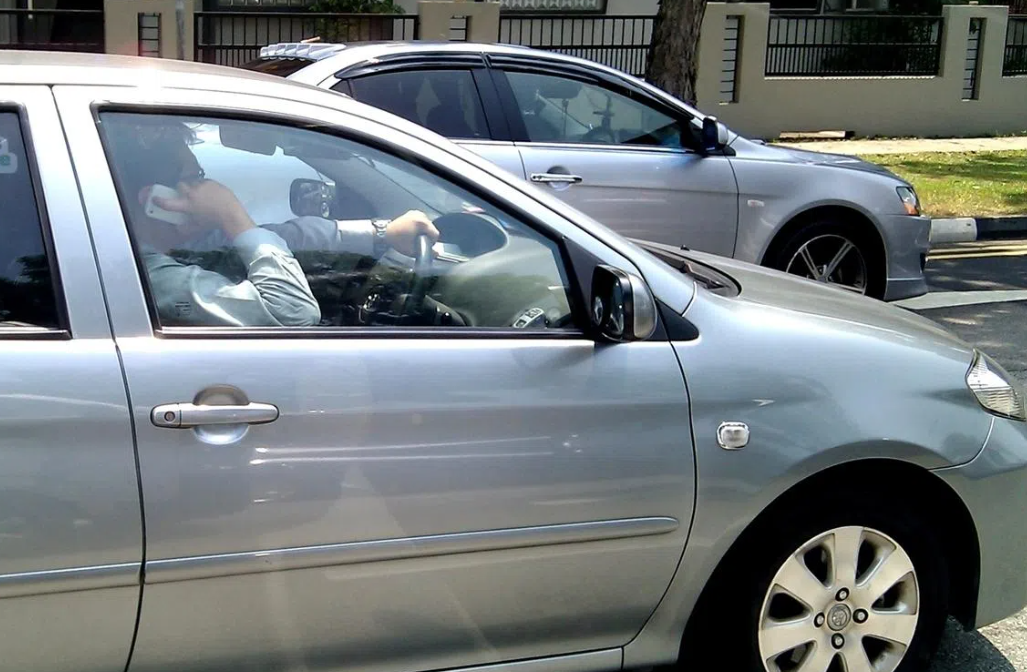
Singapore is moving to significantly toughen its traffic enforcement regime, introducing legislation that will make it illegal to hold a mobile phone while driving regardless of whether the device is actually being used. The Ministry of Home Affairs tabled the Road Traffic (Miscellaneous Amendments) Bill on Tuesday, signalling a decisive shift in how authorities will combat rising dangers on the island's roads. The proposal reflects growing concern about driving behaviour across the city-state and sets a potential benchmark for other Southeast Asian jurisdictions grappling with similar safety crises.
The surge in road incidents has prompted the legislative intervention. Between 2021 and 2025, traffic fatality rates increased by approximately 24 per cent, while violations jumped by roughly 38 per cent during the same period. Most alarmingly, deaths reached a decade-high of 149 in 2025, compared with 141 recorded in 2016. Beyond fatalities, the injured toll has also worsened, rising from 9,342 people in 2024 to 9,955 in 2025. These figures underscore the deteriorating safety landscape and justify the government's determination to arrest what officials characterise as a troubling downward trend.
Current legislation already criminalises texting or calling while holding a phone, but enforcement has proven challenging. Drivers caught under existing rules typically face 12 demerit points and fines of $400 to $500. More serious prosecutions can result in imprisonment of up to six months and fines of $1,000 for first offenders, or up to one year and $2,000 for repeat offenders. However, the law's effectiveness is hampered by a critical requirement: authorities must demonstrate that the phone was actually being used, which demands officers witness the violation directly and manually verify the behaviour. This evidentiary burden has allowed many violators to escape prosecution.
The new Bill circumvents this obstacle by criminalising the mere act of holding a phone while a vehicle is in motion. The Ministry argues this approach is justified because a driver holding a device is inherently less focused on the road, regardless of intent. Crucially, the change will enable Traffic Police to leverage technological solutions, deploying cameras to record violations and accepting photographic and video evidence submitted by members of the public. This shift towards camera-based enforcement represents a modernisation of Singapore's traffic policing approach and could eventually serve as a model for other regional governments. The exemption for stationary vehicles and mounted devices preserves legitimate use while targeting the dangerous behaviour pattern.
Beyond phone-related offences, the Bill addresses a separate category of reckless conduct: deliberate vehicular endangerment. Singapore's legal framework has struggled to capture the culpability of drivers who intentionally use vehicles as weapons against others. Currently, such individuals cannot be convicted of murder or culpable homicide unless prosecutors prove beyond reasonable doubt that the offender intended death or knew the act would likely cause it. This high threshold means dangerous driving causing death remains the most severe charge available, carrying a maximum eight-year sentence. The case of Jarrett Tee Lee Kiat, who raced on an expressway and killed an 18-year-old without showing remorse, exemplifies this limitation—he received five years and eight months imprisonment despite the intentional nature of his conduct.
The Bill introduces a new offence categorised as purposeful endangerment using a vehicle, which causes death or grievous hurt. Offenders convicted under this provision face substantially harsher consequences: imprisonment of up to 15 years, financial penalties, caning, and lifetime driving disqualification or disqualification for a minimum of 10 years subject to special circumstances. This innovation represents a middle ground in criminal culpability, acknowledging that some vehicular attacks fall short of murder but exceed careless or even dangerous driving. The provision is particularly significant for Southeast Asia, where motorised violence and reckless racing remain persistent public safety concerns across the region.
The Bill also recalibrates penalties for dangerous and careless driving causing grievous bodily harm. A recent High Court case involving Yoong Kok Kai, who drove while severely intoxicated and left an auxiliary police officer in a vegetative state, prompted judicial reflection on sentence adequacy. The judge, who increased Yoong's term from three-and-a-half years to five years, questioned whether existing maximum sentences were proportionate to the worst scenarios, but noted that legislative reform was necessary. In response, the Bill raises the maximum imprisonment for dangerous driving causing grievous hurt from five years to seven years for first-time offenders, and from 10 to 13 years for repeat offenders.
Additional aggravating factor enhancements also feature prominently. When offenders commit these crimes under exacerbating circumstances—particularly while driving under the influence of alcohol or drugs—they now face up to 18 months additional jail time, increased from the current maximum of one year. These compounding penalties reflect a punitive philosophy that treats serious violations with escalating severity based on circumstances. For Malaysian readers, these developments are particularly relevant given comparable challenges on local roads, where recent fatality statistics and rising violation rates echo Singapore's experience.
The legislative package also establishes a new offence of drug driving, though specific details remain limited in the initial announcement. This addition acknowledges that substance impairment contributes significantly to traffic incidents across Asia, yet remains inadequately addressed in many jurisdictions. By formalising drug driving as a distinct violation, Singapore aims to create clearer enforcement pathways for Traffic Police encountering drivers whose impairment stems from drugs rather than alcohol alone. This reflects evolving understanding of road safety in the region, where drug-related driving incidents have become increasingly prevalent.
The proposed amendments represent part of a broader regional conversation about balancing road safety with personal freedoms and proportionate punishment. Singapore's approach—using technology to enforce phone-holding bans while introducing harsher sentences for intentional endangerment—suggests that traffic safety policy is shifting beyond traditional deterrence models. The emphasis on purposeful endangerment and drug driving acknowledges that modern road dangers extend beyond carelessness to deliberate risk-taking and substance use. For neighbouring Malaysia and other Southeast Asian nations, Singapore's legislative experiment offers instructive lessons about enforcement mechanisms, sentencing frameworks, and public participation in traffic safety monitoring.
Implementation challenges will inevitably emerge. Public acceptance of phone-holding bans that disregard actual usage remains uncertain, particularly among drivers accustomed to holding devices for navigation or emergency communication. Questions about appeals and procedural fairness may arise when camera evidence becomes the primary enforcement mechanism. Yet the Ministry's determination to arrest rising fatalities suggests that legislative hesitation has given way to action. If the Bill passes, enforcement patterns and sentencing outcomes in the coming years will illuminate whether these measures effectively deter dangerous driving behaviour or merely shift compliance costs to offenders.

