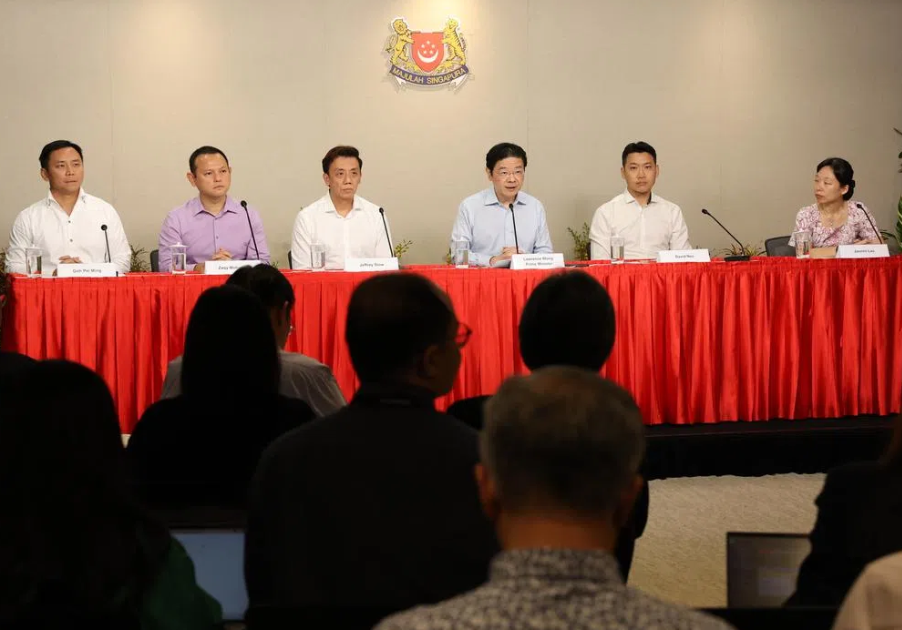
Prime Minister Lawrence Wong has announced a significant restructuring of Singapore's Cabinet that emphasises generational advancement while preserving institutional experience. The reshuffle, unveiled on July 22, aims to position newer office-holders in expanded roles whilst maintaining the steadying presence of seasoned veterans. The timing of these changes reflects the Government's ongoing effort to build a robust leadership pipeline capable of stewarding the city-state through both current pressures and future challenges.
The Cabinet overhaul comes in the wake of two notable political departures during 2026. Faishal Ibrahim, who held the position of Senior Minister of State for Home Affairs alongside responsibility for Muslim Affairs, stepped down on July 20 following what he characterised as a "lapse of judgment" in his personal interactions. Earlier that month, on June 1, Koh Poh Koon resigned from his senior minister of state appointment, citing family obligations. These unexpected departures necessitated the Government to accelerate its succession planning and redistribute portfolios across the ministerial ranks.
Two 2025 General Election newcomers—Jeffrey Siow and David Neo—have been elevated to the rank of full minister. Siow, who has served as Acting Transport Minister since May 2025, will retain that portfolio in his new capacity. Similarly, Neo, who has held the Acting Minister position for Culture, Community and Youth, will continue overseeing that ministry. Their promotions acknowledge the progress they have made in their respective departments and signal the Government's confidence in their readiness to assume greater responsibility during the transition period.
Sim Ann, another first-term legislator, has been appointed Second Minister for both Foreign Affairs and Home Affairs, taking on dual responsibilities that underscore the breadth of her departmental exposure. Meanwhile, Jasmin Lau will assume the role of Acting Minister for Manpower, with Tan See Leng stepping aside from that portfolio to take charge of Trade and Industry, with a specific focus on energy and industrial matters. The redistribution of these heavyweight portfolios reflects the Government's determination to spread expertise and create development opportunities for its emerging cohort of leaders.
Two additional backbench members from the current parliamentary term—Foo Cexiang and Shawn Loh—have been appointed as ministers of state. Both are first-term Members of Parliament whose transition to ministerial rank demonstrates the Government's commitment to drawing talent from a broader pool of experienced civil servants and legislative representatives. These appointments create a middle tier of political leadership where capable newer entrants can gain exposure to ministerial-level decision-making whilst contributing meaningfully to policy implementation.
Labour chief Ng Chee Meng returns to the Cabinet after his period outside the ministerial structure, taking on the portfolio of Minister in the Prime Minister's Office. His reappointment signals his continued importance to the Government's policy agenda, particularly given his background in workers' matters and union relations. K. Shanmugam, meanwhile, has been elevated to the position of Senior Minister, a title that reflects his standing as one of the two most experienced members of the Cabinet alongside Senior Minister Lee Hsien Loong. The creation of this senior tier aims to ensure that mentorship and strategic guidance flow from the most experienced leadership toward the newer generation.
PM Wong justified the reshuffle by emphasising the Government's need to balance immediate governance challenges with long-term institutional renewal. He observed that younger office-holders require not only assignments of greater complexity but also the counsel and support of those with decades of ministerial experience. The Cabinet structure he has maintained includes three coordinating ministers overseeing distinct areas of Government responsibility, providing additional channels for senior leadership oversight without necessarily expanding the Cabinet's overall size. Shanmugam continues as Coordinating Minister for National Security, whilst Chan Chun Sing and Ong Ye Kung hold coordinating positions for other governmental domains.
When pressed on the absence of a second deputy prime minister—Gan Kim Yong currently holds the sole deputy position—PM Wong indicated that the existing senior leadership architecture provides sufficient strength and stability. He cautioned that the political situation remains dynamic and subject to change, suggesting that the question of deputy prime ministerial succession would continue to receive periodic review as leadership renewal progressed. This measured approach reflects the Government's preference for evolutionary rather than revolutionary change in its highest echelons.
A notable aspect of PM Wong's remarks concerns his continued holding of the Finance Ministry portfolio, a position he has maintained since 2021. When questioned about identifying a successor, the Prime Minister characterised the search as a "work in progress," noting that political figures develop at different rates. Some demonstrate readiness for senior roles earlier in their careers, whilst others require extended periods of preparation. His role, as he described it, involves carefully assessing when each office-holder has reached sufficient maturity for promotion and matching their capabilities to roles where they can deliver maximum benefit to Singapore.
The Cabinet changes will be implemented progressively, with most taking effect from July 27 and others following at subsequent dates. This phased approach permits each new office-holder time to assume their responsibilities and settle into their expanded portfolios without abrupt disruption to government operations. PM Wong stressed that Singapore's approach to leadership renewal represents a continuous process rather than a one-time restructuring. The Cabinet exists as a living organism that regularly adapts to balance the necessity of institutional memory against the imperative of fresh energy and perspective.
For Southeast Asia's broader political context, Singapore's deliberate, measured approach to succession planning offers a contrasting model to the more turbulent transitions witnessed elsewhere in the region. The emphasis on building institutional capacity through systematic identification and development of talent, combined with the preservation of senior mentorship, reflects a governance philosophy centred on stability and competence rather than factional competition or personality-driven leadership contests. The Government's acknowledgment of the need to refresh its ranks whilst retaining experienced hands speaks to an understanding that effective transitions require both momentum and continuity.
The reshuffle also highlights the challenge of managing political expectations in a tightly controlled system where Cabinet positions represent scarce prizes and clear markers of political trajectory. By promoting several first-term MPs and creating space for backbenchers to access ministerial rank, PM Wong has signalled that access to higher office remains available to capable performers, potentially easing frustrations amongst members not yet elevated. The inclusion of former civil servants in ministerial positions underscores the Government's valuation of technocratic expertise over purely electoral credentials, maintaining the administrative tradition that has characterised Singapore's governance model since independence.

