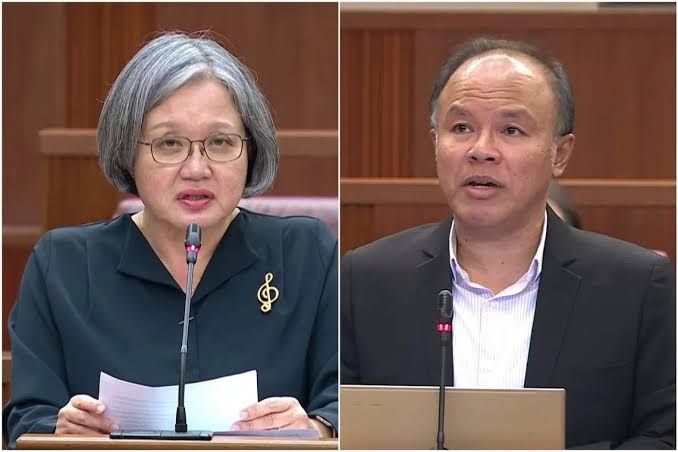
Singapore's Parliament has formally concluded a lengthy investigation into Workers' Party leaders Sylvia Lim and Faisal Manap, determining that no additional penalties can be imposed for their dishonesty before a parliamentary committee, even though their culpability has been confirmed. The decision, delivered by Leader of the House Indranee Rajah in a ministerial statement on July 7, marks the effective end of a saga that has dominated Singapore's political discourse since 2021 and underscores the complex interplay between legislative timelines and parliamentary accountability mechanisms.
The controversy originated when Raeesah Khan, then an opposition Member of Parliament representing Sengkang GRC, fabricated an anecdote about police conduct during a parliamentary speech in 2021. The subsequent investigation by Parliament's Committee of Privileges uncovered that three senior Workers' Party figures—Khan herself, party chief Pritam Singh, and the two MPs from Aljunied GRC—had misled the committee during its inquiries. The lie and the cover-up became emblematic of broader questions about opposition accountability and the institutional mechanisms available to ensure truthfulness in parliamentary proceedings.
The most serious allegations centred on Pritam Singh, who investigators found had instructed Khan to "take her lie to the grave" during a confidential meeting in August 2021. Lim and Faisal were present at that encounter but subsequently denied to the Committee of Privileges that any such instruction had occurred, leading to findings that they had deliberately provided false testimony. Parliament referred Singh for criminal prosecution, granting him the legal protections afforded to ordinary defendants, while the cases of Lim and Faisal remained in parliamentary limbo pending the outcome of Singh's legal proceedings.
Singh was convicted of lying to Parliament in February 2025 by the District Court, prompting him to appeal. The High Court upheld his conviction in December 2025, thereby validating the Committee of Privileges' earlier findings that all three opposition figures had deceived the investigating body. Indranee acknowledged that this judicial confirmation now leaves no doubt about the dishonest conduct of Lim and Faisal, stating that the court's judgment "confirmed the findings of the committee that Lim and Faisal had lied."
However, parliamentary procedure contains explicit statutory time limits governing when the House can punish members for contempt of Parliament and related breaches of integrity. Section 22 of the Parliament (Privileges, Immunities and Powers) Act stipulates that the current Parliament can only impose penalties for offences committed either in its existing session or in the second session of the preceding Parliament. Since the original falsehoods occurred during the first session of the 14th Parliament, and the 15th Parliament commenced following the 2025 general election, the legislative window for action has definitively closed.
Indranee stressed that this outcome, while legally unavoidable, represented an unusual and somewhat frustrating concatenation of circumstances. Ordinarily, she explained, Parliament can deal with such transgressions swiftly, sometimes within the same parliamentary session or at most in a subsequent session of the same Parliament. The compressed timeline in this instance—where the criminal case against Singh stretched across multiple parliamentary terms—created a situation where the passage of time rather than any substantive reconsideration precluded action. "Had the timelines been different, I would have proposed a different course of action," she remarked, implicitly acknowledging that justice through parliamentary discipline had been rendered technically impossible despite factual guilt being established.
The statute's time constraints exist ostensibly to ensure finality and predictability in parliamentary proceedings, preventing indefinite sword-of-Damocles scenarios where members could face sanctions years after contested conduct. Yet in this particular case, the law's inflexible provisions produced an outcome that many observers regard as unsatisfying from an accountability standpoint. The Workers' Party itself effectively moved past the episode during its internal elections on June 28, when party members voted to retain Singh as leader despite his conviction, suggesting that internal party dynamics had already superseded the formal parliamentary process.
Parliament retains one avenue for expressing institutional disapproval: passing a motion signalling regret at the conduct in question. However, Indranee noted that Parliament had already communicated its clear message when it declared Singh unsuitable to serve as Leader of the Opposition in January 2025, a motion that encompassed broader disapproval of deception before Parliament and its committees. Deploying this mechanism again would likely be deemed redundant, particularly since the substantive finding of dishonesty had been judicially confirmed and publicly acknowledged.
For Malaysian observers following Singapore's political developments, this episode offers instructive lessons about how Westminster-derived parliamentary systems grapple with questions of accountability and the rule of law. The incident reveals tension between formal legal procedures and substantive justice: the courts found Singh guilty of lying to Parliament, the Committee of Privileges determined that Lim and Faisal had similarly deceived it, yet parliamentary remedies became legally unavailable despite these definitive findings. The situation highlights how democracies relying on parliamentary discipline rather than external oversight mechanisms can encounter gaps when political timing misaligns with statutory deadlines.
The handling of this matter also reflects Singapore's emphasis on institutional procedures over discretionary judgment. Indranee explicitly invoked the principle that "the law, in this case the time bar provisions of PPIPA, must be observed," suggesting that parliamentary rules, however technically inconvenient their application might be, cannot be circumvented even when the House might prefer to impose additional consequences. This adherence to procedural constraints, while potentially frustrating to those demanding fuller accountability, paradoxically strengthens the long-term legitimacy of parliamentary institutions by demonstrating that they operate according to fixed rules rather than ad hoc political preferences.
Sylvia Lim, responding to the ministerial statement, indicated she took no exception to the conclusion and reiterated that she had already addressed the substance of the accusations during January's motion debate. Her measured response contrasts with the acrimony that had characterised earlier phases of the dispute, suggesting that the political temperature around the scandal has cooled considerably. The Workers' Party's decision to retain Singh as leader while Parliament effectively closed the disciplinary file suggests the opposition is attempting to move forward, albeit with reputational damage from the protracted affair.
The closure of this chapter does not erase the underlying facts: three opposition politicians deliberately misled Parliament, only one faced criminal consequences, and two escaped formal punishment due to statutory technicalities. For Southeast Asian democracies concerned with maintaining parliamentary standards and integrity, Singapore's experience underscores the importance of ensuring that legislative time limits do not inadvertently create escape routes for serious misconduct. The episode also demonstrates how the interaction between criminal and parliamentary proceedings can produce unexpected lacunae in accountability systems.

