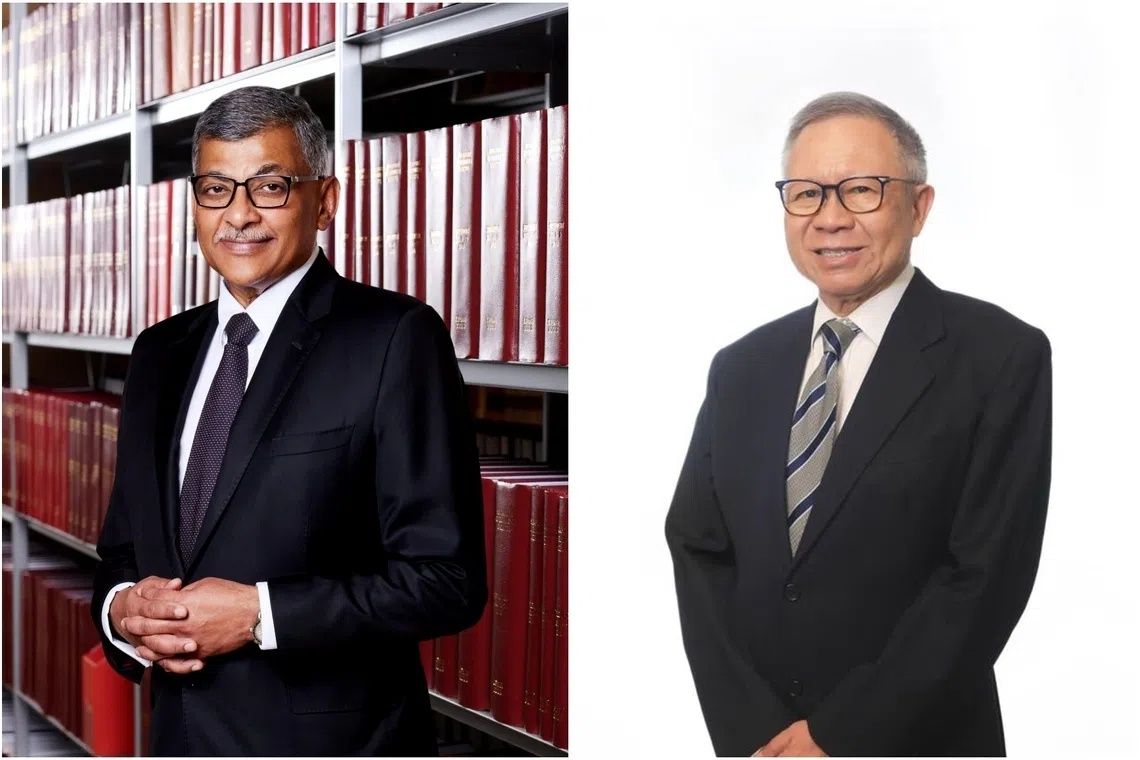
Chief Justice Sundaresh Menon and Eddie Teo, the longtime former chairman of the Council of Presidential Advisers, have been named recipients of the Order of Temasek (With Distinction), Singapore's highest civilian honour, in recognition of their exceptional service to the nation. The pair are among 7,491 individuals receiving National Day honours this year, with their awards underscoring the republic's formal acknowledgment of profound institutional leadership spanning multiple decades.
Menon, 62, concludes a transformative 14-year tenure as Chief Justice that began in November 2012 and will culminate on February 26, 2027. During his stewardship of Singapore's judiciary, Menon orchestrated sweeping modernisation that extended far beyond administrative efficiency. The judicial system underwent comprehensive digitalisation, restructuring that included the establishment of the Appellate Division of the High Court, and the creation of the Singapore International Commercial Court—positioning the republic as a regional hub for cross-border commercial dispute resolution. These institutional innovations reflected a deliberate strategy to strengthen Singapore's legal architecture while maintaining the independence and authority of the courts.
Beyond structural transformation, Menon championed a therapeutic justice philosophy that fundamentally reoriented how the Family Justice Courts and Youth Courts operate. Rather than purely punitive approaches, these courts increasingly emphasise rehabilitation and restoration, particularly for vulnerable populations including families in crisis and young offenders. Menon's establishment of the Singapore Judicial College represented another strategic initiative, creating a dedicated institution for ongoing judicial education and development—essential infrastructure for maintaining judicial quality as the legal system evolved. In a statement reflecting on his tenure, Menon framed the judiciary's achievements as collective endeavour, emphasising that strengthening the rule of law has been foundational to Singapore's governance since independence and remains essential to the nation's continued prosperity and social stability.
Teo, 79, brings a different but equally significant legacy to public administration. His career trajectory—spanning 56 years from 1970—traces the arc of Singapore's institutional development across its most critical governmental sectors. Beginning as a young officer in the Ministry of Defence's Security and Intelligence Division, Teo ascended to leadership of that agency by age 31, commanding it from 1979 to 1994. His subsequent assignments as permanent secretary for defence and later to the Prime Minister's Office placed him at the epicentre of national security and coordinating government functions during Singapore's economic consolidation and regional positioning.
Teo's tenure as Public Service Commission chairman from 2008 to 2018 culminated in his deliberate broadening of the commission's composition, recruiting members from academia, law, and social work rather than relying on traditional civil service backgrounds. This diversification reflected a recognition that public service leadership benefits from varied professional perspectives and life experience. Upon retirement from the PSC in 2018, Teo assumed the chairmanship of the Council of Presidential Advisers, a constitutional body advising the President on matters relating to drawdowns from Singapore's past reserves—a role demanding fiscal conservatism, national perspective, and deep institutional understanding. Teo held this position until June 2026, overseeing one of the most significant reserve deployments in the nation's history.
During the Covid-19 pandemic, Singapore withdrew approximately S$40 billion (US$31.3 billion) from accumulated reserves—the largest sum ever accessed—to stabilise the economy, support business continuity, and preserve employment. This extraordinary deployment required thorough deliberation between President Halimah Yacob and the Council of Presidential Advisers before approval proceeded. The decision reflected a calculated policy choice to deploy reserves rather than incur substantial public debt, thereby protecting Singapore's long-term fiscal position while providing immediate economic cushioning. Teo's role in facilitating this process underscored the advisory council's critical importance in safeguarding constitutional provisions governing reserve management.
Teo's own reflection on his career highlights his formative years learning directly from Singapore's founding generation—Lee Kuan Yew, Goh Keng Swee, and former President S. R. Nathan—figures who shaped the nation's institutional culture and governance philosophy. This intergenerational transmission of institutional values and practical governance wisdom proved pivotal in establishing the administrative standards and ethical frameworks that characterised Teo's own long career. His emphasis that public service, despite offering less wealth than private sector success, provides meaningful and intellectually engaging work reflects an effort to encourage future generations to consider government careers—particularly important as Singapore faces leadership succession and the retention of institutional memory.
Both recipients embody contrasting but complementary dimensions of Singapore's institutional excellence. Menon's Chief Justiceship modernised the judiciary while strengthening public confidence in the rule of law—a recognition that legal systems require continuous evolution to remain effective and legitimate. Teo's public service career, spanning the highest echelons of defence, prime ministerial coordination, and constitutional advisory functions, demonstrates the breadth and depth of Singapore's institutional professionalism. Their simultaneous recognition in 2026 signals governmental acknowledgment that judicial independence and impartial public administration remain foundational to the republic's continued stability and prosperity.
Also receiving the Distinguished Service Order, the next-highest honour, was Alan Chan, 73, chairman of the Land Transport Authority since 2016, for advancing Singapore's land transport infrastructure. Under Chan's leadership, rail reliability metrics improved dramatically, with mean kilometres between failures rising from 393,000 in 2017 to two million in 2026—reflecting either substantial reliability gains or methodology changes. The LTA delivered major projects including the Thomson-East Coast Line and Singapore Rail Test Centre while accelerating electric vehicle adoption across the transport system. Edmund Cheng, 73, former chairman of the Civil Aviation Authority of Singapore, also received the Distinguished Service Order for contributions spanning aviation sector development, rehabilitation of formerly incarcerated individuals, and arts patronage.
These awards collectively illustrate how Singapore recognises exceptional leadership across institutional domains—the judiciary safeguarding legal certainty, public administration ensuring governmental effectiveness, transport infrastructure enabling economic connectivity, and aviation positioning the republic within global networks. The recognition of Menon and Teo at the apex of the honours system affirms that in the Southeast Asian context, where governance quality and institutional stability frequently determine national trajectories, Singapore values those who strengthen foundational systems and transmit institutional knowledge to succeeding generations. For Malaysia and other regional neighbours, Singapore's systematic honouring of judicial and administrative leaders offers instructive contrast regarding how institutional excellence receives formal acknowledgment and how succession planning for senior judicial and civil service roles is publicly contextualised.

