The High Court in Singapore has substantially reduced the jail sentence imposed on former actor Edmund Chen, cutting his five-day custodial term to just one day in connection with a traffic accident that left a young motorcyclist severely injured. Justice Hri Kumar Nair delivered the decision on Monday, July 20, allowing Chen's appeal against the January 29 ruling by a district judge, though the judge noted he could not definitively conclude that the original court was wrong in deciding that imprisonment was warranted.
The 64-year-old Chen, whose legal name is Tan Kai Yuan, had pleaded guilty to causing grievous hurt to a 21-year-old motorcyclist while driving without due consideration for other road users. The collision occurred on March 4, 2025, along the AYE expressway near the CTE junction during midday traffic. Chen was attempting to change lanes and filter across the road to access the CTE/SLE exit, but had not properly positioned his vehicle ahead of a split in the roadway. The motorcyclist, approaching from behind, struck Chen's vehicle despite attempting to swerve, sustaining multiple wrist fractures that required surgical intervention at Singapore General Hospital.
Chen's appellate counsel, Senior Counsel Abraham Vergis from Providence Law Asia, mounted a persuasive argument that the custodial threshold should never have been crossed in the first place. Vergis sought to persuade the court that the maximum permissible fine of S$5,000 would be sufficient punishment, particularly given the specific circumstances surrounding the accident. The prosecutor's original submission had requested a fine ranging from S$3,000 to S$5,000, indicating even the state was uncertain about the necessity for imprisonment in this particular matter.
Dashcam footage played during the appeal hearing revealed critical details that supported the defence position. The footage demonstrated that Chen had activated his indicator lights before attempting the lane change, suggesting he had taken basic safety precautions. Vergis highlighted that the motorcyclist had effectively been obscured from Chen's view due to a passing vehicle positioned on a curved section of the expressway, further mitigating the culpability of the driver. While the video also captured Chen crossing white chevron road markings after the collision, this violation of traffic regulations was already a factor the district judge had weighed during the original sentencing.
The nature and severity of the victim's injuries became central to the appellate argument regarding proportionality of punishment. Vergis emphasised that while the motorcyclist did sustain fractures, these were confined to the wrists and therefore located in the peripheral extremities of the body, falling on the less severe end of the grievous hurt spectrum. The surgical repair was conducted under local anaesthesia rather than general anaesthesia, suggesting the injury severity did not constitute a particularly grave medical emergency. The victim spent only two days in hospital and received 99 days of medical leave, but crucially suffered no permanent disability or lasting impairment from the incident.
The appellate court's decision reflects a recalibration of sentencing principles in traffic accident cases, where courts increasingly distinguish between momentary lapses in judgment and deliberate or reckless conduct. While the district judge had cited Chen's infraction of changing lanes across chevron markings as an aggravating factor, the appellate decision suggests this breach alone does not necessarily justify the severity of a five-day custodial sentence. The fact that Chen immediately stopped to provide assistance to the injured motorcyclist and remained at the scene may also have factored into the appellate judge's reasoning, though this was not explicitly detailed in the court's findings.
Deputy Public Prosecutor Ben Tan resisted the appeal, contending that the five-year driving disqualification coupled with a substantial fine of up to S$5,000 represented an appropriate response. The prosecutor pointed to an aggravating circumstance that Vergis had not adequately addressed: during the critical moments of the manoeuvre, drivers of two passing vehicles had sounded their horns as warning signals, yet Chen persisted with the lane change despite these auditory alerts. This persistence in the face of warning was characterised as indicating a degree of inattention or disregard that justified the higher end of the sentencing spectrum, even if Chen ultimately deserved appellate intervention.
Beyond the sentence reduction, the court maintained the five-year driving prohibition, a penalty that carries substantial practical implications for Chen's personal mobility and potential earning capacity. This disqualification period reflects judicial concern about Chen's judgment behind the wheel, even as the custodial portion was deemed excessive. For Southeast Asian readers familiar with similar traffic safety frameworks across the region, the case demonstrates how appellate courts can modulate sentencing without entirely rejecting a lower court's assessment of culpability.
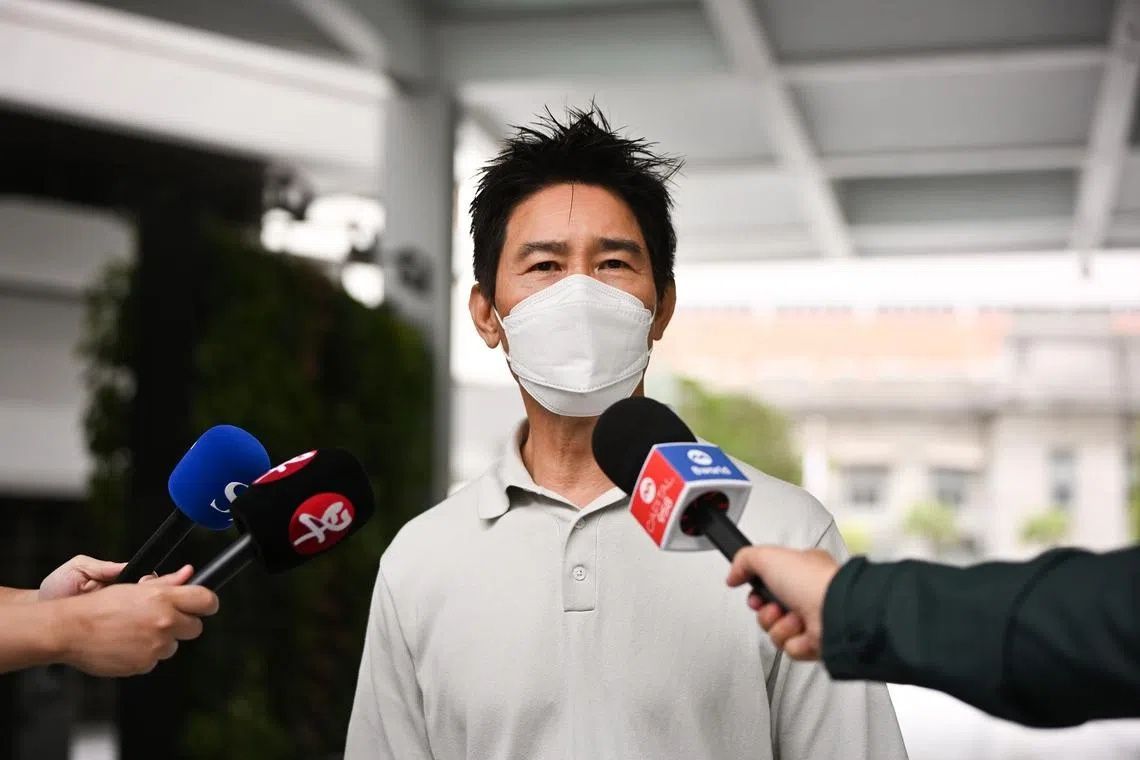
Chen's legal representation evolved throughout the proceedings, initially engaging Josephus Tan and Cory Wong from Invictus Law before transitioning to Kelvin Ong and Dickson Chew at Contigo Law following his original sentencing. The strategic decision to engage Senior Counsel Vergis for the appeal proved consequential, with the experienced appellate practitioner successfully reframing the case within parameters the High Court found persuasive. In comments to reporters before the hearing, Chen indicated his acute distress over the proceedings, noting he had prepared medication for a five-day incarceration and that neither he nor his family had slept the night before the appeal hearing.
Chen's prominence in Singapore's entertainment industry during the 1990s and early 2000s lent a human dimension to what might otherwise remain an obscure traffic case. He appeared in multiple popular television drama series including Star Maiden and Patrol, becoming a recognizable face in Singaporean households. However, he stepped away from acting after his daughter Chen Yixin was born in 2000, prioritising family responsibilities over continued professional engagement. Occasional acting roles followed, including participation in Life Less Ordinary in 2017, allowing him to maintain a connection to the industry. Chen's marriage to veteran actress Xiang Yun, celebrated for her roles in classic productions such as The Awakening, Double Happiness and The Little Nyonya, further embedded the family within Singapore's cultural landscape.
The case carries implications for how traffic accident cases are evaluated across Southeast Asia, where similar legal frameworks operate in several jurisdictions. The appellate decision suggests that proportionality in sentencing must account for the spectrum of injury severity, the presence or absence of deliberate recklessness, and individual circumstances including age and prior conduct. For Malaysian readers, the proceedings offer insight into how appellate courts in the region scrutinise custodial sentences in civil accident contexts, particularly where fines and driving disqualifications might adequately address public safety concerns without resort to imprisonment.

