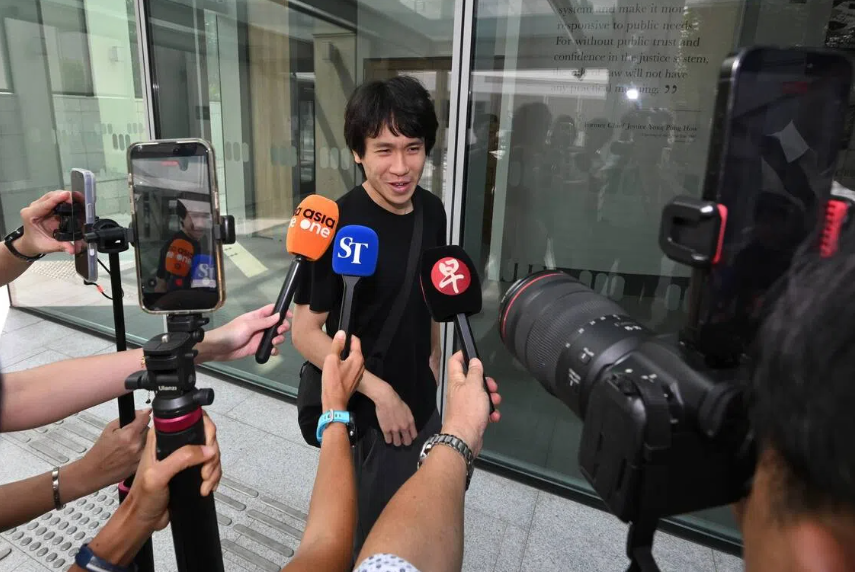
Singapore's District Court has handed former child actor Amos Yee four fresh charges, escalating a prosecution that now encompasses seven separate offences spanning racial incitement, child safety advocacy, and military service violations. The 27-year-old appeared in court on Aug 26 to face the expanded charges, which prosecutors argue represent a pattern of deliberate attempts to undermine Singapore's social cohesion and public order.
The racial disharmony charges represent the most publicly sensitive element of the case. Yee allegedly used his online platforms in April to post content characterising Malays and Indians as systematically disadvantaged by the Chinese-dominant majority in Singapore, and explicitly urged these communities to organise protests against the Government. A second similar charge stems from a video uploaded in May in which he allegedly made comparable claims about discrimination faced by the Malay and Muslim community. These allegations directly target Singapore's delicate framework of interethnic relations, a constitutional principle the Government fiercely protects through legislation and enforcement. For Malaysian observers, the case illustrates how differently Singapore polices speech that touches on race and religion compared with Malaysia's own constraints on such discourse.
Where the case becomes especially controversial are the child protection charges. Yee faces two counts under the Protection from Harassment Act for allegedly creating multiple videos in 2021 in which he advocated for decriminalising sexual contact with children, explicitly arguing that minors could consent to intercourse. Court documents indicate he went further still, calling for the abolishment of laws against producing and possessing child abuse material. A follow-up post in June reiterated similar positions. These charges occupy a peculiar legal and social space: they do not allege Yee created, possessed, or distributed child exploitation material, but rather that he publicly advocated for the normalisation of child sexual abuse through reframing consent. The distinction matters legally, though it offers little comfort to authorities seeking to prevent child harm.
The bail conditions imposed on Aug 26 attempt to contain the online speech dimension of the allegations. Yee was released on S$15,000 bail with explicit restrictions prohibiting him from posting anything expressing his views on paedophilia or content that could inflame racial and religious tensions. Such restrictions, enforced before conviction, are increasingly common in jurisdictions confronting online speech deemed dangerous, though they raise enduring questions about pre-trial suppression of expression. The court has scheduled a pre-trial conference for Sept 18, suggesting the prosecution phase will extend further.
The third category of charges relates to Singapore's compulsory national service regime. Yee faces three Enlistment Act violations: failing to present himself for mandatory pre-enlistment medical screening and departing Singapore without the required exit permits on two separate occasions. According to prosecutors, he left Singapore without authorisation from December 2015 to April 2016, then again from December 2016 to March 2026. He separately neglected to report for his national service screening from April 2016 through March 2026. These charges carry sentences of up to three years' imprisonment or fines reaching S$10,000, or both. For context, Singapore's conscription system is non-negotiable: male citizens must complete two years of active service followed by years of reserve obligations. Refusing or evading these duties amounts to a fundamental breach of civic obligation under Singapore law.
The Singapore Police Force stated in an Aug 25 statement that it had received multiple complaints between April and July regarding Yee's online conduct, prompting the investigation. Platform X (formerly Twitter) disabled Yee's video after police issued a disabling direction under Singapore's Online Criminal Harms Act on Aug 18, illustrating the Government's capacity to compel swift action from technology companies operating within its jurisdiction. Yee has also received a stop communication direction mandating removal of the offending blog posts, though enforcement of such directives against individuals who may have relocated remains uncertain.
If convicted on the racial disharmony charge, Yee faces up to three years' imprisonment, a fine, or both. Each Protection from Harassment Act violation carries a potential fine of up to S$5,000 upon conviction. The cumulative sentences possible across all seven charges could result in a substantial prison term. The legal exposure demonstrates Singapore's willingness to deploy multiple statutory frameworks—racial harmony legislation, harassment law, conscription regulations, and online harms provisions—against conduct authorities classify as threatening.
Yee's case reflects broader tensions in contemporary Singapore regarding the boundaries of protected speech and the State's capacity to regulate online discourse. Unlike Malaysia, where sedition and religious sensitivity laws remain formidable instruments, Singapore's approach emphasises racial harmony legislation and online harms provisions, creating distinct but equally restrictive speech environments. For Southeast Asia more broadly, the prosecution illustrates how different governments calibrate responses to online content they perceive as destabilising, whether framed around race, religion, child safety, or public order.
The case also highlights the vulnerability of individuals who position themselves as provocateurs or challengers to mainstream consensus. Yee's prior notoriety as a child actor, combined with his deliberate cultivation of controversial positions online, has placed him in direct confrontation with state enforcement mechanisms. Whether this represents appropriate prosecution of genuinely harmful speech or disproportionate suppression of dissent remains contested—a question that extends beyond Singapore to challenge how all democracies balance expression, public order, and child protection in the digital age.

