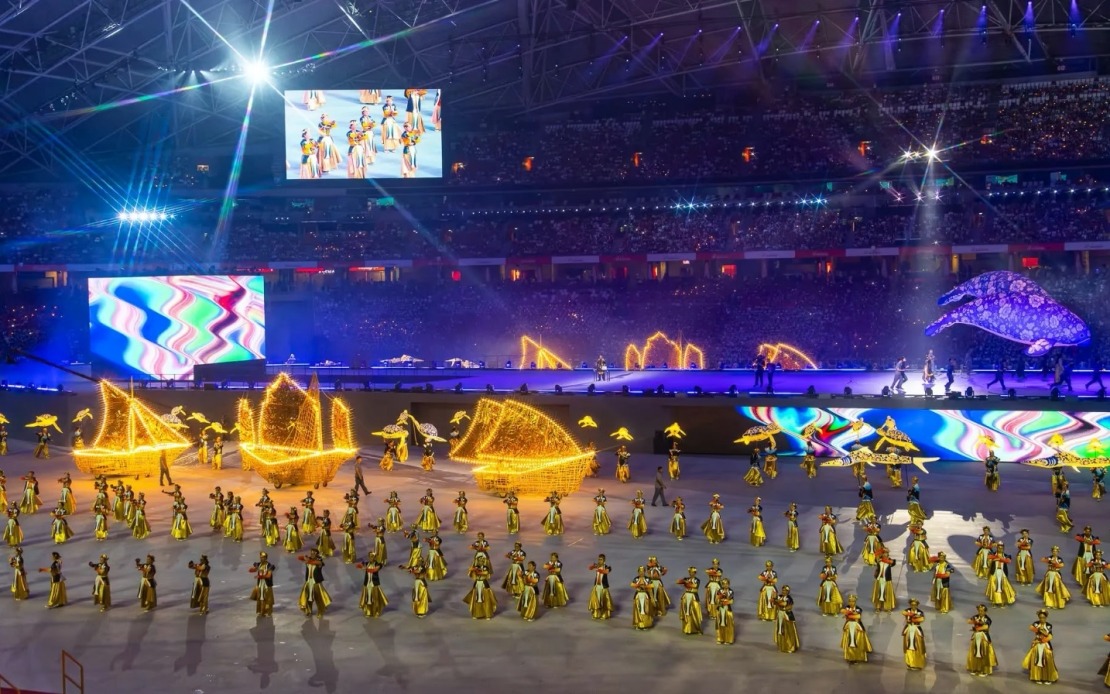
Singapore's 61st National Day on Sunday represented a significant milestone for the city-state, marked by the triumphant return of its flagship National Day Parade to the National Stadium following a decade-long absence from the venue. The celebration unfolded under the overarching theme "Majulah Singapura, Go Beyond!", a call that resonates across the island nation as it continues to chart its development pathway in an increasingly complex regional and global landscape. President Tharman Shanmugaratnam and Prime Minister Lawrence Wong presided over the ceremonies, accompanied by fellow Cabinet ministers and Members of Parliament, while approximately 42,000 members of the public filled the stadium's stands dressed in the national colours of red and white, creating a sea of patriotic sentiment.
A defining feature of this year's observance was the relocation of historically stadium-bound ceremonial elements to a broader geographic footprint. For the first time in the republic's six-decade existence, both the Presidential Gun Salute and the State Flag Flypast took place at Kallang Basin, a strategic repositioning that dramatically expanded public participation beyond the National Stadium's physical confines. This innovative approach allowed thousands of additional spectators positioned throughout the wider Kallang precinct to experience these ceremonial traditions firsthand, democratising access to key moments of national commemoration. Four 25-pounder Howitzer guns, each mounted on a Mobility 3rd Generation raft, navigated the waters of Kallang Basin, transforming the waterway into an active theatre of celebration and extending the parade's sensory reach to communities who might otherwise observe from greater distances.
The traditional 21-Gun salute drew upon military precision and coordinated personnel, with 151 participants from the 23rd Battalion of the Singapore Artillery and 35th Battalion of Singapore Combat Engineers executing the ceremonial discharge. This ceremonial component, steeped in protocol and tradition, serves as a symbolic reassertion of Singapore's sovereignty and the disciplined institutional frameworks that underpin the nation-state's functioning. The deployment of military formations for commemorative purposes reflects a broader Southeast Asian pattern wherein armed forces play prominent roles in national celebrations, reinforcing bonds between civilian and military populations while projecting an image of institutional strength and organisational capability.
The evening's proceedings commenced at approximately six o'clock with a dedicated parade and ceremony segment branded "Go Beyond Self", which brought together an impressive array of national participants. Thirty-two distinct contingents, collectively comprising more than 2,000 individuals, marched through a choreography of national pride and institutional representation. The configuration included six Guard of Honour contingents—72 personnel drawn from the Singapore Army, Republic of Singapore Navy, Republic of Singapore Air Force, Digital and Intelligence Service, Singapore Police Force, and Singapore Civil Defence Force—who escorted the Singapore Armed Forces Colours Party. A further ten contingents representing uniformed youth organisations participated, supplemented by sixteen supporting contingents, creating a comprehensive tableau of Singapore's institutional apparatus and emerging generations.
Beyond the rigid ceremonial framework, the show segment centred on the main theme and constituted the celebration's cultural and artistic centrepiece. Featuring 36 artistes and exceeding 2,600 performers, this component aimed to narrate Singapore's authentic stories through contemporary artistic expression, technological innovation, and a specially composed soundtrack. The segment's design reflected deliberate curatorial choices about national identity and societal progress, presenting Singaporeans not merely as subjects of state power but as active creators of cultural meaning.
A particularly notable dimension of this year's celebration involved the deliberate inclusion of performers representing Singapore's full demographic and ability spectrum. Seven dancers from diverse backgrounds participated in the show segment, including an autistic dancer and a dancer with Down syndrome, a programming choice that carried substantive symbolic weight. This inclusion strategy communicates an explicit national message that contribution to Singapore's collective future transcends traditional boundaries of background, ethnicity, religion, or physical and cognitive ability. For Malaysian audiences, this approach resonates with ongoing conversations across Southeast Asia regarding inclusive development and the integration of marginalised populations into mainstream civic and cultural participation.
The ceremonial and performative elements of Singapore's National Day observance serve multiple functions within the nation's political ecology. They reinforce institutional coherence, validate state legitimacy through mass participation, and project internationally an image of social cohesion and organisational sophistication. For neighbouring Malaysia and the broader Southeast Asian region, Singapore's capacity to execute large-scale civic commemorations with apparent seamlessness demonstrates the operational capabilities that enable the island-state's broader economic and diplomatic influence. The return of the parade to the National Stadium carries implicit acknowledgment of the venue's iconic status within Singapore's commemorative landscape, reasserting its centrality following a period of relocation during the preceding decade.
Regionally, Singapore's National Day celebrations warrant attention as a model of structured patriotic expression within a highly urbanised, multi-ethnic city-state context. Unlike some neighbours where commemorative practices foreground ethno-nationalist or religious elements predominantly, Singapore's approach emphasises institutional frameworks, technological modernity, and explicitly inclusive participation. This positioning reflects the island's founding philosophy of transcending communal divisions in favour of meritocratic state-building, though ongoing debates within Singapore regarding minority representation and cultural autonomy indicate that consensus on these questions remains contested.
The decade-long hiatus of the parade from the National Stadium reflected logistical and perhaps political calculations about optimal venues and public accessibility. The decision to restore it to what many Singaporeans regard as its traditional home signals confidence in the stadium's continued relevance and suggests deliberate symbolic work around re-anchoring national commemoration in recognisable institutional spaces. For Malaysian observers tracking Singapore's trajectory, such decisions illuminate how even ceremonial choices encode statements about continuity, national identity, and the relationship between state institutions and public participation in national life.

