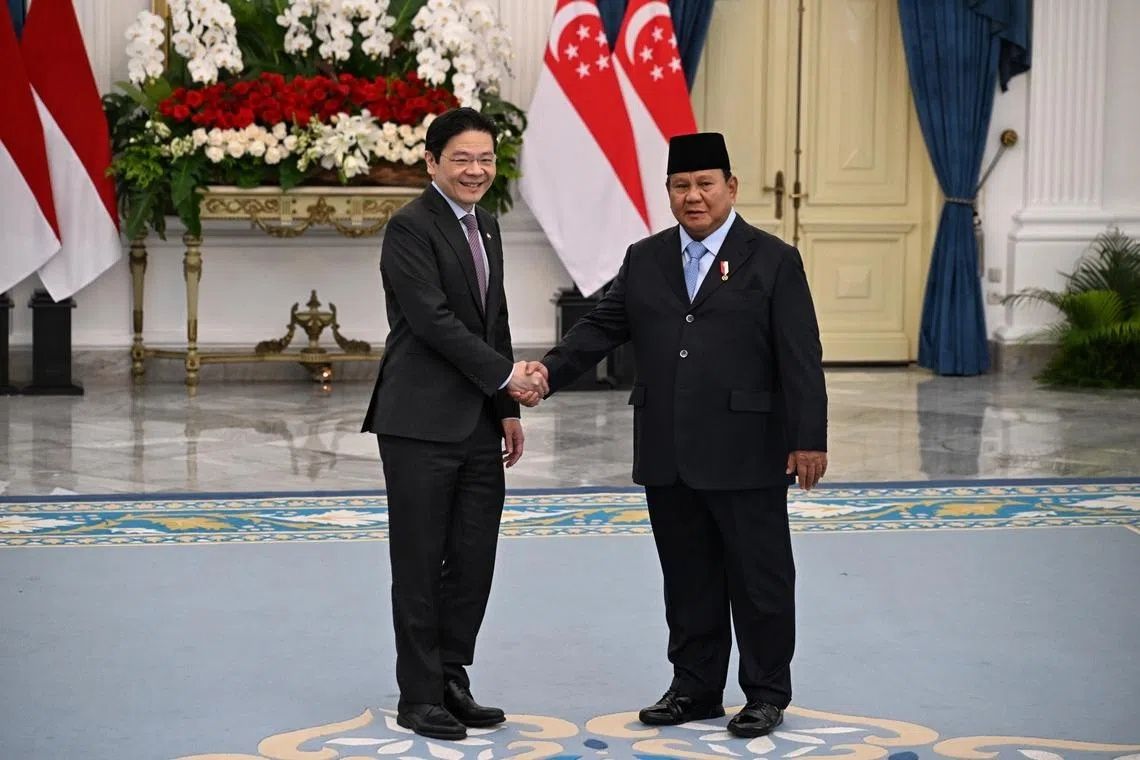
Singapore and Indonesia have strengthened their commitment to preserving the Strait of Malacca as an accessible and secure maritime passage for all shipping, elevating maritime security to a central pillar of their bilateral relationship during high-level talks held on July 6. Prime Minister Lawrence Wong and President Prabowo Subianto, meeting at the annual Leaders' Retreat, underscored that protecting one of the world's most critical shipping corridors has become essential to regional stability and sustained economic growth, particularly as geopolitical tensions continue to reshape global trade patterns.
The Strait of Malacca, through which flows roughly a third of global maritime trade and substantial energy shipments moving between the Indian Ocean and South China Sea, has increasingly commanded attention from governments across Southeast Asia and beyond. Both leaders recognised that safeguarding this waterway transcends bilateral interest, requiring coordinated action among all littoral states to ensure navigation rights are upheld and vessels remain protected from piracy, environmental hazards, and accidental disruptions. President Prabowo stressed Indonesia's determination to work alongside Malaysia and Thailand in accordance with international maritime law, ensuring the strait "always remain open to all, safe and accessible to anyone who requires access."
PM Wong contextualised the significance of maintaining open sea lanes by referencing recent disruptions in the Middle East, where geopolitical conflicts have compromised traffic through the Strait of Hormuz and destabilised global energy markets. The parallel illustrated a fundamental principle shaping contemporary maritime governance: when major shipping corridors face obstruction or security threats, the economic consequences ripple across interconnected global supply chains. For Malaysia and regional economies dependent on stable shipping routes, the Singapore-Indonesia alignment represents reassurance that two major stakeholders remain committed to preventing such disruptions in Southeast Asian waters.
The talks expanded significantly beyond maritime matters, reflecting an evolving partnership that increasingly encompasses sectors expected to define regional economic trajectories. Both nations have prioritised renewable energy cooperation and cross-border electricity trade as cornerstones of future bilateral engagement, recognising that energy security and climate imperatives demand innovative solutions transcending traditional national boundaries. The involvement of Indonesia's sovereign investment fund Danantara alongside Singapore entities including Keppel Electric, Sembcorp Industries, and Singapore Energy Interconnections signals concrete institutional commitment to translating cooperative intentions into operational electricity trade frameworks.
PM Wong characterised the cross-border electricity initiative as a "win-win" arrangement that extends beyond bilateral benefit, positioning it as a foundational component of a broader ASEAN Power Grid designed to strengthen regional energy resilience. Such infrastructure development carries particular significance for Malaysia and other ASEAN members facing energy demand pressures and decarbonisation obligations. When major regional economies collaborate on interconnected power systems, smaller neighbours gain access to diversified energy sources and reduced vulnerability to supply disruptions originating from individual suppliers.
The retreat showcased Singapore's strategic positioning as a long-term development partner invested in Indonesia's economic trajectory. Wong explicitly affirmed Singapore's confidence in Indonesia's future and outlined how Singapore's capital investments extend beyond financial flows to encompass business creation, downstream industrial development, and digital infrastructure deployment. References to ongoing expansion in the Batam-Bintan-Karimun region and the Kendal Industrial Park in central Java—which will expand by 1,000 hectares following a decade of operation—illustrated concrete manifestations of this partnership, with implications for employment generation and broader Southeast Asian manufacturing competitiveness.
The emphasis on digital infrastructure and cybersecurity cooperation reflects recognition that contemporary regional stability depends on protecting not merely physical maritime corridors but digital networks underpinning commerce and governance. Both leaders reported "fairly concrete outcomes" from discussions on cybersecurity frameworks and digital ecosystem development, though details remained limited. For Malaysian enterprises and policymakers, such initiatives suggest emerging standards for digital governance and cross-border data management that may shape regional compliance requirements and competitive positioning.
Supply chain resilience featured prominently in discussions, addressing vulnerabilities exposed during recent global disruptions. By strengthening economic connectivity and coordinating supply chain strategies, Singapore and Indonesia aim to reduce regional exposure to external shocks—a priority extending beyond bilateral relationships to encompass ASEAN-wide stability. Malaysia's central geographic position within these networks positions the country as both beneficiary and potential contributor to collective resilience initiatives.
The bilateral relationship's trajectory toward 60 years of diplomatic recognition in 2027 carries symbolic weight reflecting substantive deepening. Both nations have moved beyond conventional trade partnerships toward collaborative governance of shared resources and coordinated positioning on geopolitical developments. The elevation of maritime security reflects awareness that traditional diplomatic instruments increasingly require supplementation by concrete cooperation on infrastructure, energy systems, and digital governance to address 21st-century challenges.
For Malaysia, observing Singapore-Indonesia strategic alignment on the Strait of Malacca reinforces the necessity of tripartite coordination among all littoral states. Malaysia's own interests in maintaining open sea lanes, protecting marine environments, and preventing piracy require consistent engagement with regional partners rather than unilateral action. The Singapore-Indonesia commitment, while not formally binding Malaysia, establishes diplomatic momentum toward collective governance frameworks that Malaysia should actively shape.
The broader context reveals Southeast Asian powers positioning themselves proactively amid great power competition and shifting global trade patterns. By anchoring their relationship to specific infrastructure development projects—renewable energy, digital systems, industrial parks—Singapore and Indonesia move beyond rhetorical commitment toward institutionalised cooperation resistant to political fluctuations. This pragmatic approach offers lessons for other regional partnerships seeking durability through concrete collaboration.

