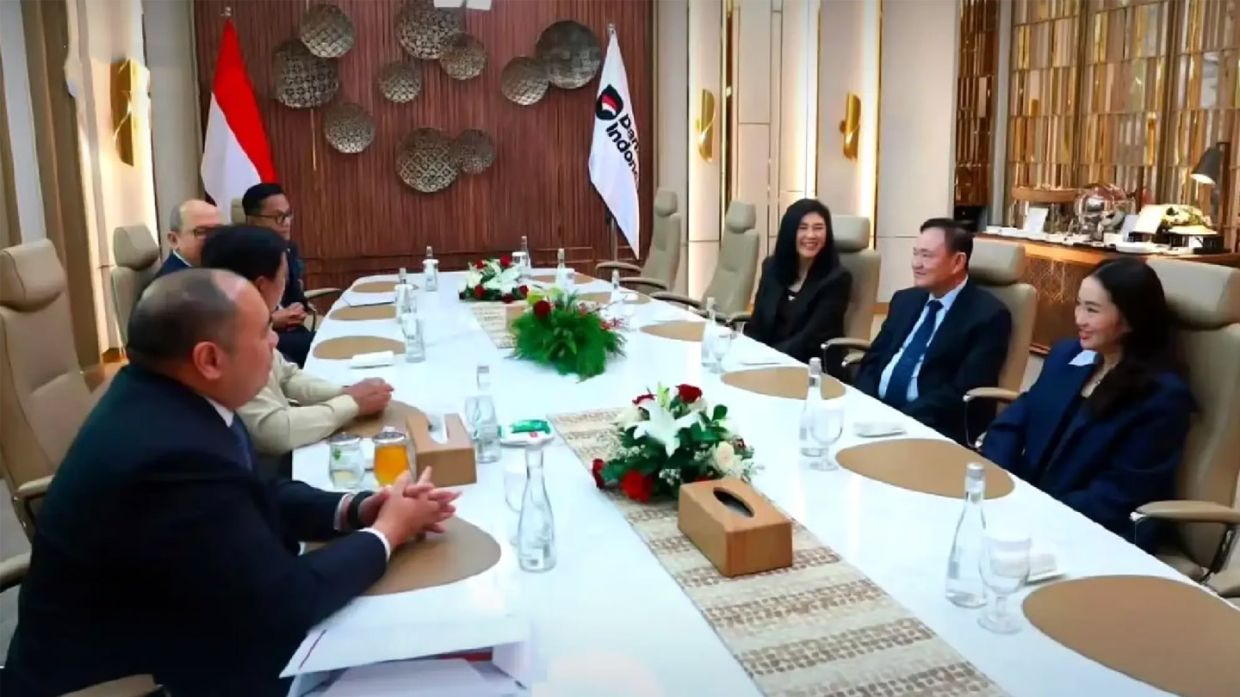
The Shinawatra family's political influence extended across Southeast Asia this week as three former Thai prime ministers convened with Indonesian President Prabowo Subianto in Jakarta to explore cross-border investment and economic cooperation. Thaksin Shinawatra, his sister Yingluck Shinawatra, and niece Paetongtarn Shinawatra held talks with Prabowo at the Danantara building on Thursday, July 9, according to Indonesian Cabinet Secretary Teddy Indra Wijaya. The gathering brought together three leaders who have collectively shaped Thailand's political trajectory over the past two decades, signalling renewed engagement between prominent Thai figures and Indonesia's newly installed leadership under Prabowo.
Thaksin served as Thailand's prime minister from 2001 to 2006, a period marked by both economic initiatives and political polarisation that would dominate Thai politics for years afterward. Yingluck later held the office from 2011 to 2014, continuing her brother's political legacy before facing similar controversies. Most recently, Paetongtarn assumed the prime ministerial role in 2024, representing the latest chapter in the family's political prominence. The convergence of all three in Jakarta underscores the Shinawatra family's enduring relevance in regional political and business circles, despite the domestic turbulence each has experienced within Thailand.
The meeting centred on identifying investment avenues, asset management strategies, and sustainable economic development frameworks. Such discussions carry particular significance given Thaksin's position on Danantara's advisory board—a role that grants him direct influence over Indonesia's state investment architecture. Danantara Indonesia functions as the government's strategic instrument for managing, optimising, and deploying national assets to support long-term economic transformation. By engaging the Shinawatra family at this level, Prabowo's administration signals intent to leverage international expertise and capital networks to advance Indonesia's development agenda.
Senior Danantara leadership participated in the Jakarta meeting, including group chief executive officer Rosan Roeslani, chief operating officer Dony Oskaria, and chief investment officer Pandu Sjahrir. Their presence alongside Indonesian President Prabowo underscores the formal nature of discussions and the administration's commitment to exploring substantive partnerships. The gathering was characterised as warm and cordial, reflecting not merely diplomatic protocol but genuine rapport between participants—a distinction that matters when assessing the likelihood of concrete follow-through on investment commitments.
Thaksin's involvement with Danantara positions him as a bridge between Thai business interests and Indonesia's state investment machinery. His advisory role places him alongside other international economic figures shaping how Indonesia deploys its strategic assets. This positioning allows Thai entrepreneurs and financial institutions to gain insight into Indonesian investment priorities whilst offering Indonesian policymakers access to networks and expertise developed across Thailand's substantial private sector. For Malaysia and other ASEAN members observing regional capital flows, such connections illustrate how former leaders leverage networks and expertise to remain economically influential beyond their formal political tenures.
The Indonesian government framed the gathering within its broader strategy of deepening international cooperation amid shifting global conditions. Jakarta emphasises that meetings with prominent foreign figures advance national interests by strengthening bilateral ties and positioning Indonesia advantageously within evolving regional dynamics. For Prabowo's administration, still establishing its international profile after coming to office, such engagement with established regional figures carries symbolic and practical value. It demonstrates openness to foreign perspectives whilst signalling confidence in Indonesia's investment environment to sophisticated international observers.
Beyond the formal Danantara meeting, Prabowo hosted Thaksin and family members at his private Jakarta residence in a separate gathering described as warm and intimate. The dual-venue approach—combining official government facilities with private hospitality—reflects diplomatic tradition whilst enabling candid discussion outside formal settings. Malaysian observers should note how regional leadership increasingly leverages such multi-layered engagement to build relationships that transcend government institutions, creating channels for cooperation that persist through political transitions. This pattern suggests how powerful families and former leaders maintain influence through networks that exist independently of their current formal roles.
The timing of these meetings warrants consideration. Prabowo assumed Indonesia's presidency recently and remains in the early phase of establishing his international diplomatic footprint. Engagement with respected regional figures like Thaksin signals sophistication and openness to global perspectives. Simultaneously, Thaksin—despite legal challenges within Thailand—maintains capacity to convene with sitting heads of state and influence investment decisions, illustrating how political exile in some contexts does not necessarily diminish economic or diplomatic relevance. This dynamic carries implications for how Southeast Asian nations manage transitions between governments and how individuals navigate periods outside formal office.
For Thai-Indonesian economic relations specifically, this gathering potentially catalyses increased investment flows and joint ventures. Indonesian state asset development relies increasingly on international expertise and capital partnerships. Thai businesses, particularly in finance, real estate, and infrastructure, possess comparative advantages that could benefit Indonesian initiatives. Conversely, Indonesian investment opportunities appeal to Thai capital seeking regional diversification. The Shinawatra family's involvement lends credibility and networks that individual investors alone might lack, facilitating introductions and trust-building essential for major cross-border commitments.
From a Malaysian perspective, these developments underscore how regional leadership networks continue reshaping ASEAN's economic architecture. Whilst Malaysia maintains its own prominent business families and former leaders, observing how neighbours like Thailand and Indonesia leverage such networks for economic advantage offers instructive lessons. Cross-border investment facilitation increasingly depends on individuals who bridge government, business, and diplomatic spheres. Thailand's Shinawatra family exemplifies this model, maintaining influence through board positions, advisory roles, and networks that transcend their formal political positions.
The broader context involves Southeast Asian governments increasingly recognising that strategic asset management and state investment vehicles require international expertise and connections. Danantara represents Indonesia's attempt to modernise asset deployment—similar aspirations drive comparable initiatives across ASEAN. Prabowo's willingness to engage Thaksin and family members reflects acknowledgment that such sophisticated financial and economic endeavours benefit from exposure to international best practices and networks. This orientation suggests future governments may increasingly seek engagement with capable foreign figures regardless of their current official standing.
Looking forward, this Jakarta meeting likely represents the beginning rather than conclusion of deeper Thai-Indonesian economic cooperation. The involvement of multiple Shinawatra family members across different government roles—with Paetongtarn currently holding Thailand's prime ministerial office—creates opportunities for sustained high-level engagement. Malaysian observers should monitor whether similar patterns emerge in bilateral relations between Kuala Lumpur and Jakarta, particularly regarding state asset management and investment partnerships that could shape regional capital flows over coming years.
The convergence of three former Thai prime ministers with Indonesia's current leader ultimately reflects how Southeast Asia's political and economic elites leverage family networks, expertise, and connections to navigate regional integration. Whilst formal government channels matter, increasingly such relationships demonstrate that influence flows through multiple pathways—board memberships, advisory roles, family networks, and personal relationships. For ASEAN's economic future, understanding and engaging with these interconnected networks becomes as important as managing bilateral government-to-government relations, a reality that shapes how regional development proceeds.

