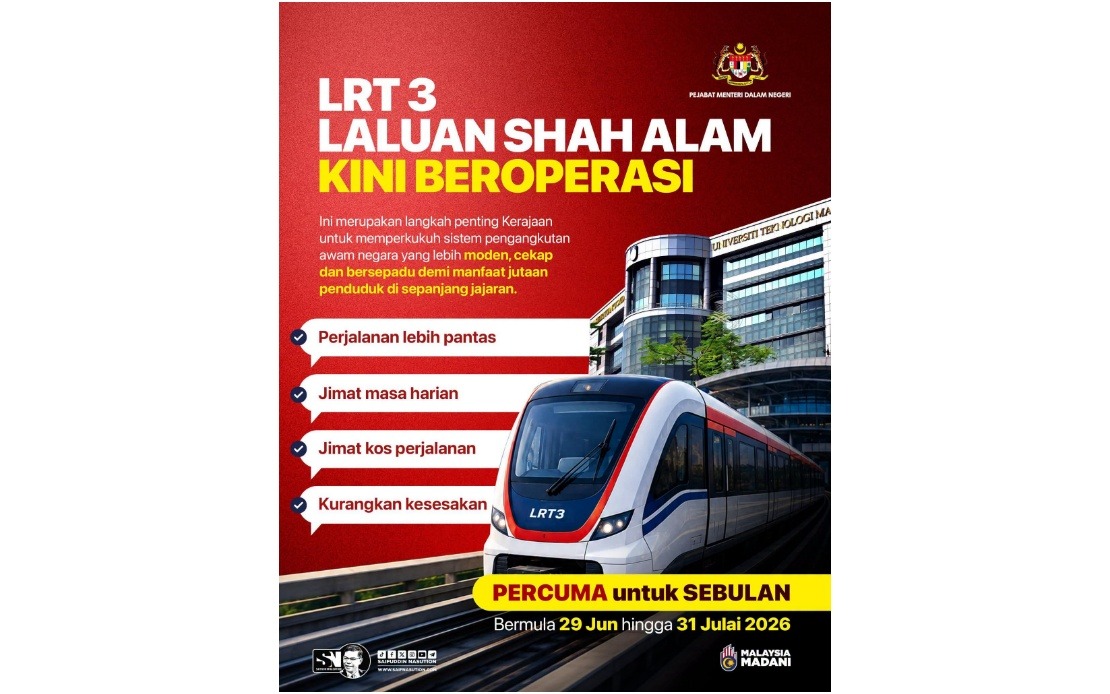
The inauguration of the Shah Alam Line LRT3 represents a significant milestone in Malaysia's efforts to overhaul its public transport architecture, with government officials positioning the project as central to their vision for urban mobility. Home Minister Datuk Seri Saifuddin Nasution Ismail emphasised that the new rail corridor exemplifies the MADANI Government's broader strategy to deliver integrated, contemporary transit solutions that address congestion in one of the country's most congested transport zones.
The Klang Valley has long struggled with traffic gridlock during peak hours, creating bottlenecks that compound journey times and operational costs for millions of daily commuters. By introducing the Shah Alam Line LRT3, authorities aim to establish an alternative transport corridor that channels passenger flows away from increasingly saturated road networks. The line serves Shah Alam, Klang, Subang and surrounding areas that form part of the critical economic spine connecting the federal territories to surrounding municipalities.
Government communications around the project emphasise its multi-faceted benefits beyond mere congestion relief. The new rail service is intended to compress commute durations for workers heading to employment centres, students accessing educational facilities, and residents managing daily personal errands. By shortening journey times, the initiative theoretically improves quality of life while reducing the financial burden of daily transportation on household budgets—a consideration of particular relevance to middle and lower-income earners whose transport expenditure represents a substantial proportion of disposable income.
Prime Minister Datuk Seri Anwar Ibrahim marked the formal commencement of operations with an announcement of complementary travel during an introductory period. From June 29 through July 31, passengers can access the Shah Alam Line LRT3 entirely without charge, a promotional window that extends to Prasarana Malaysia Bhd's feeder bus network servicing the corridor. This zero-fare initiative represents a deliberate strategy to familiarise commuters with the new infrastructure and encourage behavioural shifts toward public transport utilisation.
Saifuddin Nasution's communications strategy employed persuasive framing, entreating residents across the service area to experiment with the rail line while the complementary travel period remains available. His messaging specifically targeted those currently dependent on private vehicles, suggesting that trialling the service might catalyse permanent modal switching. The undertone of his statements reflects an underlying acknowledgment that public transport adoption requires not merely infrastructure availability but sustained behavioural incentivisation and psychological normalisation of non-vehicular commuting patterns.
The free-fare window serves multiple tactical purposes. From a revenue perspective, it allows Prasarana to establish baseline usage patterns and operational metrics that inform subsequent fare-setting and service scheduling. From a public relations angle, it generates goodwill by offering tangible benefits to residents while demonstrating governmental responsiveness to transport accessibility concerns. The arrangement also addresses equity dimensions, ensuring that lower-income populations can experiment with services without bearing upfront financial risk during the familiarisation phase.
Within the Malaysian context, the Shah Alam LRT3 occupies particular significance as part of the Klang Valley's broader transport infrastructure modernisation. The region supports nearly nine million inhabitants whose economic productivity depends substantially on reliable, efficient mobility networks. Previous iterations of the Klang Valley's public transport ecosystem developed incrementally and sometimes disjointedly, resulting in coverage gaps and connectivity challenges that the LRT3 aims to ameliorate through strategic corridor alignment and integrated feeder service provision.
The framing of this project as indicative of MADANI Government commitment carries political weight. Public transport infrastructure represents a tangible, observable manifestation of governmental competence and citizen-centric policymaking. By highlighting projects like LRT3, government messaging emphasises delivery of concrete improvements to everyday lived experience, a rhetorical strategy that seeks to build governmental legitimacy through demonstrable infrastructure outcomes rather than purely ideological appeals.
Regional implications extend beyond immediate Klang Valley impacts. Successful execution and adoption of the Shah Alam LRT3 establishes operational and financial templates for potential transit expansions elsewhere in Malaysia. The project's performance metrics will likely influence future capital allocation decisions for public transport development in secondary urban centres throughout the peninsula and East Malaysia, making this initiative instructive for infrastructure planning across the federation.
Longer-term sustainability of the LRT3 depends substantially on achieving passenger volume targets that justify ongoing operational subsidies and maintenance expenditure. While the zero-fare introductory period generates artificial usage statistics, the genuine test emerges once normal fares commence. The project's ultimate success hinges on whether convenience, journey time savings, and cost benefits prove sufficiently compelling to sustain mode-switching behaviour among commuters accustomed to private vehicle use.
The public health and environmental dimensions of the project warrant acknowledgment. Expanded public transport capacity theoretically reduces vehicular emissions and urban air pollution, delivering external benefits that extend beyond individual commuter convenience to population-level health improvements. The Klang Valley's persistent air quality challenges during haze seasons make such cumulative emission reductions increasingly relevant to environmental management strategies.
Government investment in public transport infrastructure also signals recognition that market mechanisms alone prove insufficient to ensure equitable mobility access across diverse socioeconomic populations. By subsidising or publicly developing transit systems, authorities essentially redistribute resources toward ensuring that transport access becomes less contingent on personal wealth, a principle underpinning the MADANI framework's broader development philosophy.
The Shah Alam LRT3 demonstrates how infrastructure projects function simultaneously as practical interventions and political communication tools. While the rail line addresses genuine transport deficiencies, its prominence in government narratives also reflects sophisticated understanding that visible, tangible improvements to citizen experience constitute powerful mechanisms for building governmental credibility and public confidence. As additional line extensions proceed and utilisation patterns stabilise post-promotional period, the project's lasting impact will depend on whether operational realities match the ambitious expectations embedded in current official rhetoric.

