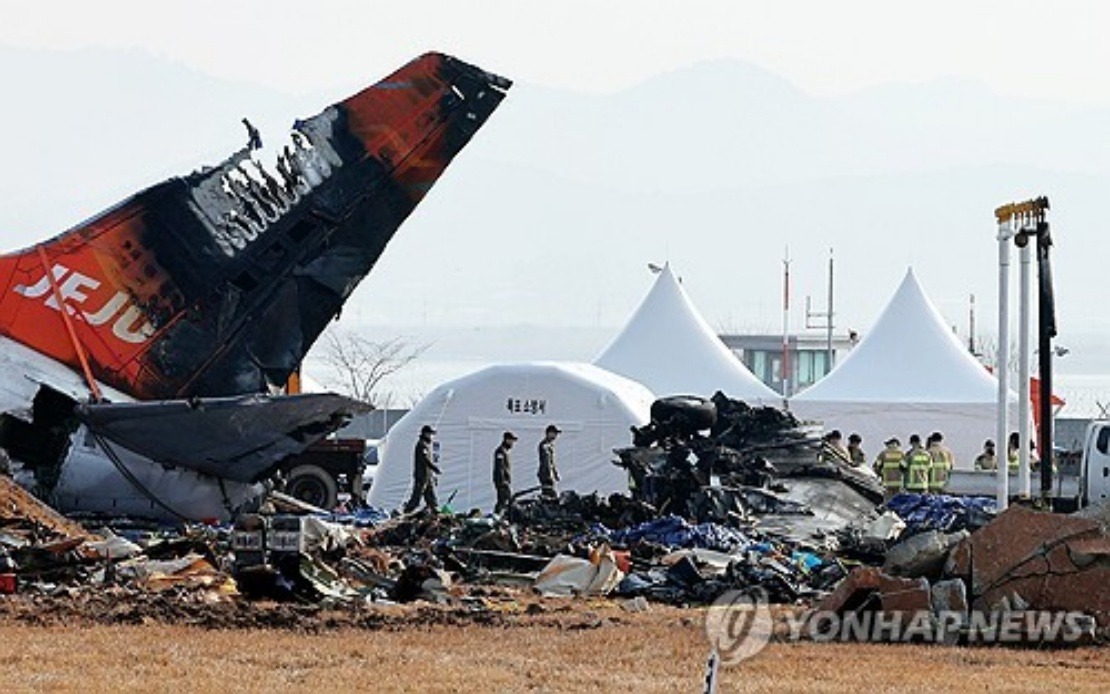
South Korean law enforcement has taken action against seven transport ministry officials suspected of deliberately obscuring critical safety information regarding equipment tied to one of Asia's deadliest aviation disasters in recent years. The Korean National Police referred the officials to prosecutors on Tuesday, accusing them of issuing misleading statements about the operational status of navigational equipment at the centre of a catastrophic airline incident.
On December 29, 2024, Jeju Air Flight 2216 descended toward Muan International Airport, located approximately 290 kilometres south of Seoul, during what began as a routine approach. The Boeing 737-800 encountered severe difficulties, forcing pilots to execute an emergency belly landing on the runway. During the landing sequence, the aircraft collided with a concrete structure designed to house a localiser—a precision navigation system that provides guidance for aircraft during final approach and touchdown. The impact proved catastrophic; 179 people aboard the aircraft perished in the collision, making it one of South Korea's worst aviation accidents in decades.
Investigations following the crash focussed substantial attention on the placement and condition of the localiser installation. The navigation aid, which should have been positioned according to strict international aviation safety standards, was embedded within a concrete mound immediately adjacent to the runway. Specialists and aviation safety experts raised serious questions about whether the structure's proximity to the landing zone—and the circumstances of its installation—contributed materially to the severity of the disaster and the extraordinarily high casualty count.
According to the special police investigation team overseeing the inquiry, the seven officials stand accused of knowingly crafting and distributing official communications that misrepresented the regulatory compliance status of the localiser system. These statements allegedly affirmed that the navigation equipment had been installed in full accordance with applicable aviation regulations, despite the officials' awareness that the installation fell short of required standards in significant ways. This discrepancy between what the authorities publicly stated and what they understood to be true forms the basis of the cover-up allegations.
The regulatory framework governing aviation infrastructure in South Korea, like most nations, establishes precise specifications for the placement, maintenance, and operational certification of navigation systems. These standards exist specifically to prevent accidents and protect lives. When safety-critical equipment fails to meet established criteria, transparent communication about those deficiencies becomes essential, allowing relevant authorities to implement corrective measures or implement alternative safety protocols. The alleged concealment of non-compliance prevented such corrective action and potentially contributed to unsafe operational conditions.
For Malaysian and Southeast Asian observers, this case carries significant implications regarding aviation governance and institutional accountability. The Jeju Air incident represents a high-profile example of how administrative failures and institutional cover-ups can magnify the consequences of technical problems. In a region where aviation traffic continues expanding rapidly, with Malaysia serving as a major air transport hub, the importance of rigorous oversight, transparent safety reporting, and genuine regulatory compliance cannot be overstated. The incident serves as a cautionary reminder that inadequate institutional safeguards and governmental opacity can transform manageable technical issues into mass-casualty disasters.
The referral of these officials suggests that South Korean authorities view the alleged cover-up as sufficiently serious to warrant criminal prosecution, moving beyond administrative discipline or internal departmental consequences. Prosecutors will now examine evidence collected during the police investigation to determine whether charges should be formally filed and whether additional individuals bear responsibility. The legal proceedings will likely illuminate how decisions were made at multiple levels within the transport ministry regarding the equipment's regulatory status and the communication strategy employed in the aftermath of the crash.
The broader investigative context remains significant. Determining responsibility for the crash involves multiple strands: pilot decisions during the emergency, aircraft maintenance and condition, air traffic control communication, and infrastructure safety. The allegations against the ministry officials represent just one component of a comprehensive accident investigation, but they address a dimension that extends beyond technical failure into the realm of institutional integrity and public trust. When government agencies tasked with protecting public safety allegedly prioritize reputation management over transparency, the implications for public confidence in aviation oversight systems prove profound.
Aviation accidents in developed nations typically trigger immediate, transparent investigations with regular public updates on findings. South Korea has demonstrated such commitment in this case, with authorities pursuing officials alleged to have departed from this standard. The criminal referrals indicate that officials' alleged efforts to suppress or misrepresent safety information constituted conduct serious enough to warrant prosecution, suggesting that prosecutors view institutional dishonesty as a separate and consequential failure beyond the technical circumstances that enabled the accident itself. The pathway from investigation to potential conviction will establish important precedent regarding accountability for governmental obstruction of safety information in South Korea and potentially throughout the region.

