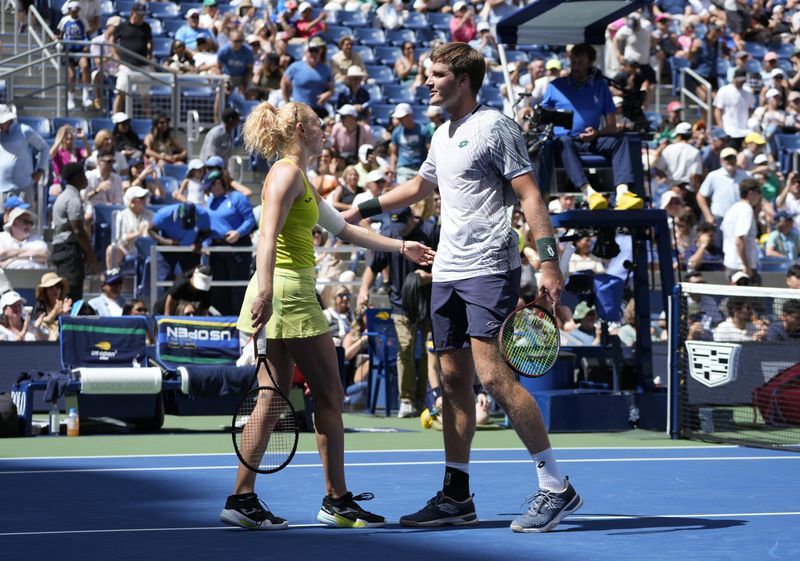
Serena Williams etched her name back into US Open history on Tuesday, executing a commanding performance in mixed doubles alongside 21-year-old Carlos Alcaraz to dispatch New Zealand's Erin Routliffe and Britain's Lloyd Glasspool 5-3, 4-1. The return represented far more than a routine first-round victory; it marked the 23-time Grand Slam champion's first appearance at Arthur Ashe Stadium since her emotional departure from professional tennis over two years ago, drawing a wave of sentiment that energised the entire tournament venue in New York.
The moment Williams stepped onto the court carried profound symbolic weight for American tennis and the broader sporting world. Her 2022 farewell had closed a transformative chapter in the sport, one that fundamentally altered how women's tennis was perceived globally and elevated the commercial trajectory of the entire game. That she elected to compete again, even in a mixed doubles format, suggested unfinished business and a connection to competition that transcended her carefully curated retirement narrative. The crowd's response, described as deafening, reflected the deep emotional investment fans maintained in her career and legacy.
Williams' partnership with Alcaraz appeared improbable on paper yet resonated perfectly in execution, as the pair displayed genuine chemistry and mutual respect despite their two-decade age gap. The world's top-ranked singles player, sidelined since April with injury concerns, seemed reinvigorated playing alongside the American icon. Their court presence generated constant momentum, punctuated by moments of levity that belied the competitive intensity they brought to each point. When Williams unleashed a 193-kilometre-per-hour ace midway through the opening set, the eruption from spectators underscored how thoroughly her presence had recaptured the tournament's emotional centre of gravity.
The mixed doubles format itself has undergone significant recalibration in recent years, repositioned as a showcase event designed to elevate the profile of the discipline beyond its traditional specialist audience. This second year of its revamped configuration deliberately scheduled prominent singles competitors into the draw, deliberately banking on their star power to attract casual fans and generate commercial enthusiasm during the week preceding the main singles competition. The strategy proved remarkably effective, delivering sellout attendance figures and mainstream media penetration that outpaced previous iterations. However, this commercial triumph created internal friction within the doubles community, with seasoned partnership specialists arguing that the format's structural emphasis on singles celebrities effectively marginalised established doubles pairings and diluted the competitive legitimacy of the discipline.
The Williams-Alcaraz advance into the quarter-finals positioned them to face Swiss star Belinda Bencic and Italian Flavio Cobolli later on Tuesday, ensuring continued high-profile matchups throughout the event. This trajectory suggested the tournament organisers' programming strategy had achieved its intended effect, maintaining star-studded encounters that would sustain audience interest and justify the premium positioning of mixed doubles within the broader US Open calendar.
Conversely, the tournament's opening rounds produced a stunning upset when defending top seeds Novak Djokovic and Aryna Sabalenka succumbed to experienced doubles operatives Henry Patten and Katerina Siniakova in straight sets, losing 1-4, 4-2, 10-2 in a decisive tiebreak. Siniakova's precise ace on match point delivered the punctuation mark on an upset that exemplified mixed doubles' inherent unpredictability. Patten's post-match commentary revealed the psychological dimensions underlying their victory: in a format where single lapses of concentration precipitate entire set losses, momentum swings occur with jarring rapidity, and momentum management becomes paramount. The Czechoslovak-British combination's ability to navigate a pivotal tiebreak demonstrated technical mastery and mental fortitude under high-pressure circumstances.
Italy's defending champions, Sara Errani and Andrea Vavassori, encountered their own disappointment when succumbing to the Russian combination of Mirra Andreeva and Andrey Rublev through a thrilling 1-4, 4-1, 11-9 scoreline that required a final-set tiebreak to resolve. This result redistributed the competitive dynamics throughout the draw and opened advancement pathways for other seeded and unseeded combinations, including American pairing Jessica Pegula and Taylor Fritz, who would compete against Norway's Casper Ruud and Russian Diana Shnaider for a spot in the semi-finals.
The mixed doubles draw's continued evolution generated storylines beyond purely competitive metrics. Married couple Gaël Monfils and Elina Svitolina secured their semi-final berth, joining Czech-based partnership Karolina Muchova and Jakub Mensik in the tournament's later stages. These progressions demonstrated that despite the commercial emphasis placed on prominent singles names, the format still rewarded established tactical awareness, court sense, and the familiarity that extended partnerships inevitably cultivated.
For Malaysian and Southeast Asian tennis observers, the Williams-Alcaraz narrative carries particular resonance, underscoring professional longevity and competitive flexibility within elite sport. Williams' comeback challenges conventional retirement narratives and suggests that retirement decisions, even when publicly finalised, remain conditional upon personal evolution and changing circumstances. Alcaraz's participation simultaneously showcased generational transition within tennis, with younger champions respecting and learning from established legends rather than dismissing them as relics of previous eras. The mixed doubles format's success in attracting mainstream attention also indicates evolving audience preferences for partnership-based competition and entertainment, suggesting potential pathways for expanded engagement with tennis beyond traditional singles-dominated programming.
The tournament's early results suggest the US Open's mixed doubles investment will continue attracting competitive interest from the sport's highest-ranked players, validating the format restructuring despite continued scepticism from doubles specialists who maintain concerns about displacement and marginalisation of dedicated doubles practitioners.

