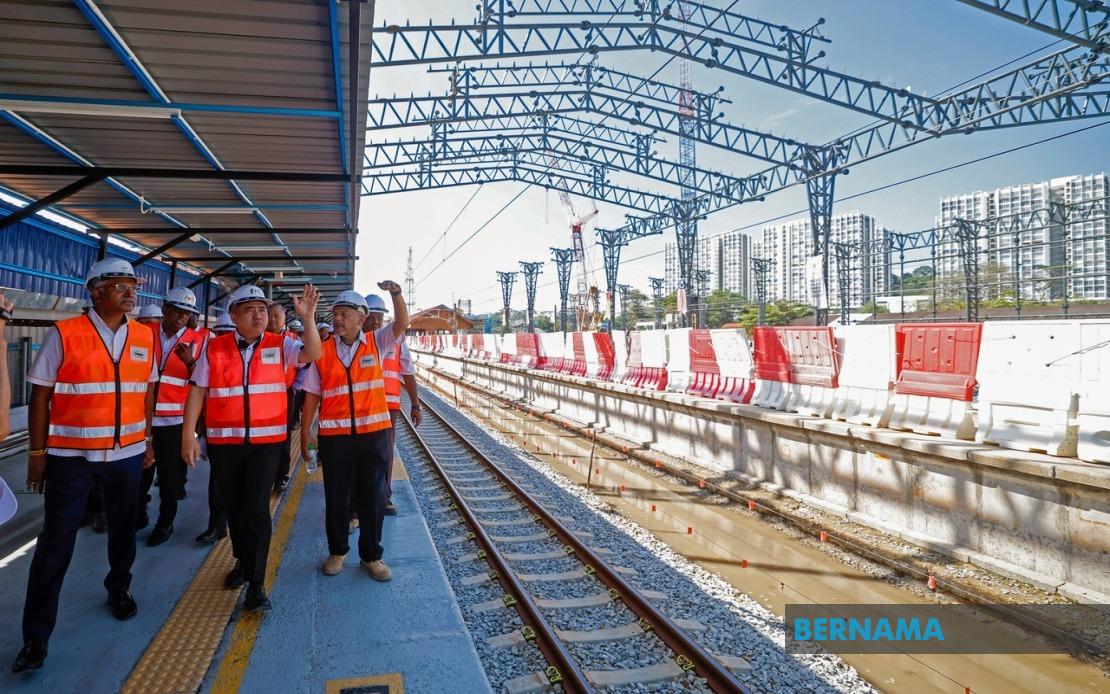
Seremban's ambitious new railway station project has crossed a significant milestone, reaching 35 per cent completion as critical foundation and infrastructure work nears completion. Transport Minister Anthony Loke announced during a site inspection that the facility is on track to open in March 2027, marking a major infrastructure upgrade for the Negeri Sembilan capital. The integrated transport hub represents one of the most substantial development initiatives undertaken in the city, designed to fundamentally reshape how passengers move through Seremban and access regional rail networks.
The foundation phase of construction, which consumed the bulk of the project timeline to date, involved painstaking underground work that proved more time-intensive than initial planning suggested. Loke highlighted that the piling operations required precise positioning and coordination with existing utility networks, necessitating the relocation of cables and underground services throughout the designated site. This preliminary stage, though lengthy, has positioned contractors to substantially accelerate construction momentum as the project transitions into the visible building phases that will define the station's final appearance.
The RM100 million investment reflects the Malaysian government's commitment to modernising transport infrastructure across regional cities beyond the Klang Valley corridor. Upon completion, the new Seremban Sentral station will merge the heritage Seremban KTMB railway station—a structure dating back over a century—with contemporary facilities housed within a modern facility. This integration preserves historical continuity while enabling operational efficiencies impossible within the original colonial-era infrastructure. The fusion approach demonstrates an increasingly sophisticated approach to urban heritage conservation that prioritises functional advancement alongside architectural respect.
Architectural design principles incorporated into the new station reflect both environmental consciousness and cultural sensitivity. The structure incorporates a green building framework alongside Minangkabau-inspired architectural elements, creating a facility that balances sustainability objectives with regional aesthetic identity. These design choices carry symbolic weight beyond mere aesthetics, signalling to residents and visitors that modern infrastructure development in Malaysia can authentically engage with cultural heritage rather than replace it wholesale. Commercial spaces integrated throughout the station will generate ongoing revenue streams supporting operational sustainability.
Capacity planning embedded within the station's architecture reveals sophisticated long-term thinking about Seremban's growth trajectory. The facility will initially accommodate 30,000 passengers daily, representing substantial operational capacity for current demand levels. However, designers incorporated expansion potential allowing the station to eventually serve 120,000 daily passengers, positioning infrastructure investment to support demographic and economic expansion across several decades. This future-proofing approach contrasts with historical patterns where transport facilities quickly become inadequate as cities evolve, requiring expensive retrofitting or abandonment in favour of new construction.
The platform configuration strategy further demonstrates this scalable philosophy. Architects designed the station with six platform positions, with only three being constructed initially. This phased approach allows subsequent platforms to be developed incrementally as passenger volumes and service frequency increases justify the investment. Loke specifically referenced plans to expand Komuter and ETS service frequencies once the broader Seremban rail corridor undergoes the necessary double-track upgrades, creating a virtuous cycle where improved infrastructure attracts more commuters and justifies further investment.
Logistical considerations for urban traffic flow received careful attention in the design process. Two separate entrances—one fronting Jalan Tunku Antah and another positioned at the station's rear—combined with dedicated drop-off zones, aim to distribute vehicular traffic and prevent the transportation facility from becoming a congestion catalyst. This dual-access approach reflects lessons learned from congested transport hubs throughout the region where inadequate circulation design transforms connections into bottlenecks. By spreading entry and exit points, planners endeavour to maintain surrounding neighbourhood traffic flow even during peak passenger volumes.
The renovation of the original Seremban KTMB Station, completed in recent months, undertook essential modernisation of the heritage building's technical systems. Electrical infrastructure received comprehensive upgrades bringing the century-old facility into contemporary safety and reliability standards. Simultaneously, authorities implemented a critical flood mitigation programme that addresses historical operational disruptions. A new sewerage system will divert rainwater directly into Sungai Temiang, preventing the situation where heavy rainfall previously inundated platforms and tracks. This drainage innovation protects valuable transport infrastructure while demonstrating integrated problem-solving that addresses both modernisation and environmental challenges.
The Seremban Sentral project forms part of a broader regional transport modernisation programme stretching across central Peninsular Malaysia. The Klang Valley Double Track Phase 2 upgrade project, encompassing infrastructure supporting rail services into Seremban, has reached 55.8 per cent completion. Current afternoon Komuter service frequency reductions represent a temporary trade-off accepting reduced schedules to accelerate construction timelines. This sequencing strategy, while temporarily inconveniencing commuters, reflects a strategic calculus that compression of construction periods minimises overall disruption and accelerates attainment of planned service improvements.
The transit-oriented development initiative anchored by Seremban Sentral represents evolving metropolitan planning philosophy emphasising integration of transportation and residential development. The TOD Seremban Sentral mega project planned behind the station exemplifies Singapore and international best-practice approaches where rail hubs catalyse dense, mixed-use urban precincts. Such concentrations support environmental sustainability through reduced transportation distances while generating economic value through property appreciation and business concentration around high-accessibility nodes. For Seremban, the model offers potential to establish the city as a more vibrant urban centre within Negeri Sembilan's hierarchy.
From a national transport policy perspective, the Seremban project addresses longstanding concerns about regional cities' dependence on automobile transportation and inadequate intercity connectivity. As Minister and Seremban Member of Parliament, Loke positioned the station as contributing to his constituency's transformation, potentially attracting residents and businesses through improved accessibility. The anticipated capacity to serve 120,000 passengers daily ultimately aims to shift transport patterns, encouraging commuting from outer districts and potentially enabling commercial activities previously concentrated in the Klang Valley to establish operations in more accessible regional locations.
The March 2027 completion target carries significant political and operational implications for Malaysia's transport sector. Successful delivery on schedule would demonstrate procurement and project management maturity in complex infrastructure undertakings, building confidence for subsequent major rail investments. Conversely, delays or budget overruns could reinforce public scepticism about government infrastructure project delivery—a persistent concern affecting support for major transport initiatives. For Seremban residents and businesses, the new station represents a tangible investment in their city's future connectivity and economic positioning within the broader Peninsular transport network.

