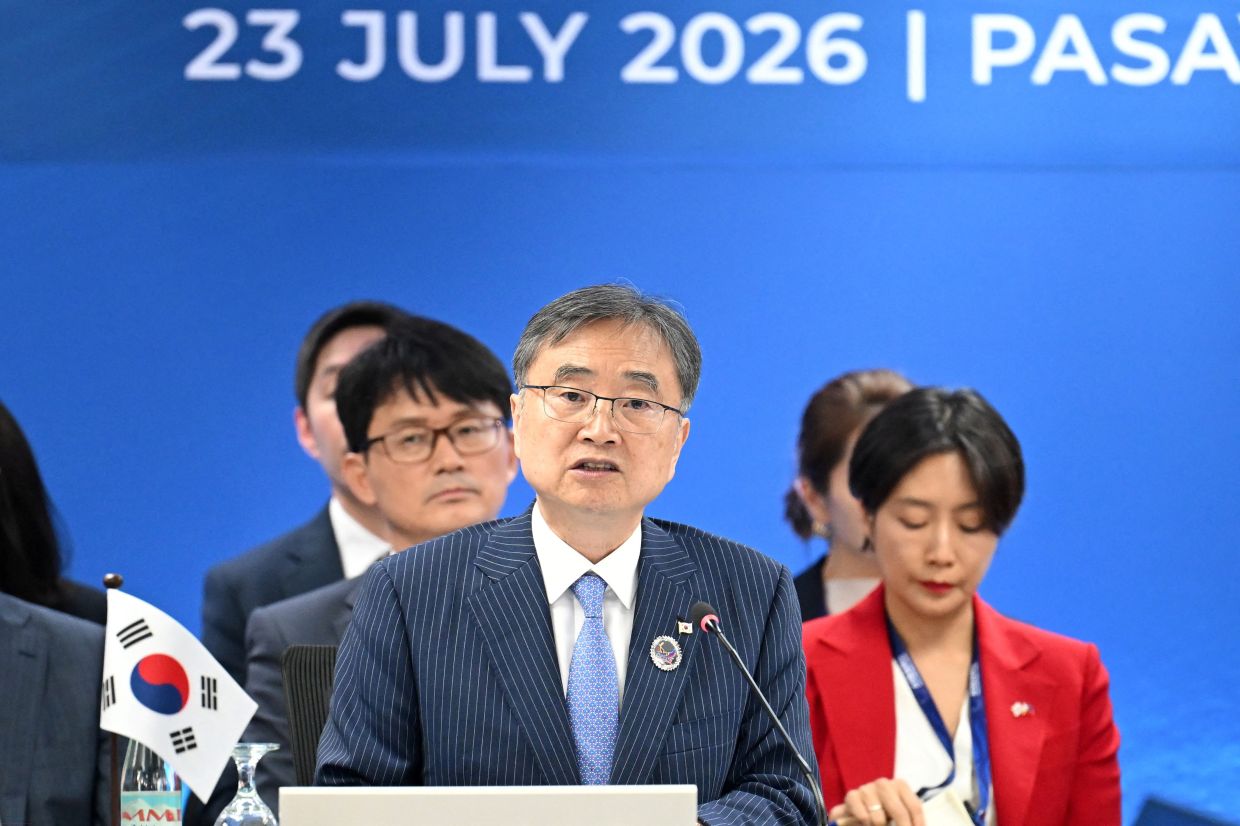
A rare public disagreement between two of South Korea's most senior policymakers has laid bare the internal tensions within President Lee Jae Myung's government as it pursues a controversial shift toward engagement with North Korea. The clash between Foreign Minister Cho Hyun and Unification Minister Chung Dong-young, who presented competing visions for dealing with Pyongyang during a high-level meeting this week, reveals the fragility of Seoul's current diplomatic approach at a moment when the administration is pushing hardest to revive frozen inter-Korean contact.
The rupture became public when Cho, speaking to journalists, characterised Chung's sweeping proposals for renewed dialogue as too idealistic and lacking the support of other government agencies. Chung's vision included reviving four-party talks bringing together North and South Korea, the United States, and China—an ambitious agenda that has repeatedly foundered in the past. Rather than accepting Cho's criticism quietly, Chung responded defiantly the following day, arguing that idealism was precisely what was needed to break through the impasse and reshape reality on the peninsula. The unusually pointed exchange suggests deeper philosophical divisions between the two ministries that extend far beyond tactical disagreements.
This bureaucratic discord comes at a particularly delicate moment for Seoul. The Lee administration has fundamentally reoriented its North Korea policy away from the "denuclearisation-first" framework that dominated the previous conservative government's approach, instead embracing what officials describe as a "peace-first" strategy. The administration has also been actively lobbying United States President Donald Trump to arrange a summit meeting with North Korean leader Kim Jong Un, hoping that a high-level diplomatic breakthrough might unlock negotiations that have been frozen since the collapse of denuclearisation talks in 2019. Against this backdrop of renewed diplomatic initiative, the public disagreement between Cho and Chung sends a troubling signal about the coherence and resolve of Seoul's negotiating position.
When pressed by reporters on Friday about the contrasting statements, both ministries issued carefully worded responses pledging continued policy coordination while declining to elaborate further. The Presidential Blue House similarly avoided immediate comment, allowing the silence to speak volumes about official embarrassment regarding the public disagreement. Yet analysts warn that such internal discord cannot be easily concealed from an adversary as sophisticated and observant as Pyongyang, which routinely monitors South Korean political divisions as indicators of Seoul's commitment and reliability in any future agreement.
Lim Eul-chul, a North Korea specialist at Kyungnam University, has pointed out that the visible rift "exposed internal differences and weakening policy momentum surrounding North Korea policy," potentially undermining the entire diplomatic effort. More troublingly, Lim suggests that North Korea is likely to interpret the disagreement as evidence that any meaningful settlement reached with Seoul could easily be reversed or abandoned by a future South Korean administration. This pattern of perception has deep historical roots, rooted in how agreements have indeed shifted dramatically with changes in South Korean presidencies, making Pyongyang fundamentally skeptical about the durability of any commitment made by Seoul.
The broader context for this ministerial clash reflects how dramatically inter-Korean relations have deteriorated over recent years. Since the COVID-19 pandemic, Pyongyang has taken an increasingly hard line, with Kim Jong Un announcing in 2024 that North Korea would abandon its decades-long pursuit of reunification and systematically dismantling joint economic projects previously developed with Seoul on North Korean territory. Dialogue channels have contracted to near-total silence, and the North's tightened border security has dramatically reduced the flow of defectors—only 63 North Koreans successfully crossed into the South during the first half of 2026, a catastrophic decline from the 1,047 who made the journey in 2019.
Despite this hostile environment, the Lee administration has unilaterally adopted conciliatory measures designed to signal peaceful intent. Seoul has suspended anti-North Korean loudspeaker broadcasts that had been a staple of previous administrations' psychological pressure tactics, removed other measures deemed potentially provocative, and sought to create space for dialogue. Yet Pyongyang has largely ignored these overtures, viewing them as weakness rather than as genuine shifts in South Korean strategy. The asymmetry between Seoul's efforts and Pyongyang's calculated indifference has created a frustrating dynamic where engagement appears to proceed in only one direction.
The Lee administration's pivot toward engagement has come at considerable cost to human rights advocacy efforts on the peninsula. Critics, particularly conservative groups accustomed to support from previous administrations, argue that Seoul has subordinated concerns about North Korean human rights abuses to the imperative of maintaining engagement. While South Korea formally co-sponsored a United Nations resolution on North Korean human rights last year, observers note that the government has quietly downgraded related initiatives, suspending certain human rights reporting and restricting broadcasts intended to reach North Korean audiences. These constraints have had immediate material consequences for advocacy organizations; Kim Tae-Hoon, former president of the nonprofit PSCORE which focuses on North Korean human rights issues, noted that policy changes have dried up donor funding, describing the situation as "very, very difficult."
The philosophical divide between Cho and Chung reflects broader tensions within South Korean society and the governing establishment regarding how best to approach North Korea. One camp believes that sustained engagement and confidence-building measures, even if initially rebuffed, create the foundation for eventual dialogue. The other maintains that such measures require demonstrable reciprocation and that idealistic gestures risk being interpreted as capitulation by a regime that respects only strength. These competing worldviews have animated South Korean politics for decades, yet the public airing of such disagreement at ministerial level is unusual and signals genuine conviction rather than performative debate.
For regional observers, particularly policymakers in Japan and the Southeast Asian nations, the ministerial discord underscores the fundamental unpredictability of Seoul's North Korea strategy. If the South Korean government cannot maintain internal consensus on such a critical policy, how can neighbouring countries or the United States confidently coordinate multilateral responses to North Korean provocations or diplomatic initiatives? The incident also illustrates how domestic political divisions in Seoul continue to constrain its ability to project unified diplomatic messaging, a weakness that adversaries like Pyongyang have historically exploited to divide South Korea from its allies.
The coming weeks will reveal whether the Lee administration can consolidate its policy messaging or whether further public disagreements will erode the credibility of its engagement strategy. Both the Foreign Ministry and Unification Ministry face pressure to maintain harmony while advancing their institutional perspectives, a balance that becomes increasingly difficult when core policy disagreements reflect genuine philosophical divides rather than mere administrative turf disputes. Unless resolved quietly but firmly, these internal fractures risk becoming self-fulfilling prophecies, with Pyongyang watching closely to determine whether Seoul's engagement strategy will prove durable or susceptible to reversal.

