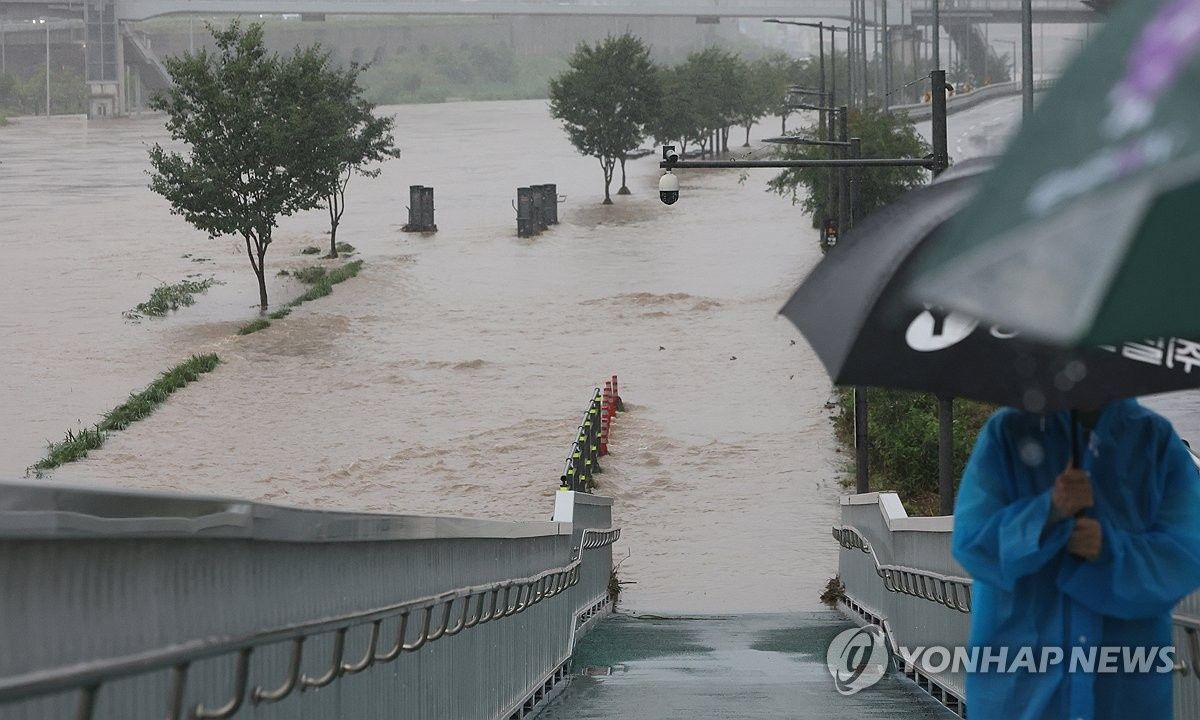
South Korea's capital region and eastern Gangwon province experienced severe flooding overnight after intense rainfall swept across the densely populated areas, with officials reporting approximately 540 cases of property damage by Saturday morning. The deluge, which commenced after midnight and persisted until mid-morning, deposited substantial quantities of water across multiple municipalities, prompting an emergency response from disaster management authorities and forcing the temporary relocation of vulnerable residents from affected communities.
Rainfall measurements recorded across the Seoul metropolitan area and Gangwon province revealed the intensity of the weather system. Paju registered 192.5 millimetres, Dongducheon documented 189.5 millimetres, Pocheon experienced 179 millimetres, while Gimpo and Cheorwon recorded 166.5 millimetres and 159.5 millimetres respectively during the critical overnight period. These figures, compiled by the Central Disaster and Safety Countermeasure Headquarters, represented significant precipitation that overwhelmed drainage infrastructure in urban and semi-rural locations, contributing to the widespread flooding that affected transportation networks and residential properties.
The impact on infrastructure and public access proved substantial. Ten national parks, including the popular Mount Bukhan destination, were shuttered to prevent visitor injuries during hazardous conditions, whilst 275 designated hiking trails were also closed to the public. Additionally, authorities suspended seven ferry services operating along the western coastal regions, disrupting transportation for residents and commuters who typically rely on these water-based routes. As of late Saturday morning, heavy rain alerts remained active across ten administrative divisions within Gangwon Province, whilst Pocheon faced an elevated mudslide warning due to soil saturation and terrain vulnerability.
The reported damage revealed a significant but manageable emergency situation. Authorities documented 148 distinct incidents involving flooded residential dwellings and inundated roadways, whilst an additional 392 cases involved fallen trees and scattered debris obstructing thoroughfares and properties. The combination of water accumulation and wind damage created multiple operational challenges for emergency response teams working to clear affected areas and restore basic services. Despite the scale of property destruction, disaster management officials emphasized that no deaths or serious injuries occurred during the overnight emergency, reflecting both the preparedness of local authorities and fortunate timing of the weather system.
Precautionary evacuation measures proved necessary in several municipalities. Ninety-five individuals representing forty-four separate households across six cities received temporary shelter and relocation assistance as a preventive measure against potential secondary flooding or landslide risks. These evacuations, whilst disruptive, remained relatively limited in scope given the extent of water-related damage reported throughout the affected regions. Local administrators coordinated with regional governments to provide essential services and accommodation for displaced residents whilst cleanup and restoration efforts commenced across affected communities.
Weather forecasters projected continued deterioration of conditions through Sunday, with meteorological projections indicating that some areas might experience rainfall intensity reaching 300 millimetres per hour during peak storm activity. This forecast prompted regional authorities to reinforce preparation efforts and position equipment strategically in anticipation of potential secondary flooding. The projection of sustained heavy precipitation across multiple days created concerns about cumulative water accumulation and soil saturation levels, particularly in regions already experiencing Saturday's deluge.
Prime Minister Han Seong-sook initiated an emergency response coordination meeting, during which she directed relevant governmental agencies to mobilize equipment and personnel resources to minimize continuing disruptions in affected communities. The prime minister acknowledged the fortunate absence of casualties whilst expressing sympathy for residents suffering property losses and residential displacement. Her statements reflected the dual responsibility of acknowledging both the severity of the emergency and the successful mitigation of loss of life through preparedness protocols and responsive crisis management.
Subsequent warnings from government officials specifically highlighted the elevated risk of landslides in central Chungcheong Province and northeastern Gangwon Province, where forecast models predicted substantial rainfall during the evening hours through early Sunday. The prime minister explicitly requested that disaster management officials prepare contingency measures addressing potential landslide scenarios, recognizing that waterlogged hillsides and sloping terrain in these regions presented secondary hazard risks beyond simple flooding. This forward-looking directive reflected established protocols for managing complex weather emergencies requiring multi-hazard response capabilities.
For Malaysian and Southeast Asian observers, the South Korean experience demonstrates both the vulnerability of densely urbanized regions to intensive precipitation events and the operational frameworks that minimize casualties through coordinated disaster response. As climate patterns shift regionally and extreme weather events increase in frequency, the mechanisms employed by Seoul's authorities—rapid alert systems, pre-positioned emergency resources, coordinated evacuation protocols, and inter-agency communication networks—represent applicable models for comparable metropolitan areas throughout Asia contending with intensifying monsoon systems and unpredictable rainfall patterns that challenge traditional infrastructure design specifications.

