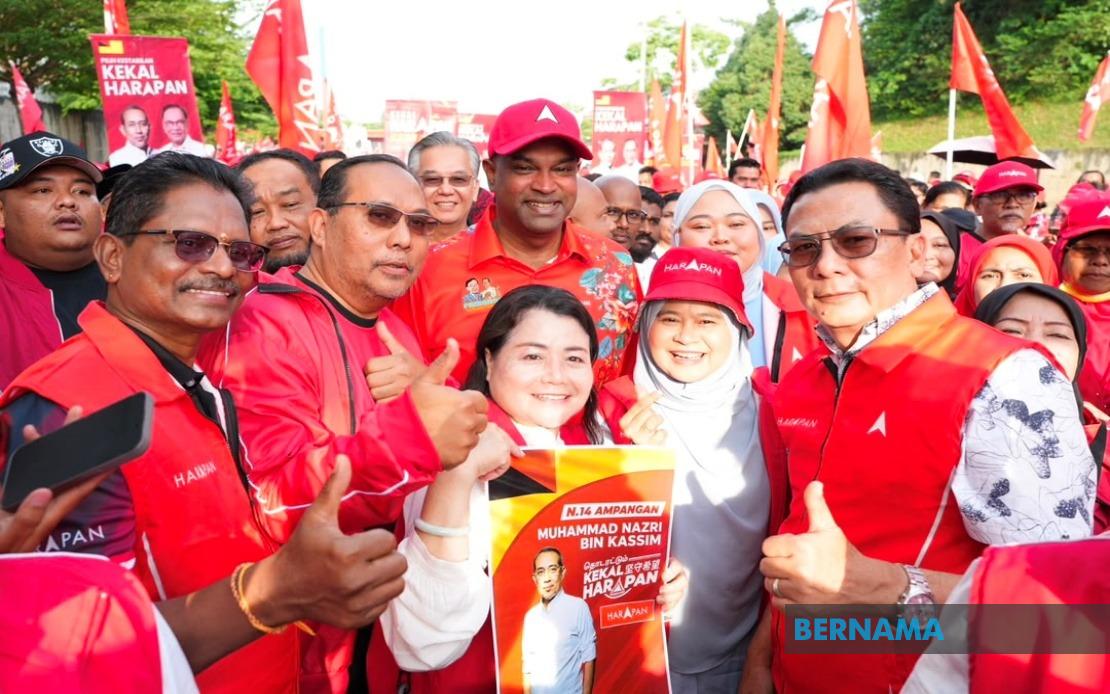
Senior Pakatan Harapan figures assembled at Seremban's nomination centre this week to throw their weight behind six coalition candidates vying for seats in the forthcoming Negeri Sembilan state election, signalling the opposition alliance's determination to consolidate its position in the central Malaysian state. The show of strength came as PKR vice-president and Sungai Buloh MP Datuk Seri R. Ramanan joined DAP deputy secretary-general Steven Sim and other party heavyweights in publicly endorsing candidates nominated across the state's key electoral battlegrounds.
The six individuals receiving the senior leadership's backing represent a cross-section of PH's component parties and demographic appeal. They include Nor Azman Mohamad for Sikamat, Datuk Muhammad Nazri Kassim contesting Ampangan, Zarinna Abu Zarin in Lenggeng, Chew Seh Yong vying for Lobak, J. Arul Kumar running in Nilai, and Ho Weng Wah seeking the Temiang seat. The geographical spread of these candidacies underscores PH's strategy to contest multiple constituencies across the state rather than concentrating resources in traditional strongholds.
Ramanan's presence at the Wisma MBS nomination centre carried particular symbolic weight, as the PKR vice-president represents the larger party within the PH coalition and holds considerable sway among the base. His statement emphasised the robust mobilisation of party machinery and grassroots supporters, framing the visible turnout not merely as logistical competence but as a reflection of genuine electoral enthusiasm. The projection of organisational strength at nomination venues often signals to observers the relative health and momentum of political movements heading into formal campaigning periods.
The coalition's unified front reflects ongoing efforts to maintain cohesion within Pakatan Harapan following periods of internal friction and electoral setbacks in other states. Negeri Sembilan, where PH currently holds considerable sway, represents an important testing ground for the alliance's ability to retain power and demonstrate to voters that it remains a viable governing alternative. The central state occupies a distinctive position within Malaysian electoral geography, serving as a bellwether for broader political trends affecting more marginal constituencies nationally.
Ramanan articulated the coalition's campaign philosophy in his remarks, emphasising continuous community engagement and relentless grassroots work throughout the formal campaign period. His statement conveyed the message that PH's electoral strategy rests on sustained people-to-people contact rather than reliance on media machinery alone. This approach acknowledges the reality that local elections in Malaysia are frequently decided by constituency-level dynamics and the relationships between candidates and voters rather than national narratives alone.
The official campaign timeline for the 16th Negeri Sembilan state election commenced immediately following the completion of nomination procedures, establishing a compressed but intensive period for candidates to canvas support. The Election Commission's scheduling provided relatively limited time for formal campaigning before early voting commenced and polling day arrived, a compressed calendar that typically advantages incumbent parties possessing established campaign infrastructure and voter databases. The two-week window between nomination and election day demands rapid activation of party machinery and strategic deployment of resources.
Negeri Sembilan's 36-seat state assembly represents a mid-sized legislature within Malaysia's state parliament system, with electoral contests typically decided by pluralities rather than overwhelming majorities in most constituencies. The state's demographic composition—including significant urban populations in Seremban and Nilai alongside rural and semi-rural constituencies—requires political coalitions to construct broad electoral coalitions spanning diverse voter interests. Pakatan Harapan's candidacy selections for this election reflect calculations about which individuals can appeal across these varied constituencies.
The Election Commission's earlier dissolution of the state assembly on June 5 set in motion the formal processes culminating in the nomination and campaign phases. This timing placed the election cycle during Malaysia's mid-year period, a scheduling choice with implications for voter turnout and campaign momentum. The provision for early voting on July 28, ahead of the August 1 general polling day, enabled shift workers and others with scheduling constraints to participate, potentially altering the demographic composition of the electorate compared to single-day voting scenarios.
For Pakatan Harapan, success in Negeri Sembilan carries implications extending beyond the immediate state administration. Maintaining control of the state assembly preserves the coalition's claim to electability and effectiveness in governance, narratives essential for opposition credibility in national political discourse. Conversely, losses in traditional PH strongholds would provide ammunition to rival coalitions questioning the opposition alliance's ability to deliver on campaign promises and manage state affairs competently. The election thus functioned as a barometer of PH's standing among Malaysian voters more broadly.
The mobilisation of senior party figures at nomination centres represented a calculated investment in generating media coverage and demonstrating to party cadres that leadership remained committed to the electoral contest ahead. Such symbolic gestures, while superficially routine, carry psychological significance for party workers evaluating leadership priorities and commitment. Ramanan's physical presence communicated to PKR members and coalition partners that the Negeri Sembilan election warranted serious organisational and strategic attention rather than being treated as a secondary priority.
Looking forward, the compressed campaign period demanded that PH candidates leverage nomination day momentum to build electoral organisations capable of sustained voter contact through August 1. The presence of senior leaders at nomination ceremonies provided candidates with associations linking them to broader coalition narratives while offering implicit endorsements to local electorates. Such positioning becomes particularly valuable in states where personality-driven politics and local relationships frequently outweigh national party considerations in determining electoral outcomes.

