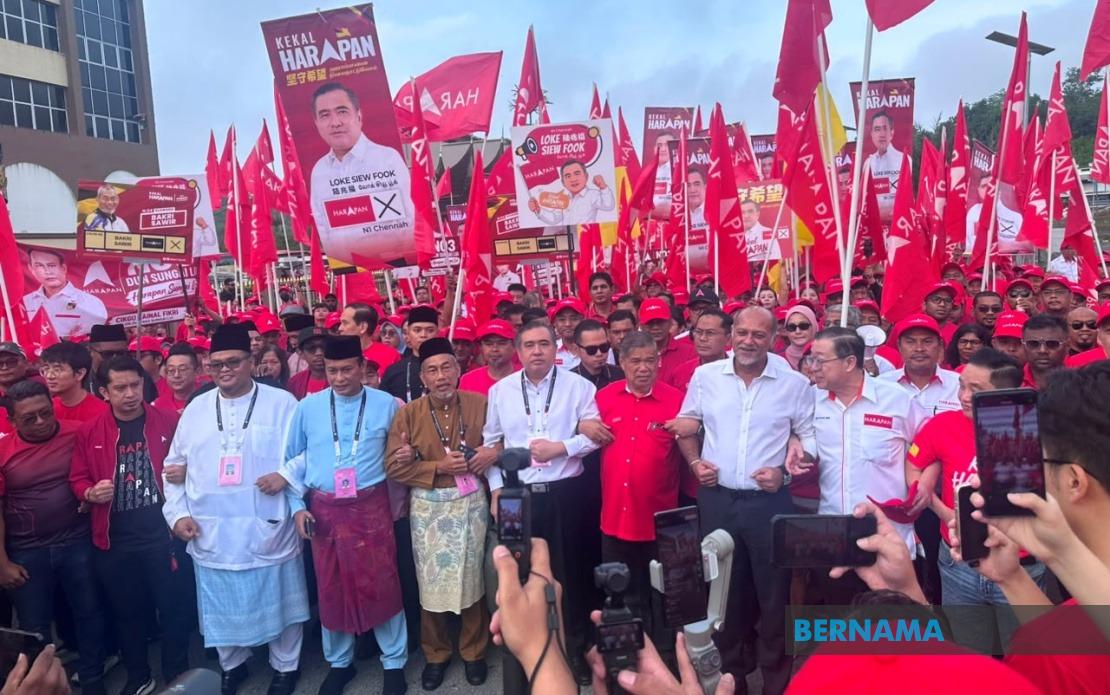
The Pakatan Harapan coalition demonstrated its organizational muscle on nomination day across Negeri Sembilan, deploying senior party figures to support candidates filing their papers for the state election scheduled for August 1. The high-profile turnout reflected the coalition's determination to retain the legislative advantage it secured in the 2023 election, when it captured 17 of the state assembly's 36 seats.
In what appeared to be a carefully choreographed show of unity, Transport Minister Anthony Loke of the DAP personally submitted his nomination papers for the Chennah seat in Jelebu constituency. His appearance at the Dewan Besar Kuala Klawang nomination centre came surrounded by heavyweight party colleagues, including DAP chairman Gobind Singh Deo and influential adviser Lim Guan Eng, signals of the party's confidence in retaining this position. Amanah president Datuk Seri Mohamad Sabu's presence underscored the multi-party nature of PH's challenge in defending its 2023 gains.
The coordination extended to Jempol district, where Communications Minister Datuk Seri Fahmi Fadzil orchestrated the nomination submissions of four candidates across separate constituencies. His presence at the nomination centre highlighted the PH leadership's hands-on approach to this critical state election. Among those filing papers was incumbent Teo Kok Seong, seeking to retain the Bahau seat he has held since the 14th General Election. Newly emerging candidates Yaacob Mahmood, Muhammad Zahin Zinal Abidin and Manivanan Gowin represented the coalition's effort to inject fresh talent into its electoral machinery.
Negeri Sembilan Menteri Besar Datuk Seri Aminuddin Harun, operating as both the state's chief executive and PH's chairman in the state, positioned himself at the Port Dickson nomination centre while filing papers for the Linggi seat. His entourage revealed the cross-party architecture of Pakatan Harapan, with DAP deputy secretary-general Hannah Yeoh, PKR secretary-general Datuk Dr Fuziah Salleh and Prime Minister Anwar Ibrahim's political secretary Datuk Farhan Fauzi all present. This constellation of federal and state figures underscored how seriously the national coalition leadership regards defending its foothold in this central state.
The nomination day choreography included three incumbent representatives who would be defending their seats: Yew Boon Lye in Chuah, Choo Ken Hwa in Lukut and Dr G Rajassekaran in Sri Tanjung. Their presence alongside senior coalition figures signalled PH's intention to consolidate rather than retreat, a strategic posture essential for a coalition that made significant inroads in Negeri Sembilan just two years ago but faces a fragmented opposition that demands disciplined performance.
Entrepreneur and Cooperatives Development Minister Steven Sim coordinated a six-candidate showing at the Wisma Majlis Bandaraya Seremban nomination centre, a demonstration that illustrated how PH's cabinet-level representation has extended into state-level campaigning. The attendance of Selangor State Legislative Assembly Speaker Lau Weng San, Bukit Gelugor MP Ramkarpal Singh and PKR vice-president Datuk Seri R. Ramanan highlighted the interstate cooperation that characterizes modern Malaysian electoral politics, where successful states like Selangor lend operational expertise and political credibility to coalition efforts elsewhere.
The Negeri Sembilan election unfolds against a specific historical context. The state assembly was dissolved on June 5 following constitutional consent from Yang Dipertuan Besar Tuanku Muhriz Tuanku Munawir, setting the stage for this mid-term contest. The 2023 result that gave PH its 17-seat plurality remains the immediate reference point, though the subsequent political environment has shifted considerably. With Barisan Nasional holding 14 seats and Perikatan Nasional five, the mathematical reality suggests a fragmented legislature where PH's plurality represents genuine advantage but not domination.
The staggered polling process reflects standard electoral commission procedures, with early voting scheduled for July 28 and main polling on August 1. This timeline compresses the campaign period into a concentrated window where ground organization and leadership visibility become particularly consequential. The prominent appearance of federal ministers and national party officers on nomination day served partly as a morale-boosting exercise for candidates and party machinery, but equally as a signal to voters about the national coalition's stake in this particular contest.
For Negeri Sembilan voters, this election represents an opportunity to either consolidate the Pakatan Harapan experiment that began in 2023 or signal dissatisfaction with the coalition's performance. The presence of cabinet ministers on nomination day suggested confidence that PH has delivered sufficiently on state-level commitments to justify voter re-endorsement. However, the deployment of senior figures also reflected awareness that no electoral outcome is predetermined; PH's unity was on display precisely because maintaining the 2023 majority requires active mobilization rather than passive reliance on previous support.
The nomination day proceedings revealed how Malaysian political coalitions operate in practice. Rather than functioning as monolithic structures, PH's constituent parties—DAP, PKR and Amanah—maintained distinct candidate slates and organizational hierarchies while coordinating around shared objectives. The overlapping attendance of party figures from different coalition members at multiple nomination centres illustrated both the coordination essential to coalition success and the distinct party brands that members must maintain to justify their separate organizational existence to their respective support bases.

