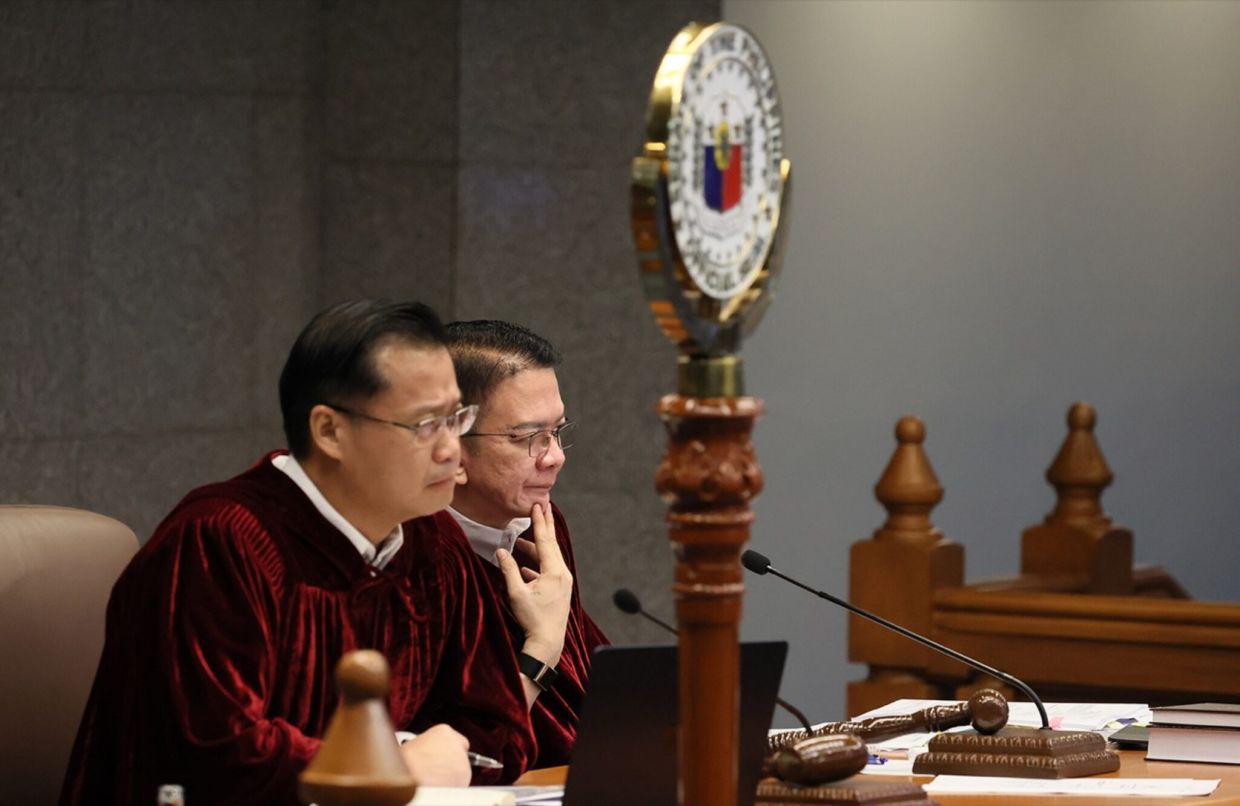
The Philippine Senate impeachment court faces a pivotal procedural decision this week that could reshape the trajectory of Vice President Sara Duterte's trial. House prosecutors have expressed strong confidence that senators will approve their request to subpoena Duterte's financial documents, framing the Monday afternoon vote as fundamentally about whether the court can access information necessary to adjudicate claims of unexplained wealth and breach of public trust.
The impeachment case against Duterte rests partly on allegations under Article II that she accumulated assets disproportionate to her lawful income while serving as a public official. Prosecutors contend that without access to her bank accounts, tax records, and reports filed with the Anti-Money Laundering Council, they cannot present comprehensive evidence to support these charges. The proposed subpoena would also compel disclosure of financial documents belonging to her husband, lawyer Manases Carpio, which the prosecution views as integral to establishing patterns of suspicious financial activity.
Benjamin Tolosa Jr., the House prosecutors' spokesperson, drew historical parallels to strengthen their case, invoking the 2012 impeachment trial of former Chief Justice Renato Corona as precedent. In that landmark case, the Senate ordered production of bank records despite constitutional protections surrounding financial privacy, establishing that impeachment proceedings constitute a recognized exception to bank secrecy legislation. Tolosa emphasized that Republic Act No. 1405, the foundational bank secrecy law, explicitly carved out impeachment as a context where confidentiality protections do not apply, suggesting the legal framework already contemplates such disclosure.
Prosecutor Chel Diokno articulated the substantive case for the subpoena with precision during oral arguments last Wednesday. He argued that the Senate, functioning as an impeachment court, derives constitutional authority to compel disclosure of confidential records and need not defer to other statutes protecting financial privacy. Diokno presented evidence that Duterte's financial transactions exceeded 3 billion Philippine pesos between 2007 and 2013, a figure sourced from Anti-Money Laundering Council reports already accessible to the House. He contended that financial records spanning Duterte's tenure as Davao City mayor and vice mayor remain relevant because the impeachment complaint alleges she accumulated unexplained wealth throughout her public service career.
The defense mounted a sophisticated counter-argument that transcended simple objections to disclosure. Michael Poa, Duterte's lead counsel, reframed the dispute as fundamentally about constitutional due process protections and whether the prosecution's timing and scope satisfy procedural fairness. Poa characterized the subpoena request as an impermissible fishing expedition, contending that prosecutors sought financial evidence only after impeachment complaints had already been filed, suggesting an intent to construct evidence rather than corroborate existing allegations. He further objected to the temporal breadth of the request, noting that records dating back nearly two decades would include periods when Duterte held positions not subject to impeachment under constitutional provisions limiting removal to elected national officials.
A critical juncture in the defense strategy involved invoking recent Supreme Court jurisprudence. Poa cited a 2025 Supreme Court ruling in Duterte v. House of Representatives establishing that impeachable offenses must have occurred while the accused occupied an impeachable office. This principle, if accepted, would substantially narrow the evidentiary scope prosecutors could legitimately pursue. The defense also distinguished between the bank secrecy law's impeachment exception and other confidentiality regimes. While acknowledging that banking confidentiality yields in impeachment contexts, Poa argued that the Anti-Money Laundering Act and National Internal Revenue Code contain no comparable exceptions, requiring the Senate to respect confidentiality of AMLC reports and tax records even in impeachment proceedings.
Additionally, the defense objected to including Carpio's financial records on the technical ground that he is not himself an impeachable official. This argument raises interesting questions about the constitutional scope of impeachment discovery—whether the court may compel disclosure of records belonging to family members or associates when investigating an official's conduct. The prosecution presumably views such records as probative of wealth accumulation patterns, while the defense views them as legally irrelevant to determining Duterte's individual culpability.
Civil society organizations have mobilized to influence the Senate's decision, viewing the vote as a test of institutional integrity. The August Twenty-One Movement invoked the infamous "second envelope" episode during former President Joseph Estrada's 2001 impeachment trial, when the Senate voted against opening a sealed envelope containing potentially incriminating evidence. That decision sparked public outrage that ultimately contributed to Estrada's downfall, creating a cautionary historical narrative about the political consequences of withholding material evidence. The organization argued that senator-judges should approve the subpoena to avoid repeating history and signal that accountability mechanisms function properly.
The Kingdom Keepers coalition, a faith-based advocacy group, adopted a complementary rhetorical strategy by emphasizing public officials' accountability for financial conduct. Their framing inverted the burden of proof, suggesting that if Duterte is innocent of accumulating ill-gotten wealth, she should embrace transparency rather than invoke privacy protections. This approach reflects broader debate about whether confidentiality rights should shield public officials from financial scrutiny when misconduct allegations arise. The coalition's argument essentially treats financial transparency as an affirmative obligation of public service, a principle with significant implications for governance across Southeast Asia.
For Malaysian and Southeast Asian observers, this impeachment proceeding illuminates fundamental tensions between institutional accountability and individual privacy rights in democratic systems. The vote's outcome will likely influence how other regional democracies balance transparency in high-level corruption investigations against constitutional protections for financial confidentiality. The precedent set here may reverberate through similar impeachment or accountability proceedings in neighboring jurisdictions where wealth accumulation allegations figure prominently.
The scope of Duterte's impeachment trial has expanded substantially beyond initial parameters. She now faces four distinct articles accusing her of misusing confidential funds, accumulating unexplained wealth, and threatening President Ferdinand Marcos, first lady Liza Araneta-Marcos, and former Speaker Martin Romualdez. The potential consequences are severe—conviction would result in removal from office and permanent disqualification from holding any public position, fundamentally altering Philippine political dynamics. The trial has already consumed considerable legislative time as the Senate functions simultaneously as impeachment court, diverting attention from other legislative priorities.
Prosecutors have telegraphed their next evidentiary phase, indicating that National Bureau of Investigation Director Melvin Matibag will testify Tuesday regarding the agency's investigation into Duterte's alleged threats against national officials. The NBI apparently determined that these remarks were not spontaneous utterances but reflected a deliberate plan, a characterization that prosecutors view as supporting Article III allegations. This testimony is expected to provide documentary evidence and investigative findings regarding the communications that triggered impeachment proceedings.
As the Senate prepares for Monday's vote, the decision will likely prove determinative of whether the prosecution can mount a comprehensive case built on documentary evidence or must proceed substantially on witness testimony and circumstantial inference. The vote's outcome will also signal how Philippine institutions navigate the perennial tension between democratic accountability and constitutional protections, a balance with implications extending well beyond this individual case to the broader institutional architecture of presidential responsibility in the Philippines.

