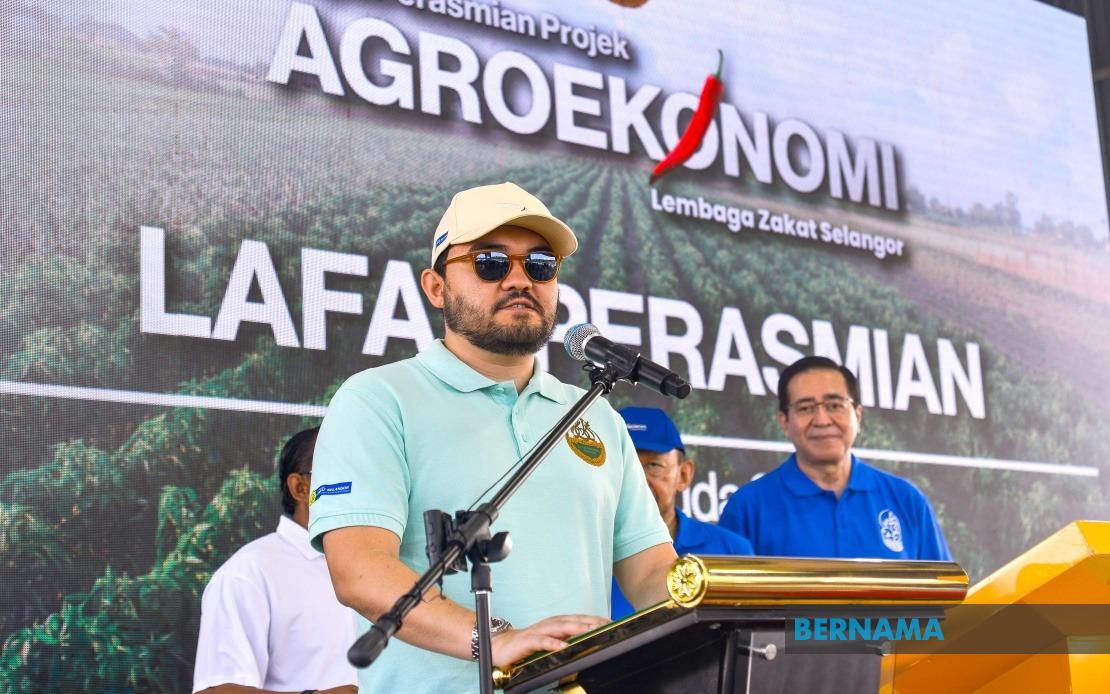
The Selangor Zakat Board has shifted its approach to poverty alleviation by moving beyond temporary cash assistance toward creating permanent, self-sustaining income streams through agriculture. On July 1, the Raja Muda of Selangor, Tengku Amir Shah Sultan Sharafuddin Idris Shah, formally inaugurated the Agroeconomic Project, a RM26 million investment spanning 110 acres at Laman Agro Ehsan in Bukit Beruntung. The initiative represents a significant departure from conventional welfare models, positioning agricultural entrepreneurship as a pathway out of poverty for vulnerable Malaysian communities.
The project's physical footprint encompasses 76 acres dedicated entirely to agricultural production and development activities. At its heart lies a specialized chilli cultivation programme utilizing advanced fertigation technology—an irrigation method that delivers nutrients directly to plants through water systems. This technical sophistication distinguishes the initiative from traditional subsistence farming, equipping participants with modern agricultural practices that can sustain commercial-scale production. The remaining acreage supports administrative operations, training facilities, and ancillary services required to maintain the comprehensive support structure.
Forty-eight asnaf participants have been carefully selected to participate in an intensive three-year development programme. The screening process involved collaboration with the Kuala Langat Area Farmers' Organisation, ensuring that candidates possessed the physical capacity, motivation, and aptitude for agricultural work. Each participant receives a dedicated 0.5-acre cultivation plot containing 2,000 chilli plant bags, collectively representing 96,000 planting units per production cycle across the entire project. This standardized approach allows for consistent monitoring, knowledge transfer, and troubleshooting across all operations.
The financial projections are substantial. Project administrators estimate that participants could achieve monthly incomes reaching RM4,000 once their crops mature and production stabilizes. This income ceiling assumes successful crop management and consistent market access—factors that will depend heavily on market conditions, pest management, and the durability of supply chain relationships. For context, this represents approximately double Malaysia's current statutory minimum wage of RM1,500 monthly, offering genuine economic advancement for households previously dependent on zakat assistance.
Beyond land access and technical support, the Selangor Zakat Board has removed accommodation as a barrier to participation. All participants receive housing in the Prima Beruntung residential area, with rental costs fully subsidized throughout the three-year programme period. This comprehensive support model recognizes that relocation to an agricultural zone requires financial capacity many asnaf households lack. By providing housing, the board eliminates competing financial pressures and allows participants to channel all income toward household needs and reinvestment in their agricultural operations.
The training component represents the programme's intellectual foundation. Participants receive structured instruction in crop management, pest control, soil health optimization, and post-harvest handling. Hands-on mentorship accompanies this classroom learning, with extension officers providing field-based guidance as participants navigate their first planting cycles. This graduated support structure—moving from intensive supervision toward participant autonomy—reflects an understanding that technical knowledge alone insufficient without practical experience and confidence-building.
Financing the project required substantial coordination across Malaysia's Islamic finance ecosystem. The Selangor Zakat Board mobilized RM2.07 million in wakalah contributions from three strategic partners: the Pilgrims Fund Board, RHB Islamic Bank Berhad, and Cagamas Berhad. These partnerships demonstrate how Islamic financial institutions can align commercial operations with social welfare objectives. The wakalah structure—where donors delegate fund management to trustees—provides a Shariah-compliant mechanism for channeling private resources toward poverty reduction.
Participant testimonies reveal the programme's human dimension. Norfhadilah Mohd Shafiin, a 45-year-old mother of five, emphasized how the initiative addresses not merely income deficiency but psychological empowerment. Her observation that the programme "equips us with knowledge and experience to manage our own crops and build confidence to become self-reliant" indicates that sustainable poverty reduction involves dignity restoration alongside financial improvement. Similarly, Raimi Rusydi Rodi, a father of two, highlighted the value of peer learning within the cohort structure, suggesting that community formation among participants enhances resilience and knowledge retention.
The initiative carries broader implications for Islamic social finance in Malaysia. Zakat represents one of Islam's five pillars, generating substantial annual revenue in Selangor and other states. Historically, distribution has concentrated on direct cash transfers to eligible recipients. The Agroeconomic Project demonstrates an alternative model: using zakat corpus to create productive assets that generate ongoing returns, eventually enabling participants to graduate from welfare dependency. This approach maximizes zakat's developmental impact while respecting traditional distribution principles.
Successful implementation will require sustained attention to market dynamics. Chilli cultivation in Malaysia faces competition from imports and price volatility. The project's viability depends on securing reliable off-take agreements with agricultural processors, food manufacturers, or retail distributors. Without guaranteed market access, participants risk producing excellent crops without profitable sales channels. Project administrators must establish supply chain relationships before the first substantial harvest reaches maturity.
The programme also highlights emerging trends in Malaysia's approach to inclusive economic development. Rather than viewing poverty and asnaf status as permanent conditions requiring endless assistance, the Selangor model treats poverty as a temporary circumstance remediable through skills transfer, asset allocation, and market integration. This perspective aligns with international best practices in social protection, moving from charity toward capability building.
For other Malaysian states and Islamic organizations, the Selangor Agroeconomic Project offers a replicable template. Similar initiatives could adapt this model to local agricultural contexts—palm oil smallholding support in Johor, aquaculture projects in Terengganu, or livestock development in Pahang. The framework's success depends not on chilli cultivation specifically but on matching available land, zakat resources, and participant demographics to viable agricultural enterprises.
As the project matures over its three-year cycle, outcomes data will illuminate whether this investment model effectively lifts participants above poverty thresholds and sustains their economic progress beyond programme completion. The initiatives's architects and funders will need to track income trajectories, asset accumulation, household consumption patterns, and psychological indicators of empowerment. Such rigorous evaluation will determine whether the RM26 million investment represents a transformative intervention or an ambitious but ultimately insufficient approach to Malaysia's persistent poverty challenges.

