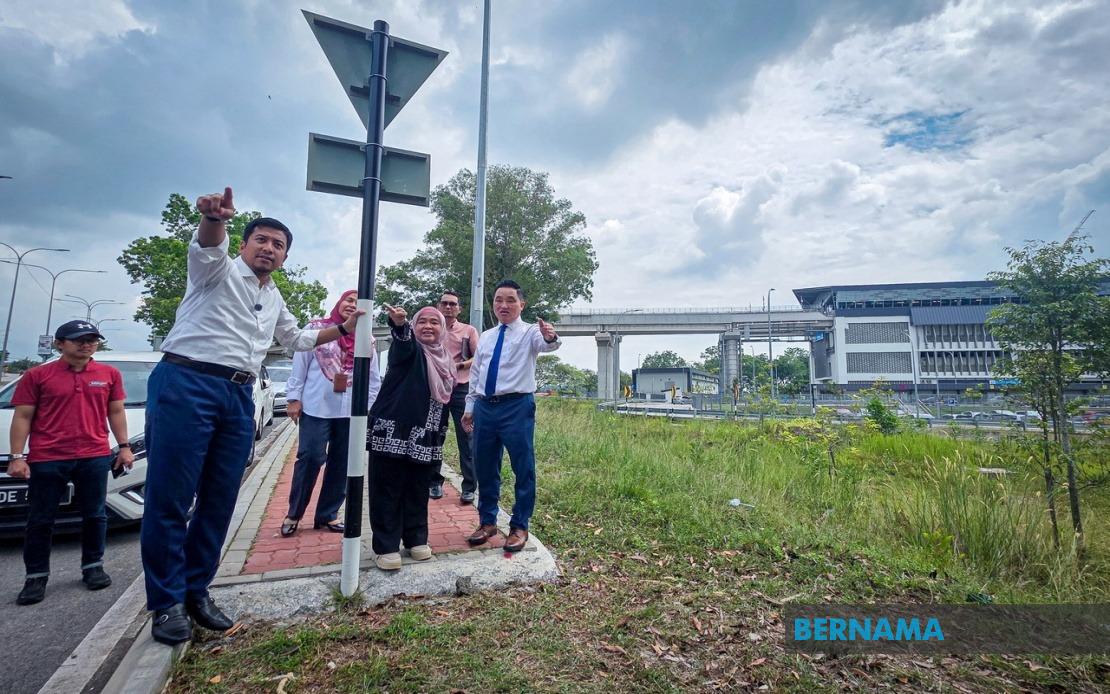
The Selangor State Government has committed to expediting the completion of connectivity infrastructure at stations along the Shah Alam Line LRT3 to create a safer and more accessible environment for commuters. State Local Government and Tourism Exco Datuk Ng Suee Lim announced the initiative following a site inspection of public access facilities, signalling the government's willingness to address long-standing concerns about incomplete amenities at key transit points in the state capital.
Datuk Ng identified two stations requiring immediate remedial action: Dato' Menteri Station and Shah Alam Stadium Station. At Dato' Menteri Station, connectivity challenges centred on essential infrastructure including pedestrian walkways and zebra crossings. The Exco member disclosed that permit-related delays had hindered progress at this location but stressed that Prasarana, the public transport operator, had received explicit instructions to rectify these gaps within a two-month window. This timeline reflects administrative pressure to resolve bureaucratic bottlenecks that have slowed construction and installation work.
Shah Alam Stadium Station presents a more complex situation, as its connectivity shortfalls are intertwined with private development activity in the surrounding area. The resolution of amenities at this station depends partly on a tender process managed by neighbouring developers, introducing variables beyond direct government control. Despite these complications, Datuk Ng assured stakeholders that the state government would maintain vigilant oversight to accelerate timely completion. He acknowledged that no infrastructure project emerges flawlessly from its initial phase, and that identifying deficiencies during operational testing is a natural part of the implementation cycle. The government's approach centres on taking ownership of these issues and compelling responsible parties to address them promptly.
The Shah Alam City Council (MBSA) will assume an enhanced monitoring role in tracking progress on all connectivity improvements. Recognising that coordination across multiple agencies and private entities is essential for success, Datuk Ng announced that regular meetings with relevant developers and stakeholders would be convened to expedite the resolution process. This collaborative framework aims to eliminate delays stemming from siloed decision-making and to ensure that commuters gain access to properly finished facilities without prolonged waiting periods.
Beyond the two priority stations, the state government has directed all Local Authorities (PBT) operating stations within their jurisdictions to undertake comprehensive reviews identifying connectivity shortcomings. This district-by-district approach expands the scope of remediation beyond isolated problem areas to a system-wide assessment. The Royal Klang City Council (MBDK) and other relevant councils have been instructed to leverage their grassroots networks, enlisting council members and state assemblymen to gather feedback from commuters and identify additional gaps requiring attention.
Datuk Ng's acknowledgement that weaknesses exist represents a candid recognition of implementation challenges, a posture that contrasts with defensive communications sometimes offered by government officials. By framing these shortcomings as part of an operational learning curve rather than systemic failures, he positioned the government as proactive and solutions-oriented. The commitment to "drastic steps" suggests a willingness to deviate from standard procedures where necessary to accelerate outcomes.
For Malaysian commuters reliant on public transport, the LRT3 represents a crucial component of the Klang Valley's expanding rapid transit network. Infrastructure deficiencies—whether missing pedestrian crossings or incomplete walkways—undermine the appeal of rail transport and create safety risks, potentially driving commuters back to private vehicles and exacerbating traffic congestion. The Selangor government's focus on these "last-mile" connectivity issues reflects an understanding that seamless multimodal journeys depend not only on reliable train services but also on accessible, well-designed access infrastructure.
The two-month deadline established for Dato' Menteri Station will serve as a benchmark for government delivery and operational efficiency. Meeting this target requires coordination between multiple agencies, securing necessary permits, and mobilising construction resources—tasks that have historically proven challenging in Malaysian public administration. The success or failure of this specific commitment will likely influence public confidence in the state government's broader transport infrastructure agenda.
The involvement of Exco Youth, Sports and Entrepreneurship Mohd Najwan Halimi in the inspection visit underscores the multi-dimensional importance of transit infrastructure to community development and public health. Accessible transport networks facilitate youth mobility, support economic activity, and contribute to liveable urban environments—concerns that extend beyond transport specialists into broader governance portfolios.
For developers working on adjacent projects at these stations, the government's heightened scrutiny creates both obligations and clarity regarding expectations. The stated commitment to ongoing coordination meetings signals that delays or incomplete work will trigger escalating administrative pressure. This dynamic may incentivise faster progress and higher quality standards, though it also introduces regulatory uncertainty that some private actors may find challenging.
The Selangor initiative reflects broader conversations across Southeast Asia about the alignment between transport infrastructure investment and last-mile connectivity. Cities across the region have discovered that expensive rail networks underperform when access infrastructure remains incomplete or inadequate. By prioritising these finishing touches, Selangor positions itself as responsive to commuter experience and capable of learning from early-stage operational feedback—qualities increasingly expected of modern public administrations managing complex infrastructure systems.

