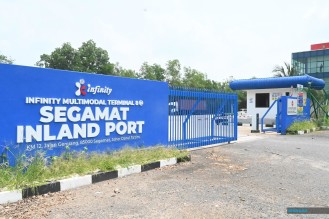
Segamat Inland Port (SIP) is charting an ambitious course for 2026, aiming to process more than 6,000 twenty-foot equivalent units (TEUs) of containers before the year concludes. The facility, which was reactivated on June 25 following more than a decade of dormancy, is now being positioned as a cornerstone of Malaysia's evolving logistics infrastructure and a practical alternative to truck-dependent supply chains.
The port's first full month of operations—running through July—already demonstrated promising early traction, with approximately 1,000 TEUs of containerised and bulk cargo passing through its gates. Samuel Ho, the facility's manager, attributed this early success to renewed focus on the Road to Rail initiative, a government-backed programme aimed at shifting freight movement from congested highways to rail corridors. Operating under Infinity Logistics & Transport, SIP now serves an industrial corridor spanning northern Johor, southern Pahang, southern Negeri Sembilan, and Melaka—a strategically important region for manufacturing and commerce.
The revival of SIP represents far more than a simple infrastructure relaunch; it reflects a fundamental rethink of how Malaysia's logistics sector can operate more efficiently and safely. Ho emphasised that rail transport presents significant advantages over traditional trucking, particularly regarding accident prevention and fuel efficiency. A single freight train journey, he noted, displaces the need for approximately 80 container trucks on Malaysian roads, a calculation that carries substantial implications for both safety and environmental sustainability. This efficiency ratio underscores why government initiatives are increasingly prioritising modal shift away from trucking.
The facility's resurgence has been enabled by critical infrastructure improvements that were not available during its original operational period. When SIP first opened in 1997, the rail network operated on single-track configurations, which severely constrained its practical utility. Under such constraints, freight services had to defer to passenger trains, making scheduling unpredictable and limiting cargo throughput to approximately one shipment per week. This fundamental limitation rendered the facility uncompetitive against truck-based alternatives, ultimately leading to its years of underutilisation.
The completion of the double-tracking project extending to Johor has fundamentally altered this calculus. Ho explained that SIP can now accommodate up to four cargo movements weekly, a fourfold improvement that directly enhances the facility's commercial viability. This expanded scheduling flexibility opens pathways for regular connections with major container ports including Port Klang, Port of Tanjung Pelepas, and Johor Port in Pasir Gudang, effectively integrating the inland facility into Malaysia's broader port ecosystem. Such connectivity transforms SIP from an isolated curiosity into a genuine logistics node.
The broader economic implications for northern Johor are substantial. Ho articulated a vision of SIP functioning as a catalyst for investment and industrial development in districts such as Batu Pahat and Kluang, areas that historically lack the direct port access available to coastal regions. By offering reliable rail-based cargo access to major ports, SIP can make industrial real estate in these districts more attractive to manufacturing and logistics companies seeking to reduce their transportation costs and carbon footprints. The facility is already operating across 20.23 hectares in its initial phase, with plans for two additional expansion phases that will substantially increase capacity and employment opportunities.
Job creation represents a tangible benefit already materialising on the ground. The current operational phase has generated over 200 positions for local residents, with expectations that completion of all three phases will multiply this figure considerably. These positions span security, logistics operations, administrative functions, and specialised cargo-handling roles, providing pathways into formal employment for communities in areas where job opportunities have historically been limited. Transport Minister Anthony Loke Siew Fook, who officiated the facility's formal reopening, specifically highlighted employment generation as a key benefit of the initiative.
The logistics benefits extend beyond individual job creation to encompass systemic improvements in national infrastructure performance. SIP's operations are projected to remove approximately 18,000 lorry movements—including trailers and container trucks—from Malaysian roads each month once the facility reaches maturity. This reduction carries cascading benefits: decreased road congestion, improved safety outcomes through fewer heavy vehicles navigating increasingly crowded highways, and optimised utilisation of rail infrastructure that has historically operated below capacity. For a nation grappling with urban congestion and mounting logistics costs, such a modal shift offers meaningful relief.
Management has also recognised the importance of knowledge transfer and institutional development alongside commercial operations. Partnerships with Universiti Tun Hussein Onn Malaysia (UTHM) will provide fieldwork exposure and facilitate academic research into rail-based inland port operations. These collaborations serve multiple functions: they build local expertise in a specialised logistics domain, create research opportunities for students and faculty, and strengthen the intellectual foundation for future port development projects elsewhere in Malaysia.
The facility's three-phase development strategy indicates confidence in the long-term viability of rail-based inland logistics in the Malaysian context. Phase one, currently operational, represents a foundation upon which subsequent expansions will build. Ho's stated ambition—transforming SIP into a primary gateway for rail-based cargo movement—reflects an understanding that this facility operates within a broader transition toward more sustainable and efficient transport modes. For northern Johor specifically, this transition offers an opportunity to position the region as a competitive alternative to congested ports, potentially attracting manufacturing investment from companies seeking to reduce supply chain vulnerabilities and operating costs.
The government's emphasis on SIP's role in strengthening the national logistics network reflects broader policy recognition that Malaysia's port infrastructure, while extensive, requires geographical distribution to serve inland industrial concentrations effectively. By channelling containerised cargo through SIP rather than forcing all traffic through coastal ports, the system can reduce bottlenecks and distribute economic benefits more evenly across regions. For Malaysian manufacturers, logistics operators, and regional supply chain managers, this diversification of inland options represents a meaningful competitive advantage.

