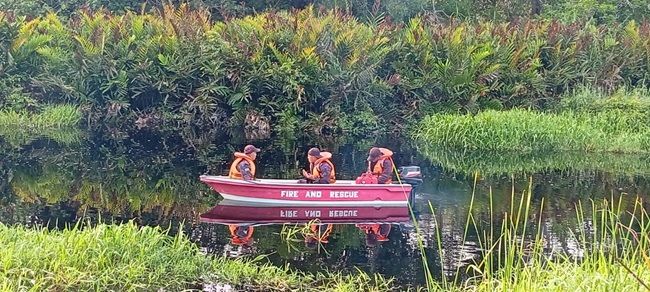
The hunt for a man feared to have been killed in a crocodile attack in Brunei has stretched into its third day, with rescue personnel continuing systematic efforts across Kampong Baru Sungai Bera despite finding no evidence of the missing fisherman. The incident, which unfolded on Wednesday when authorities received a distress call, has mobilised an interagency response involving multiple branches of the government, underscoring both the seriousness of the situation and the logistical complexity of conducting river rescue operations in crocodile-infested waters.
The Fire and Rescue Department coordinated the initial response, dispatching two fire engines and nine personnel led by Acting Station Officer Mohd Zulkifli Md Tahir to the scene. Upon arrival, discussions with the victim's family confirmed that the individual had been engaged in fishing along the river when the alleged attack occurred. This detail proved crucial in shaping the search strategy, as it established a specific location and timeframe for the incident, allowing rescue teams to concentrate their efforts around known fishing spots and areas where crocodiles typically congregate.
The operational scope has expanded considerably since the first hours of the incident. The FRD established a dedicated Tactical Command Post to coordinate activities across multiple search methodologies. River patrols utilising FRD boats remain the primary search tool, with personnel systematically covering the waterway in both directions from the initial incident site. Simultaneously, teams have been conducting searches along the riverbanks, examining areas where a victim might have managed to escape or where remains might have been deposited by tidal or current movements in the river system.
Technological assets have become integral to the rescue operation. The FRD has deployed its fleet of drones to provide aerial surveillance capabilities, allowing search coordinators to monitor broader stretches of the river and identify areas of interest that ground teams can then investigate more thoroughly. This aerial reconnaissance advantage proves particularly valuable in dense vegetation zones adjacent to the river, where manual searching would be time-consuming and potentially dangerous for personnel working in crocodile habitat.
Inter-agency coordination has been essential to the operation's effectiveness. Beyond the FRD's core involvement, the Royal Brunei Police Force has committed significant resources, including officers from Seria Police Station and specialised personnel from the Royal Brunei Police Force Marine Police division, known locally as POLMAR. The Wildlife Division has also contributed expertise, presumably to assist in understanding crocodile behaviour patterns and habitat preferences that might inform where search teams should concentrate their efforts. This collaborative approach reflects Brunei's systematic response to wildlife emergencies.
Senior Superintendent Amirul Hadi Junaidi, serving as Commanding Officer of the Operations Branch, has assumed leadership of the coordinated search effort. His appointment indicates the authorities' recognition of the incident's gravity and the need for experienced command oversight in managing a complex, multi-agency operation. The command structure ensures clear decision-making authority and streamlined communication among the various participating agencies.
The specificity of the incident—a crocodile attack on a fisherman—carries particular significance for Southeast Asian communities where both fishing and crocodile encounters represent recurring realities. Crocodiles inhabit numerous waterways throughout Brunei and the broader region, and incidents involving them, while statistically uncommon, capture public attention given the dramatic and consequential nature of such attacks. The fact that this individual was engaged in legitimate fishing activity when the incident occurred underscores the inherent risks that local fishermen and riverside residents face when accessing these ecosystems.
The extended search operation reflects the challenges inherent in locating individuals in river environments, particularly when predators may be involved. Unlike terrestrial search operations where ground visibility and evidence preservation prove more straightforward, river searches require navigating water currents, extensive vegetation, and the possibility that a victim may have been carried substantial distances from the initial incident location. The involvement of the Wildlife Division suggests that searchers are factoring crocodile behaviour into their operational planning, recognising that these apex predators do not necessarily abandon a site or remain in predictable patterns after an attack.
The absence of early signs or recovery remains notable as the operation extends beyond the initial critical window. In such situations, search teams typically anticipate finding evidence within the first 24 to 48 hours if recovery will be successful. The continued operation despite the passage of time reflects either persistent hope for a positive outcome or, more pragmatically, the need to provide closure and establish facts for official records and the victim's family. The thoroughness of the search effort—combining water-based patrols, aerial surveillance, and ground searches—demonstrates the authorities' commitment to resolving the matter comprehensively.

