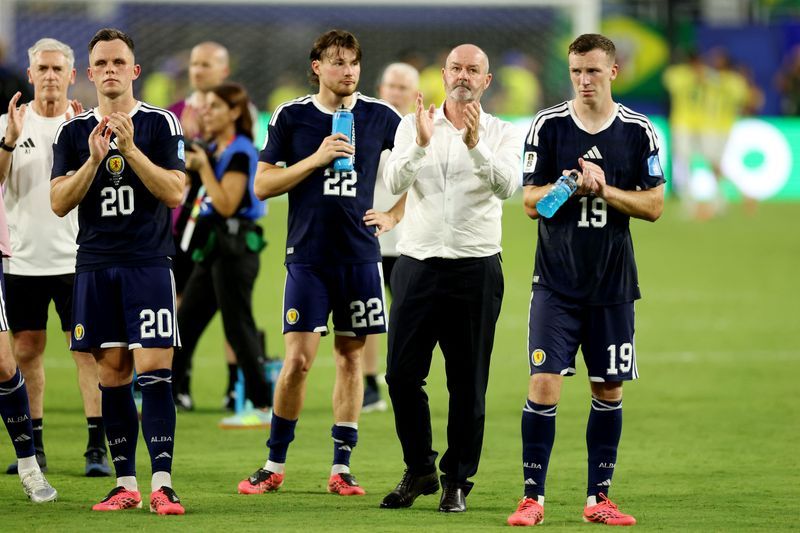
Scotland's long-awaited return to the World Cup appears destined for a premature exit after coach Steve Clarke conceded defeat in the wake of a 3-0 loss to Brazil in Miami on Wednesday, marking the end of their first tournament appearance in 28 years. The Scottish team, managed by the former Chelsea defender, had harboured hopes of reaching the knockout stages but Clarke's post-match assessment suggested the dream would end in disappointment, with the players themselves culpable for their capitulation against one of football's elite nations.
Though Scotland remain mathematically alive in the tournament with three points accumulated, Clarke's pessimistic outlook reflects the reality of their predicament. The Scots currently occupy the sixth-best position among eight third-placed teams vying for a knockout spot, a precarious position that requires other results to fall in their favour dramatically. With 20 group matches still to be contested across the competition's remaining stages, Clarke's expectation that at least two teams will leapfrog Scotland's tally suggests he views their elimination as inevitable rather than merely probable.
The coach's primary criticism centred on his team's defensive vulnerability and lapse in concentration, particularly in transition play. Clarke pointed to specific moments where Scotland gifted Brazil opportunities that the five-time World Cup champions exploited with ruthless efficiency. The first two goals he attributed directly to Scottish errors, while the third also resulted from defensive negligence rather than clinical Brazilian brilliance. This self-destruction in crucial moments against an opponent of Brazil's calibre proved the decisive factor in determining the match outcome.
Despite the severity of the defeat, Clarke acknowledged that goalkeeper Angus Gunn prevented the scoreline from reaching even more humiliating proportions, with the shot-stopper making several important saves throughout the encounter. Scotland also created limited opportunities of their own, though none materialised into genuine threats, further illustrating the gulf in execution between the two sides. The performance lacked the quality and coherence that Clarke knows his squad is capable of producing, suggesting a tactical or mental failure rather than a fundamental shortage of talent.
The manager's disappointment extended beyond Wednesday's match into a broader assessment of where Scottish football stands on the world stage. Clarke emphasised that his squad had underperformed relative to their established capabilities, a sentiment he believes extends to the broader football-watching public in Scotland who have monitored the team's recent trajectory. The suggestion that players failed to reach their expected levels carries implications for future tournaments and raises questions about consistency and mentality in high-pressure situations.
Clarke identified structural deficiencies within Scottish football that demand attention from governing bodies and academies. His observation of the physical prowess, athletic power, and technical excellence displayed by both Morocco and Brazil prompted a call for systematic improvements in player development. The coach argued that Scotland must enhance its processes for identifying and cultivating young talent capable of competing against the world's strongest footballing nations, tacitly acknowledging that current pathways are producing players ill-equipped for elite competition.
The former Chelsea fullback, however, refused to direct criticism solely at his players, instead taking care to defend their achievement in qualifying for the tournament. Clarke reminded observers that without this group's efforts on the qualifying campaign, Scotland would remain absent from the World Cup entirely, a fate that has been far too common for the nation over recent decades. His words served as both gratitude and gentle reminder that reaching a World Cup itself represents considerable accomplishment for a smaller footballing nation.
Clark also addressed Scotland's travelling supporters, acknowledging the Tartan Army's enthusiastic contribution to the tournament atmosphere in the United States. The fans have earned widespread praise for their conduct and passion, becoming ambassadors for Scottish culture during their World Cup adventure. Yet Clarke cautioned against allowing the social experience to overshadow the primary objective, reminding supporters that this opportunity for celebration and international travel exists solely because the players succeeded where Scottish teams have repeatedly failed in recent years.
The contrast Clarke drew between Scotland's current participation and the alternative scenario—watching from home—underscores the significance of what this group achieved during qualifying. Previous generations of Scottish supporters endured decades of World Cup exclusion, making the present moment bittersweet. While the tournament experience provides undeniable value, both for players and fans experiencing elite competition, Clarke's framing suggests that merely attending without progressing represents an incomplete mission.
Looking forward, Clarke's comments hint at his commitment to identifying and addressing the systematic weaknesses exposed during Brazil's dismantling of his team. The defensive lapses, particularly in transition moments, and the failure to maintain discipline against technically superior opponents will form the basis for future preparation. Scotland's pathway to improvement requires not only tactical refinement but also a genuine enhancement in the quality and resilience of players coming through the development system.
The manager's measured response to elimination, while acknowledging disappointment, reflects his professionalism and understanding of context. Scotland's World Cup presence, however brief, represents progress from a nation accustomed to absence. Yet the manner of their departure—through avoidable mistakes against elite opposition—carries lessons that will shape Scottish football's approach to future tournaments and the investments required to produce players capable of competing at this level consistently.

