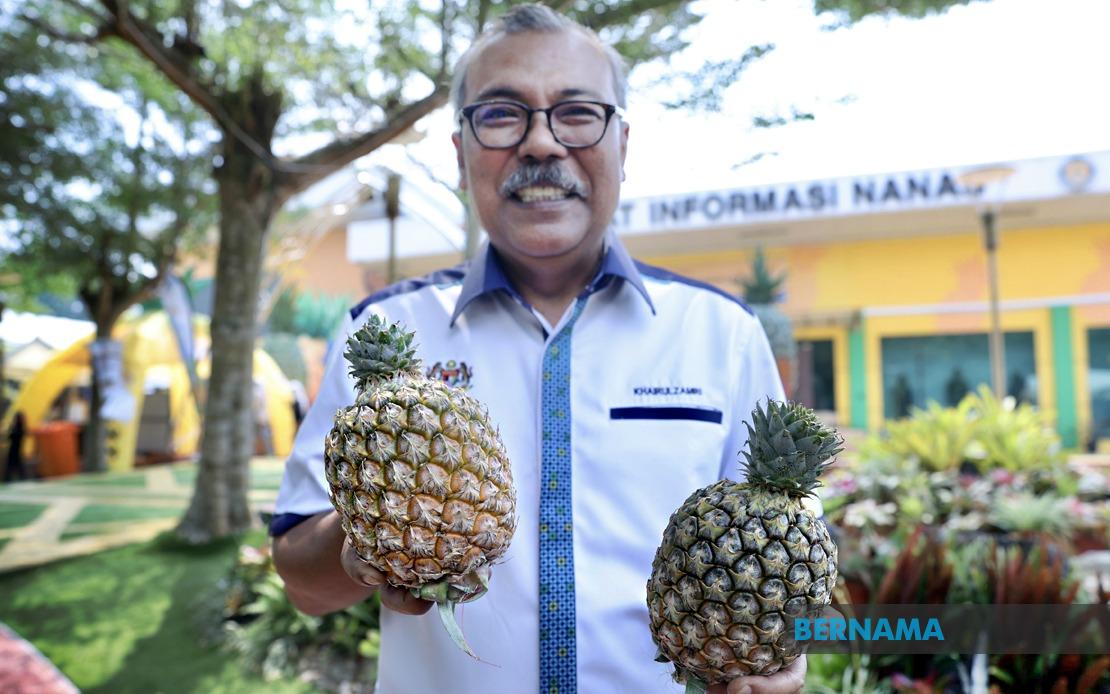
A striking new pineapple variety cultivated in Sarawak has become a major drawcard at MAHA 2026, the Malaysian agricultural showcase currently underway at the Malaysia Agriculture Expo Park in Serdang. The Sarawak Gold (SG1) pineapple is on prominent display at Laman Nanas, where seven tonnes of the fruit have been shipped in from Miri to introduce Malaysian consumers and industry players to this innovative agricultural development.
Mohd Khairuzamri M. Salleh, director-general of the Malaysian Pineapple Industry Board (LPNM), highlighted the commercial potential of SG1 during the exhibition, describing it as a premium variety poised to transform domestic pineapple cultivation. The fruit combines several advantages that distinguish it from established market varieties, most notably the popular MD2. While SG1 delivers sweetness comparable to MD2, it presents a visually distinctive appearance with a crown shaped remarkably like a rose, an aesthetic quality that adds marketing appeal beyond basic flavour profiles.
A decisive advantage of SG1 lies in its dramatically accelerated growth cycle. Maturing in just nine months from planting to harvest, the variety cuts the production timeline nearly in half compared to MD2, which requires fourteen months. This faster turnover has profound implications for farm economics across Malaysia, allowing growers to cycle through multiple harvests within shorter timeframes and improve cash flow significantly. The consistency of quality and flavour throughout each fruit further enhances its commercial viability, eliminating the variation issues that sometimes affect premium pineapple sales.
Perhaps most revolutionary is the exceptionally high planting density that SG1 permits. Growers can cultivate between 25,000 and 30,000 plants per acre, dramatically surpassing the density thresholds of conventional varieties. This capacity to produce substantially higher yields per unit of land addresses a critical challenge facing Malaysian agriculture—maximizing productivity within limited arable space. For a country with expanding urban development and competing land demands, such efficiency gains carry strategic importance for agricultural sustainability and food security objectives.
The LPNM is actively pursuing nationwide expansion of SG1 cultivation beyond its Sarawak origin. Seedlings are anticipated to reach growers across Peninsular Malaysia within the coming year, signalling a deliberate strategy to establish the variety as a significant component of Malaysia's pineapple industry. This rollout reflects confidence in the variety's adaptability and market readiness, though successful transplantation to different growing regions will require careful agronomic management and farmer education programmes.
International market potential for SG1 has already demonstrated real promise. Trial shipments from Sarawak to Singapore have successfully navigated export logistics and market reception, establishing a crucial proof of concept for cross-border commerce. Building on this foundation, industry officials are targeting premium markets including China and New Zealand, where the variety's distinctive characteristics and consistent quality could command higher prices than commodity pineapples. The strong resilience attributed to SG1 suggests favourable prospects for meeting stringent phytosanitary requirements demanded by these discerning markets.
Laman Nanas at MAHA 2026 operates under the thematic framework of "Value Creation for Food Security," reflecting a broader industry initiative to reshape public understanding of pineapple cultivation beyond fresh fruit production alone. The exhibition concept promoting "one planting, three harvests" emphasizes the full-cycle utilization potential that pineapple farming offers to Malaysian agriculture. Visitors encounter not merely fresh fruit marketing but a comprehensive value chain narrative encompassing seeds, plant residues, and derivative products.
This expanded value proposition responds to evolving global perspectives on agricultural sustainability and waste minimization. Pineapple plant waste materials, traditionally discarded or underutilized, are now transformed into high-value products serving diverse industries. Ruminant feed production utilizing pineapple byproducts supports Malaysia's livestock sector, whilst fibre extraction enables textile and apparel manufacturing. Pulping and processing technologies convert plant material into paper products, creating integrated agricultural-industrial ecosystems that improve overall farm profitability and environmental stewardship.
The commercial mathematics favouring such integrated approaches particularly benefit smaller-scale farmers who often struggle with income volatility and input cost pressures. When pineapple cultivation generates multiple revenue streams from a single planting cycle, farm resilience improves substantially. This model aligns closely with Malaysian agricultural policy objectives emphasizing value addition, farmer prosperity, and efficient resource utilization across the sector.
MAHA 2026 itself operates as a significant platform for showcasing such agricultural innovations to a broad audience. Running from August 28 through September 6 at MAEPS, the exposition features approximately 2,000 exhibitors and anticipates attracting over four million visitors. For a developing economy pursuing food security and agricultural modernization, such large-scale showcases serve critical functions beyond entertainment, facilitating knowledge transfer, industry networking, and consumer engagement with contemporary farming practices.
The strategic positioning of SG1 within this national exhibition reflects deliberate promotional intent by Malaysian agricultural authorities. Introducing new varieties to mass audiences through major trade events generates consumer awareness, builds retailer interest, and communicates innovation narratives that enhance national agricultural branding. As regional agricultural competition intensifies, particularly with competitors from Thailand, Vietnam, and the Philippines, demonstrating technological advancement and superior product characteristics becomes increasingly important for market share preservation and premium positioning.
For Malaysian pineapple farmers facing cyclical market pressures and international price competition, SG1 represents tangible opportunity for differentiation and margin improvement. The combination of shorter production cycles, higher planting densities, superior aesthetics, and export market validation creates compelling incentives for adoption. Successful establishment of SG1 cultivation across Peninsular Malaysia could materially strengthen the nation's pineapple industry competitiveness whilst contributing to broader agricultural productivity objectives essential for achieving food security targets within Southeast Asia's evolving economic landscape.

