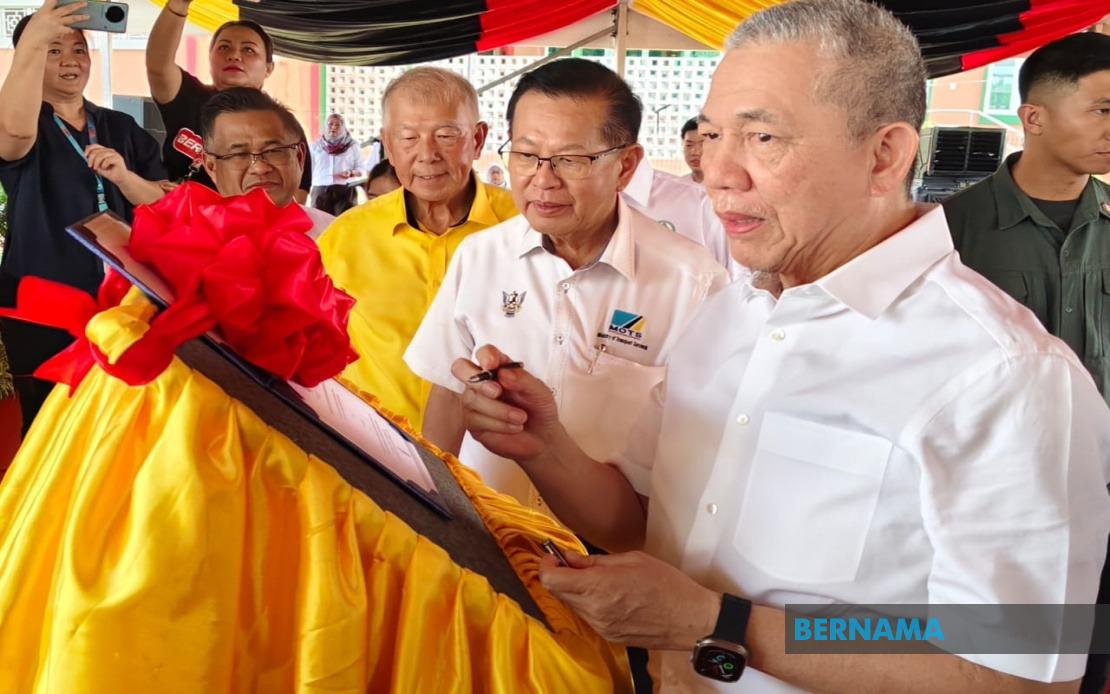
Sarawak has received approval for 52 projects under the Cakna MADANI Programme totalling RM9.46 million this year, as part of a broader initiative to tackle escalating environmental challenges including coastal erosion, riverbank degradation, and recurring flood events. Deputy Prime Minister Datuk Seri Fadillah Yusof, who also holds the portfolio of Energy Transition and Water Transformation Minister, announced the development during a site visit in Miri, where he inspected ongoing infrastructure work designed to stabilise vulnerable waterways and protect surrounding communities.
The portfolio of 52 projects demonstrates varied stages of progress, reflecting the staggered implementation approach adopted by authorities. To date, 12 of these initiatives have reached completion, indicating that tangible outcomes are already materialising on the ground. A further 13 projects remain under active construction, with work progressing according to schedule. Meanwhile, 27 projects have not yet commenced implementation, positioned at the preparatory stage as design finalisation and procurement processes continue. This distribution across three advancement stages suggests a sustained commitment to delivering environmental protection measures over the coming months and years.
During his visit to Miri, Fadillah highlighted the Riverbank Stabilisation Project at Tab Cinaq Cemetery as a representative example of Cakna MADANI's practical applications. The initiative, budgeted at RM134,682, commenced in May and is anticipated to conclude by November. The engineering solution involves constructing a 50-metre retaining wall specifically engineered to arrest riverbank erosion while safeguarding the cemetery and nearby built infrastructure from further degradation and potential inundation. This modest-scale project typifies how the programme addresses localised vulnerabilities affecting both heritage sites and residential areas.
Miri itself hosts three Cakna MADANI projects, positioning the district as a focal point for this developmental initiative. The concentration of multiple projects within a single locality underscores the severity of environmental pressures affecting the coastal region. Erosion and flooding represent persistent threats to Miri's stability, making the clustering of interventions a logical strategic response to interconnected challenges that demand comprehensive rather than piecemeal solutions.
Beyond the immediate Cakna MADANI portfolio, the government has charted a substantially more expansive vision for long-term flood resilience across Sarawak. Fadillah outlined that 29 flood mitigation projects, collectively valued at RM3.834 billion, have secured approval. This figure dwarfs the Cakna MADANI allocation, signalling that authorities recognise the magnitude of investment required to fundamentally transform how the state manages water-related risks. The comprehensive flood mitigation architecture encompasses multiple policy instruments, including the Flood Mitigation Plan (RTB), the High Priority Flood Mitigation Programme (TBBT), dedicated coastal erosion mitigation schemes, and river conservation undertakings.
The composition of these 29 projects reveals a balance between consolidating previous efforts and pioneering new interventions. Of the total, 18 projects represent continuations of existing initiatives, commanding RM3.567 billion in cumulative spending. These continuation projects build upon established approaches and address areas where prior assessments identified ongoing requirements. Conversely, 11 newly approved projects, worth RM267 million, introduce fresh technological or engineering solutions to emerging vulnerabilities or previously unaddressed hotspots. This dual approach acknowledges that flood risk management demands both persistence in executing proven strategies and innovation in adapting to evolving environmental conditions.
Among the major undertakings, the RTB Sungai Miri programme exemplifies the scale of investment being deployed. Carrying a price tag of RM31 million, this continuation project initiated construction in October 2023 and has achieved 58.11 per cent physical progress as of the update. Completion is targeted for November 2026, suggesting a three-year construction window necessary to deliver the flood mitigation infrastructure. The extended timeline reflects the complexity of riverine engineering works that must account for monsoon seasons, ecological considerations, and integration with existing urban development patterns.
The investment across Sarawak's flood and erosion management initiatives carries direct relevance for Malaysian policymakers beyond the state's boundaries. As climate variability intensifies and extreme weather events grow more frequent and severe, the vulnerability of low-lying coastal and riverine communities becomes increasingly acute. Sarawak's experience implementing these large-scale mitigation frameworks offers empirical data on what financial commitments, technological approaches, and implementation timelines prove effective. The lessons derived from the RTB Sungai Miri and comparable projects may inform strategies being developed in other Malaysian states facing similar environmental pressures, particularly those in the peninsula's east coast and coastal regions.
The financial commitment represented by RM3.834 billion in approved flood mitigation spending, supplemented by the RM9.46 million Cakna MADANI allocation, indicates that Sarawak is advancing from reactive crisis management toward proactive resilience building. Rather than responding episodically to disasters, the state is implementing systematic engineering interventions designed to prevent or substantially diminish the impact of future inundation events. This represents a significant philosophical and operational shift, one with implications for insurance markets, property valuations, urban planning practices, and community confidence in government capacity to manage environmental risks.
Fadillah's dual ministerial responsibilities underline the governmental recognition that water management transcends narrow sectoral boundaries. Energy and water transformation intersect with climate adaptation, economic development, and public safety. The consolidation of these portfolios within a single office suggests institutional arrangements designed to ensure coordinated policy implementation and resource allocation across traditionally siloed bureaucratic domains. For Sarawak's residents and businesses, this structural alignment may enhance delivery effectiveness, though sustained performance will ultimately depend upon timely disbursement of allocated budgets and rigorous project oversight throughout implementation phases.
The regional significance of Sarawak's approach extends to South East Asian discourse on climate adaptation and disaster risk reduction. As rising sea levels and intensifying precipitation patterns threaten multiple countries within the Association of South East Asian Nations, the mechanisms and financing instruments that Sarawak deploys may serve as reference points for neighbouring states formulating comparable strategies. Malaysian expertise in managing these challenges, disseminated through regional forums and bilateral exchanges, contributes to broader efforts across South East Asia to build climate-resilient societies capable of protecting both human populations and economic assets.

