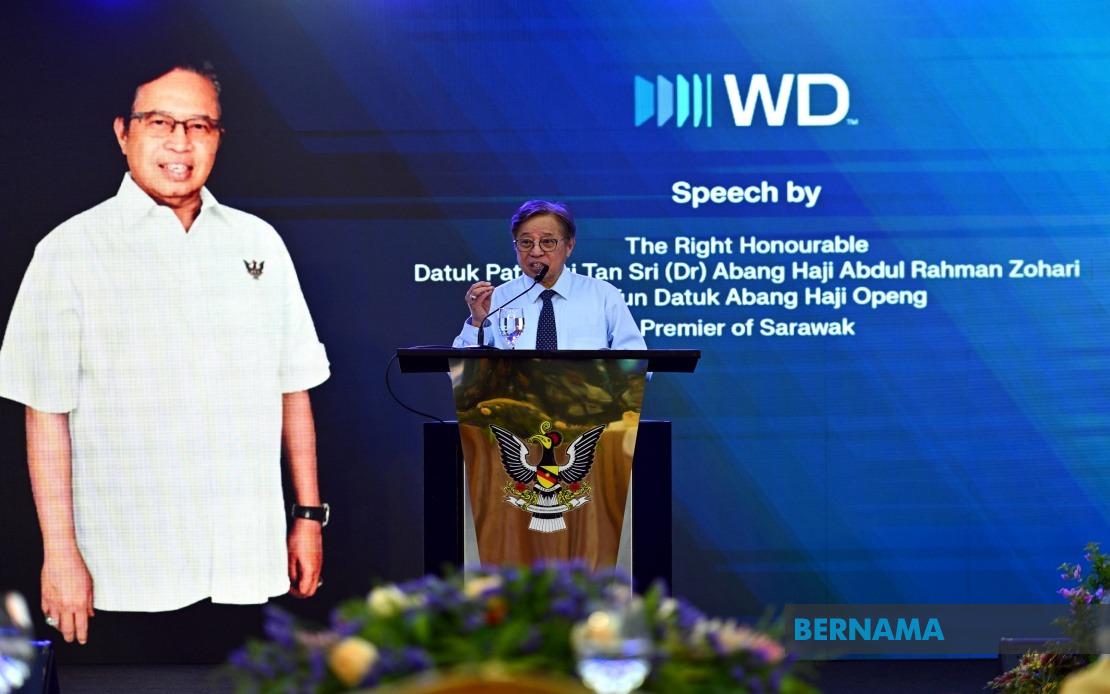
Sarawak's leadership has adopted a pragmatic stance on the question of increasing the state's special constitutional grant, signalling openness to higher allocations while acknowledging the constraints facing federal finances. Tan Sri Abang Johari Tun Openg, the state premier, expressed this balanced position following his attendance at the New Horizon for Western Digital programme in Kuching, reframing what could be a contentious fiscal negotiation as a matter of mutual understanding between the federal and state governments.
The special grant referenced falls under Article 112D of the Federal Constitution, a provision rooted in the Malaysia Agreement 1963 (MA63) that established Sarawak's unique constitutional relationship with the federation. This financial arrangement has long been a significant element of Sarawak's autonomy and economic development capacity, making discussions around its quantum particularly sensitive. Abang Johari's measured language—welcoming increases while demonstrating flexibility about federal constraints—suggests Sarawak's approach prioritises constructive engagement over confrontation, a marked contrast to some earlier MA63-related disputes between the state and Putrajaya.
Crucially, the premier indicated that substantive negotiations have not yet commenced. He acknowledged that the matter was broached only in general terms during a recent meeting with Prime Minister Datuk Seri Anwar Ibrahim in Bintulu, suggesting that any future discussions would require more detailed engagement between state and federal officials. This measured pace reflects the complexity of federal fiscal planning, where adjustments to entitlements for any state must be weighed against competing national priorities and other states' expectations.
On June 30, Anwar had informed the Dewan Rakyat during Prime Minister's Question Time that discussions on Sarawak's special grant remained active and aligned with the spirit of MA63, framing the matter within the broader context of honouring historical constitutional commitments. This public acknowledgement from the federal leadership provides some assurance to Sarawak that the matter retains high-level political attention, though the absence of concrete proposals suggests that resolution may require patience from all parties.
Abang Johari's flexibility on the grant issue may be partly contextualised by Sarawak's own economic optimism, particularly regarding technology and energy sectors. During the same event, he highlighted the enduring strategic partnership between Sarawak and Western Digital spanning approximately three decades, characterising it as a foundation for future prosperity. The premier emphasised that glass substrate-based data storage technology represents the next frontier for the state's collaboration with the multinational corporation, a field that promises substantial industrial and employment benefits.
The technological pivot reflects a broader strategic reorientation in Sarawak's economic vision. Abang Johari articulated a forward-looking argument that data storage will eventually supersede petroleum as a wealth generator, positioning Sarawak's abundant renewable energy and water resources as competitive advantages in attracting high-technology investment. This narrative aligns with global trends toward artificial intelligence infrastructure and digital transformation, suggesting that Sarawak sees its future less dependent on traditional resource extraction and more centred on knowledge-intensive industries.
Western Digital's statement complemented this vision, describing glass substrate as a transformative recording technology that substantially increases data storage capacity while supporting the infrastructure demands of artificial intelligence-driven systems. The technology underscores how advanced manufacturing in semiconductors and storage media can anchor a regional economy, particularly where energy and cooling water are abundant and cost-effective. For Malaysia and Southeast Asia more broadly, Sarawak's positioning as a data storage hub signals regional ambitions to capture portions of the global digital supply chain currently dominated by East Asian competitors.
From a federal perspective, Sarawak's flexible stance on the special grant negotiation may facilitate easier agreement, particularly if the federal government can demonstrate tangible progress on economic diversification and technology-sector development as alternative sources of state revenue. The framing of the grant discussion within the context of shared economic ambitions rather than zero-sum fiscal competition potentially creates space for creative solutions, whether through staged increases, performance-based allocations, or co-investments in technology infrastructure.
For other Malaysian states, particularly Sabah, Sarawak's approach establishes a template for how MA63-related negotiations can proceed constructively. Rather than issuing ultimatums or maximalist demands, the Sarawak government has demonstrated that acknowledging federal constraints while articulating state interests can maintain pressure for favourable outcomes without destabilising the federation. This diplomatic approach may prove more effective in the long term than confrontational tactics, particularly given the complexity of federal budget management and the multiple competing claims on national resources.
The convergence of Sarawak's special grant discussions with its technology sector ambitions also hints at a potential strategic linkage. Future negotiations might conceivably tie increased grant allocations to measurable outcomes in technology investment, job creation, or infrastructure development, transforming what is conventionally a revenue distribution matter into a development partnership. Such an approach would align financial arrangements with economic goals, potentially yielding greater prosperity for Sarawak while demonstrating to the federal government that enhanced investment in the state generates tangible national returns.
Looking ahead, the pace and outcome of these negotiations will likely depend on the federal government's fiscal recovery and Sarawak's ability to deliver on its technology ambitions. Economic growth and improved tax revenues at the federal level would create the fiscal space Abang Johari has identified as necessary, while successful execution of major technology projects could strengthen Sarawak's negotiating position by demonstrating the returns on enhanced state investment. The choreography of these discussions—patient, calibrated, and embedded within broader economic collaboration—may ultimately prove more productive than the more contentious constitutional and fiscal battles that have occasionally marked federal-state relations in Malaysia.

