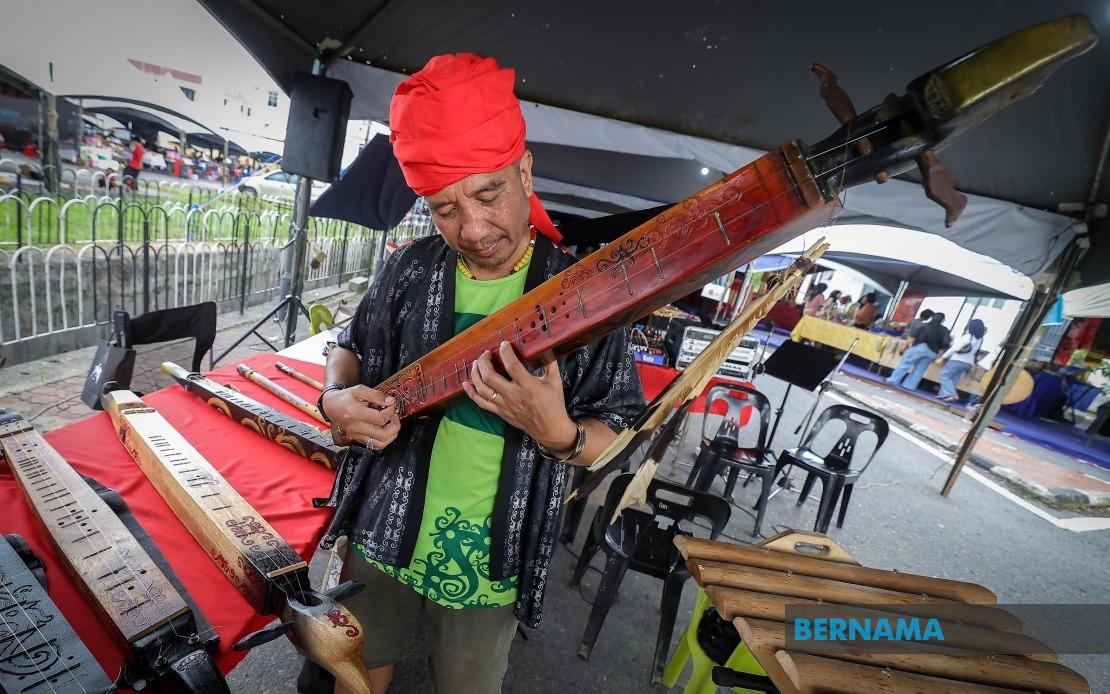
Sarawakian musician Rining Peter Paris is making waves in the region's world music scene with 'Sigar Suba', a culturally significant single released on July 1 that addresses a notable gap in indigenous representation. Performed alongside his ensemble Bata' Uduh, the track channels the musical traditions of the Lun Bawang community while introducing contemporary audiences to centuries-old heritage through a modern fusion lens. The initiative represents a calculated artistic move to ensure that minority musical traditions remain vibrant and relevant to younger generations who might otherwise drift away from their cultural moorings.
At the heart of 'Sigar Suba' lies the Tapi', a distinctive two-string plucked instrument that occupies a revered position within Lun Bawang heritage. The single weaves together this traditional centerpiece with complementary instruments including the Pek Bu, Ruding, and xylophone, creating a soundscape that honours ancestral musical knowledge while embracing contemporary production sensibilities. This layering of old and new reflects a broader creative philosophy: that indigenous traditions need not remain frozen in time to retain authenticity, but can instead evolve in ways that maintain their essential character while expanding their appeal.
Rining's motivation for creating 'Sigar Suba' stemmed from observing an imbalance in existing Lun Bawang musical output. His previous compositions, including 'Busak Baku' and 'Busak Elai', had typically centred feminine themes—celebrating the intricate beadwork of traditional necklaces and the natural beauty of the landscape. The 53-year-old musician recognised that this thematic emphasis inadvertently marginalised male perspectives and cultural signifiers. He therefore set out to compose a song that would specifically honour and celebrate the identity markers of Lun Bawang men, addressing what he perceived as a cultural blind spot in contemporary indigenous music production.
The song's title carries profound cultural significance. 'Sigar' refers to a distinctive traditional head covering, while 'suba' denotes the colour red, together forming a descriptor for the striking red headpiece that Lun Bawang men don during significant celebrations, most notably the Irau Aco festival. By anchoring the composition to this singular cultural artefact, Rining created a focused meditation on male identity and ceremonial importance within Lun Bawang society. The choice demonstrates sophisticated cultural curation—selecting symbols that carry weight and meaning within community consciousness rather than generic representations of indigeneity.
The lyrics, composed entirely in the Lun Bawang language, function as a detailed ethnographic document set to music. They traverse the landscape of traditional male attire with specificity: the kuyu talun, or bark shirt worn during ceremonial occasions; the pelepet, a traditional machete that combines practical utility with symbolic weight; and the distinctive tusk ornaments that signify status and heritage. This linguistic and material documentation serves a pedagogical function, providing younger community members with concrete knowledge about their ancestors' material culture and aesthetic choices. In doing so, the song becomes more than entertainment—it transforms into a cultural transmission vehicle.
Rining's commitment to preserving Lun Bawang heritage extends well beyond songwriting into instrument craftsmanship. Over nearly a decade, he has devoted substantial energy to revitalising the Tapi', both as a functional musical instrument and as a symbol of cultural continuity. His decision to become an instrument maker himself reflects a holistic approach to cultural preservation, recognising that the survival of musical traditions depends not merely on people playing existing instruments, but on maintaining the knowledge systems and skills required to manufacture them. This interdependence between composition, performance, and manufacture creates resilience within cultural ecosystems.
The commercial dimension of Rining's work further underscores the viability of indigenous cultural products in contemporary markets. To date, he has handcrafted and sold 66 Tapi' instruments to buyers spanning three continents—Australia, the United States, and Canada—alongside domestic Malaysian purchasers. This international demand suggests that properly contextualised and marketed indigenous instruments can find audiences beyond their communities of origin, creating economic sustainability for cultural practitioners. The interest from Malaysian experimental musician Belle Sisoski, a respected figure in local avant-garde circles, indicates that the Tapi' is gaining recognition among serious musicians seeking authentic alternative sonic textures.
Rining's strategy of blending reggae and fusion genres into Bata' Uduh's repertoire reflects pragmatic cultural stewardship. Rather than insisting on musical purism that might alienate younger listeners accustomed to global genres, he has chosen to create hybrid forms that maintain traditional instrumentation and language while adopting contemporary rhythmic and production vocabularies. This approach mirrors successful cultural preservation models elsewhere in Southeast Asia, where communities have discovered that tradition and modernity need not exist in opposition, but can instead generate creative synergies that enlarge rather than diminish cultural relevance.
'Sigar Suba' is now accessible through major streaming platforms, a distribution model that democratises access to indigenous music in ways previously impossible. Digital distribution removes geographical and logistical barriers, enabling diaspora communities, researchers, and curious listeners worldwide to encounter Lun Bawang musical expression without travelling to Sarawak. This technological advantage compounds Rining's efforts, extending the song's reach far beyond what traditional media channels would permit and creating multiple pathways for cultural knowledge transmission.
Rining's artistic vision extends beyond immediate commercial or artistic success. He has articulated an explicit long-term goal: to transition to full-time Tapi' manufacturing and music composition by 2028, roughly five years hence. This timeline suggests confidence in the trajectory of his work and a belief that sustained cultural labour can eventually become economically viable without compromising artistic integrity. For Lun Bawang communities watching cultural erosion accelerate globally, Rining's example offers an important counternarrative—demonstrating that determined individuals can generate conditions where heritage traditions become sources of pride, economic opportunity, and intergenerational connection rather than markers of obsolescence.
The broader significance of 'Sigar Suba' extends beyond individual artistic achievement. In a regional context where indigenous communities across Southeast Asia face similar pressures of cultural assimilation and economic marginalisation, Rining's work illustrates how musicians and cultural practitioners can intervene actively in heritage preservation. By creating professionally produced, aesthetically compelling music that centres indigenous languages, instruments, and ceremonial knowledge, he establishes templates for cultural resilience that other communities might adapt and emulate. The song ultimately functions as both artistic statement and cultural activism, asserting the enduring vitality of Lun Bawang identity within contemporary Malaysia.

