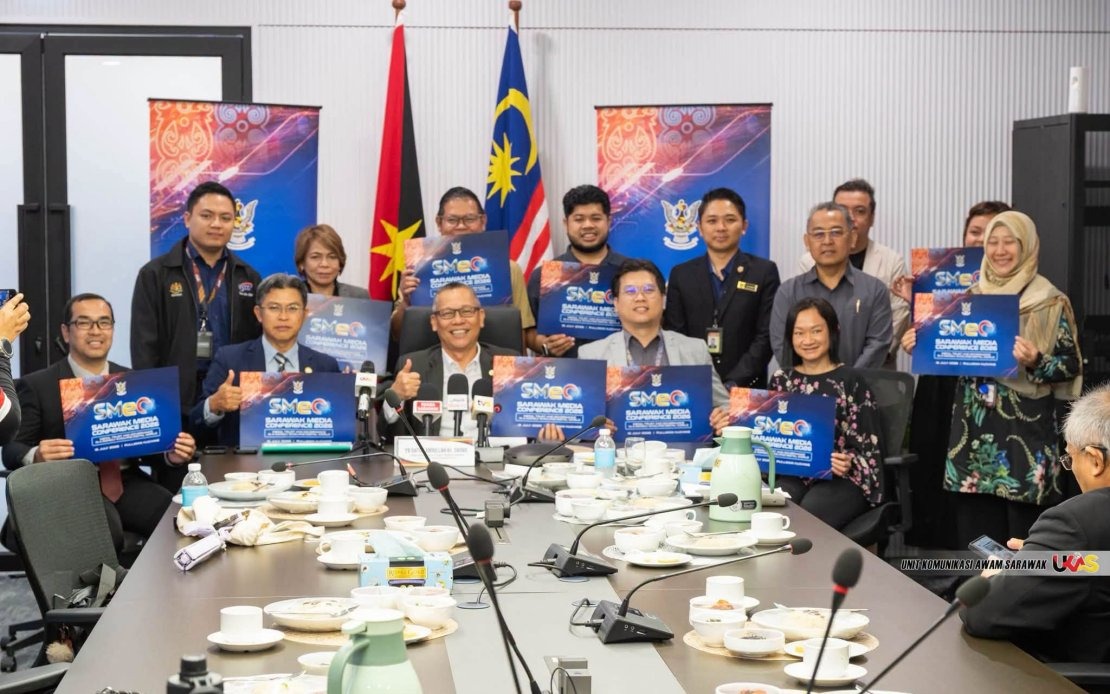
Sarawak's inaugural media conference next year will serve as a critical gathering point for examining how journalists, communicators and policymakers can navigate the profound shifts reshaping the industry. The Sarawak Media Conference (SMeC) 2026, scheduled to convene in Kuching, expects to attract approximately 800 participants spanning media organisations, academic institutions, government bodies and emerging voices from the student community. The event, coordinated by the Sarawak Government through its Public Communications Unit (UKAS), will be formally opened by Sarawak Premier Tan Sri Abang Johari Tun Openg and represents a significant commitment to addressing industry-wide concerns at the state level.
The chosen theme, "Media, Trust and Governance in a Rapidly Evolving Digital World," encapsulates challenges that extend well beyond Sarawak's borders. According to Datuk Abdullah Saidol, Deputy Minister in the Sarawak Premier's Department, the conference programme will concentrate on restoring public confidence in news institutions—a priority that resonates across Malaysia and Southeast Asia as misinformation and polarised discourse increasingly undermine media credibility. The agenda recognises that effective governance and ethical journalism are interdependent, with each requiring reinforcement as newsrooms grapple with technological disruption and shifting audience behaviour.
Artificial intelligence and other emerging technologies will occupy substantial space in the conference discussions. Rather than treating these tools as peripheral concerns, the organisers have positioned them as central to understanding contemporary journalism's trajectory. The emphasis on exploring both opportunities and risks posed by AI reflects growing recognition that newsrooms must develop capacity to harness these technologies responsibly while guarding against their misuse. For Malaysian media practitioners, such conversations are increasingly urgent as publications and broadcasters invest in automation tools, algorithmic content distribution and data analytics.
The conference roster includes prominent industry figures whose perspectives will shape deliberations. Lunnie Gan, founder of SOL Digital, brings expertise in digital media innovation and business models, while Premesh Chandran, deputy chairman of the Malaysian Media Council, brings regulatory and industry governance experience. Their participation signals that SMeC 2026 will ground discussions in practical realities faced by digital publishers and traditional media outlets alike. The diversity of speakers will likely ensure conversations remain rooted in implementation challenges rather than abstract theory.
In parallel with the main conference, a dinner event honouring journalists will elevate the occasion's significance beyond professional networking. The Sarawak-level National Journalists' Day (HAWANA) 2026 celebration, held in conjunction with SMeC 2026, will welcome Deputy Prime Minister Datuk Seri Fadillah Yusof, underlining federal government interest in media sector development. This alignment suggests the event carries implications for national media policy discussions, potentially influencing how Kuala Lumpur addresses journalism's sustainability and professional standards.
The special appreciation awards programme demonstrates explicit recognition of journalism's diverse forms in the contemporary landscape. By honouring contributions across five categories—traditional journalism roles alongside photographers, videographers, radio presenters and social media influencers—the Sarawak Premier's awards acknowledge that news dissemination now occurs through multiple channels and formats. This inclusivity reflects genuine industry evolution rather than nostalgic tradition. Social media influencers' inclusion particularly signals acceptance that information flows through non-institutional channels, a reality Malaysian newsrooms have sometimes resisted acknowledging.
For Malaysian media professionals, SMeC 2026 represents an opportunity to engage with peer networks beyond Peninsular Malaysia's dominant media landscape. Sarawak's distinct media ecology—shaped by geographic dispersion, indigenous language considerations, and specific political dynamics—offers valuable perspectives on how journalism operates in diverse contexts. Conversations grounded in Sarawak's experience will enrich understanding of how media institutions can serve geographically dispersed, multilingual populations while maintaining editorial standards and audience trust.
The conference's explicit focus on governance carries particular weight given ongoing debates about media regulation in Malaysia. The emphasis on strengthening public trust through better governance suggests organisers view institutional credibility as dependent on transparent, accountable decision-making. This framing invites journalists to examine their own organisational practices while also engaging with government and policy discussions about media law, ownership concentration and editorial independence. Such conversations, conducted at arm's length from partisan pressure, are essential for industry health.
Digital transformation discussions will likely address business model sustainability alongside editorial and technological questions. Malaysian publications, like their counterparts regionally, face mounting pressure to monetise digital audiences while competing against technology platforms for advertising revenue. SMeC 2026 offers space for sharing strategies, learning from failed experiments and identifying viable paths forward. The conference's academic contingent will contribute evidence-based perspectives on audience behaviour, trust factors and effective engagement strategies.
The convening of this diverse stakeholder group—practitioners, academics, policymakers, students and industry leaders—reflects recognition that media sector challenges require multidisciplinary engagement. No single group possesses sufficient insight to address trust deficits, governance gaps or technological disruption independently. Students' participation particularly signals investment in developing the next generation of media professionals, introducing emerging talents to peers across institutions and sectors while exposing them to senior practitioners' accumulated expertise.
For Southeast Asian media observers, SMeC 2026 merits attention as a regional test case for addressing shared challenges through state-level coordination. Sarawak's initiative may encourage similar conferences elsewhere, potentially establishing a network of regional gatherings where journalists and officials engage substantively with digital-age journalism questions. The model—organised state coordination, high-level political endorsement, multi-stakeholder participation—offers a framework others might adapt to their circumstances.

