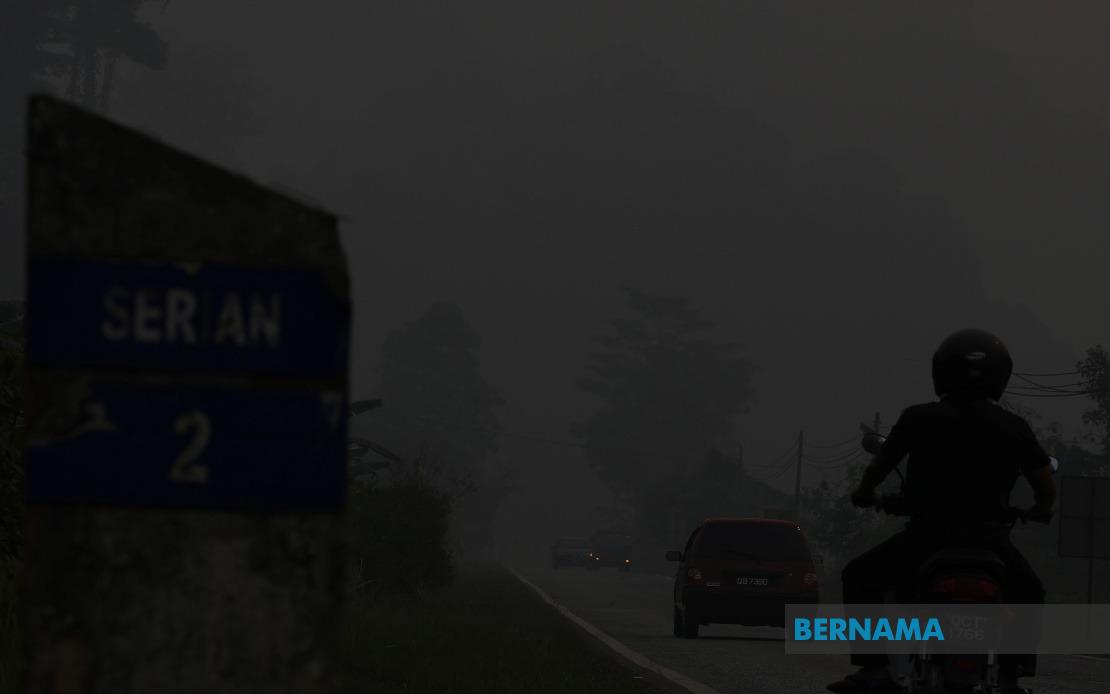
The Sarawak Disaster Management Committee has issued fresh guidance to organisers planning official, private and community events, emphasising the need to evaluate current haze conditions and pollution measurements before finalising their schedules. Speaking in Kuching on August 30, SDMC chairman Datuk Amar Douglas Uggah Embas stressed that while the responsibility for event decisions remains with individual organisers, they must act responsibly by weighing public health considerations, particularly for outdoor activities.
The advisory comes at a critical moment, as air quality across multiple Sarawak districts has deteriorated sharply. According to readings from the Department of Environment's Air Pollutant Index Management System recorded at midday, Serian District recorded hazardous levels at 412 at its police headquarters monitoring station, followed by Samarahan at 332 and Kuching at 304. These figures underscore the severity of the current haze situation affecting the state's population centres. Additional areas including Sarikei, Sibu, Bintulu and Mukah all registered unhealthy air quality readings ranging from 156 to 197.
Uggah, who also serves as Sarawak's Deputy Premier, outlined specific thresholds and recommended responses for organisers navigating the haze crisis. When the Air Pollutant Index surpasses 200, outdoor physical activities, sporting events and strenuous exercise should be reconsidered, with particular caution advised when children, elderly persons or other at-risk populations are involved. This guidance reflects international best practices on air quality management and public health protection during pollution episodes.
The committee has presented organisers with practical alternatives to cancellation, recognising the disruption that postponing events can cause to communities and businesses. Options include relocating activities to indoor venues with proper air filtration, substantially modifying programmes to reduce physical exertion or strenuous components, or deferring events to a later date when atmospheric conditions improve. This flexible approach acknowledges the diverse nature of planned activities while maintaining health safeguards.
More stringent measures take effect if pollution levels continue climbing. Should the API exceed 500, established disaster management guidelines authorise the closure of government and private sector offices and workplaces, with exceptions only for essential services. Such closures would require a formal Disaster Emergency declaration from the National Disaster Management Committee, representing an escalation of response protocols rarely triggered in Malaysian jurisdictions.
The SDMC's current posture reflects a graduated approach to crisis management, where responsibility and decision-making authority remain distributed across stakeholders rather than concentrated in government hands. This system places onus on individual event organisers to demonstrate prudence and accountability, rather than relying on top-down mandates. Uggah's statement made clear that no blanket directive has been issued prohibiting events, allowing organisers flexibility while establishing clear guidance on risk thresholds.
Coordination between state and federal agencies forms a backbone of Sarawak's response framework. The SDMC is working in concert with multiple governmental bodies to maintain continuous environmental monitoring and to implement countermeasures progressively, aligned with established disaster management protocols. This interagency approach ensures that decisions at state level remain consistent with national frameworks and that information flows smoothly between monitoring stations and decision-makers.
For businesses, educational institutions and community groups across Sarawak, the advisory serves as an important reminder that haze events carry measurable public health consequences. The concentration of hazardous readings in urban and industrial areas—particularly the 412 reading in Serian and 332 in Samarahan—suggests that transboundary pollution sources remain active. Such pollution episodes, increasingly common during fire seasons in neighbouring regions, require proactive management rather than reactive crisis response.
The divergent API readings across Sarawak districts indicate that haze intensity varies significantly by location, requiring organisers to consult real-time data specific to their event venues rather than relying on state-wide generalalisations. This granular approach to air quality assessment enables more nuanced decision-making and reduces unnecessary disruptions in areas experiencing less severe pollution. The Department of Environment's APIMS portal provides publicly accessible, regularly updated readings that organisers can reference throughout the day.
For Malaysian businesses and organisations operating across Sarawak, this advisory underscores the ongoing challenge posed by transboundary haze to economic activity and community life. Unlike sudden-onset disasters such as floods or earthquakes, haze episodes develop gradually, allowing time for deliberate responses but requiring vigilance and advance planning. Organisations should establish internal protocols for consulting air quality data and for making event decisions, rather than waiting for government directives that may come late in evolving situations.
The Sarawak situation also carries implications for other Malaysian states vulnerable to seasonal haze. As Southeast Asia grapples with recurrent transboundary air pollution, authorities across the region are refining their governance frameworks to balance economic activity with health protection. Sarawak's approach—emphasising organiser accountability within a framework of clear guidance rather than imposed restrictions—offers one model that other jurisdictions may study and adapt.

