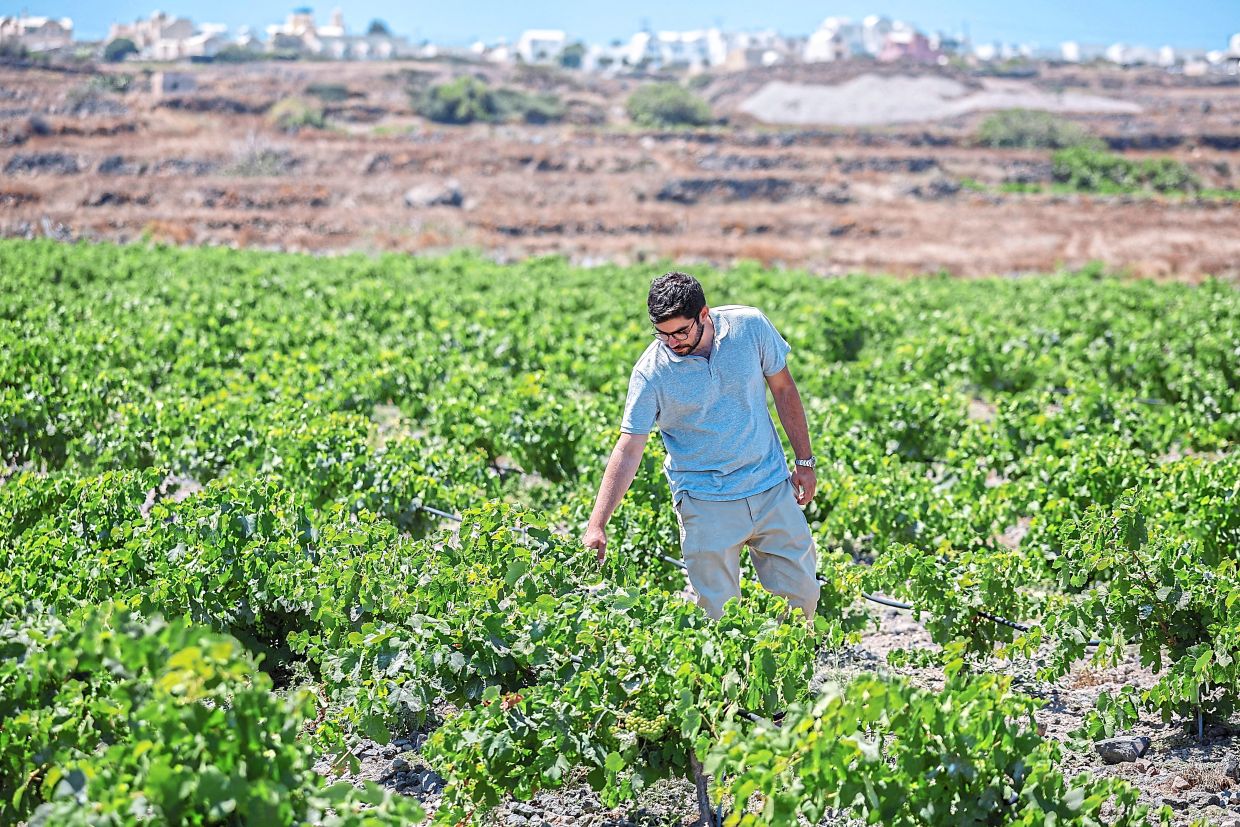
The vineyards of Santorini face an unprecedented crisis. A 90-year-old vine trained into the traditional basket shape, designed to shield grapes from the relentless Mediterranean sun, has finally succumbed to years of accumulated heat and drought. For Yiannis Boutaris, a sixth-generation winemaker and operator of Domaine Sigalas winery—now part of the Kir-Yianni family of wineries—the loss of this ancient plant represents far more than a single agricultural setback. It symbolises a turning point for an island whose wine culture has endured for millennia, and signals that the old ways of survival no longer suffice in an era of accelerating climate instability.
The environmental pressures bearing down on Santorini have intensified dramatically between 2023 and 2025. Abnormally low rainfall combined with record-breaking temperatures have created the harshest conditions in six decades, fundamentally reshaking the region's agricultural economics. Grape prices have surged, while wine production volumes have contracted sharply. More critically, competition for water has become fierce, as hotels, swimming pool operators, and tourism infrastructure siphon supplies that farmers increasingly depend upon. For an island that welcomes millions of tourists during the warm months, the squeeze on freshwater resources threatens not only wine production but the entire summer tourism model that sustains the local economy.
Stefanos Koundouras, a viticulture professor at Aristotle University in Thessaloniki, has documented the scale of the challenge. The temperatures recorded on Santorini during 2023 and 2024 were the hottest in 60 years—a stark marker of how rapidly Mediterranean climates are shifting. Koundouras warns that the problem extends well beyond a single island; if current trends persist, wine production across Europe, particularly throughout the Mediterranean basin, risks becoming fundamentally unsustainable. The quality and distinctive character that define Mediterranean wines—attributes refined over centuries—are already showing signs of deterioration as growing conditions become increasingly hostile.
Rather than retreat, however, Boutaris and his peers are embracing adaptation. The winemaker's operation is now testing a pilot scheme developed in collaboration with local authorities and scientists to recycle wastewater from residential properties and hotels for vineyard irrigation. This approach, already established in California's wine regions, promises greater sustainability and energy efficiency compared to the costly alternative of purchasing desalinated water. For an island with acute freshwater scarcity, such innovation moves beyond mere agricultural technique; it represents a philosophical shift toward circular resource management and away from the extractive practices that have characterised Mediterranean agriculture for generations.
Beyond water recycling, Boutaris is experimenting with structural changes to his vineyards. The traditional scattered planting pattern, while culturally embedded and suited to historical conditions, proves inefficient under contemporary drought stress. He is testing row-based planting arrangements that enable more targeted, economical irrigation coverage. Additionally, the winery has begun piloting atmospheric water harvesting technology—a system that captures moisture suspended in the air using specialised hydrogels. Solar panels then generate the heat needed to extract usable water from these hydrogels, creating a closed-loop system that relies on abundant Mediterranean sunlight rather than fossil fuel energy or groundwater reserves.
Yiannis Papaeconomou, another vineyard operator, represents a parallel wave of innovation within Santorini's wine community. His six-year-old vines are enrolled in the wastewater recycling project, positioning him to benefit from infrastructure investments driven by collective industry response. Beyond this initiative, Papaeconomou has implemented subsurface drip irrigation—a technique that delivers water directly beneath the soil surface rather than from above, substantially reducing evaporation losses that plague conventional overhead watering. He has also restructured vine trellising to optimise water efficiency and facilitate more controlled application of limited supplies.
These adaptations reflect a broader recognition within Santorini's wine sector that survival requires embracing rather than resisting change. For Boutaris, the principle guiding his decisions is explicit: the winery remains committed to preserving tradition, but tradition must now encompass adaptation to radically altered environmental circumstances. This framing proves psychologically and commercially important; it allows winemakers to maintain connections to their heritage whilst pursuing innovations that would have seemed heretical just a decade ago. The challenge lies in maintaining wine quality and authenticity whilst fundamentally altering production methodology.
The water crisis on Santorini exemplifies tensions that will intensify across the Eastern Mediterranean as climate change accelerates. Unlike winemakers in northern Greece, where a kilogram of grapes sells for merely €0.80 (RM3.70), Santorini producers benefit from premium pricing that reflects the island's reputation and terroir. This economic advantage provides capital for investment in experimental technologies. However, not all Mediterranean wine regions possess such resources, and many smaller producers lack the scale to justify investment in sophisticated water management infrastructure. The island's experience thus serves as both a template and a cautionary tale.
The competitive contest for water on Santorini during peak tourist season highlights the precarious position of agriculture within Mediterranean island economies. When hotels, resorts, and swimming pools compete with vineyards for finite freshwater supplies, and when tourism revenue dwarfs agricultural output, political pressure often favours hospitality sectors. Winemakers have little choice but to innovate their way toward independence from centralized water systems. Wastewater recycling and atmospheric harvesting represent not merely agricultural optimisations but assertions of sectoral survival in an increasingly water-stressed landscape.
Looking forward, Santorini's wine industry faces a complex future. The technologies being piloted—wastewater treatment, solar-powered water extraction, precision irrigation—are scientifically sound but require sustained investment and proper maintenance infrastructure. Success depends upon continued coordination between private winemakers, municipal authorities, and scientific institutions. It also depends upon whether Mediterranean climate change stabilises at current levels or accelerates further. If temperatures continue rising and rainfall becomes even more erratic, even these adaptive strategies may prove insufficient to sustain wine production at historical scales. Nevertheless, the commitment demonstrated by figures like Boutaris and Papaeconomou to experiment and adjust offers a model for how traditional industries might negotiate the transition to a fundamentally altered climate.

