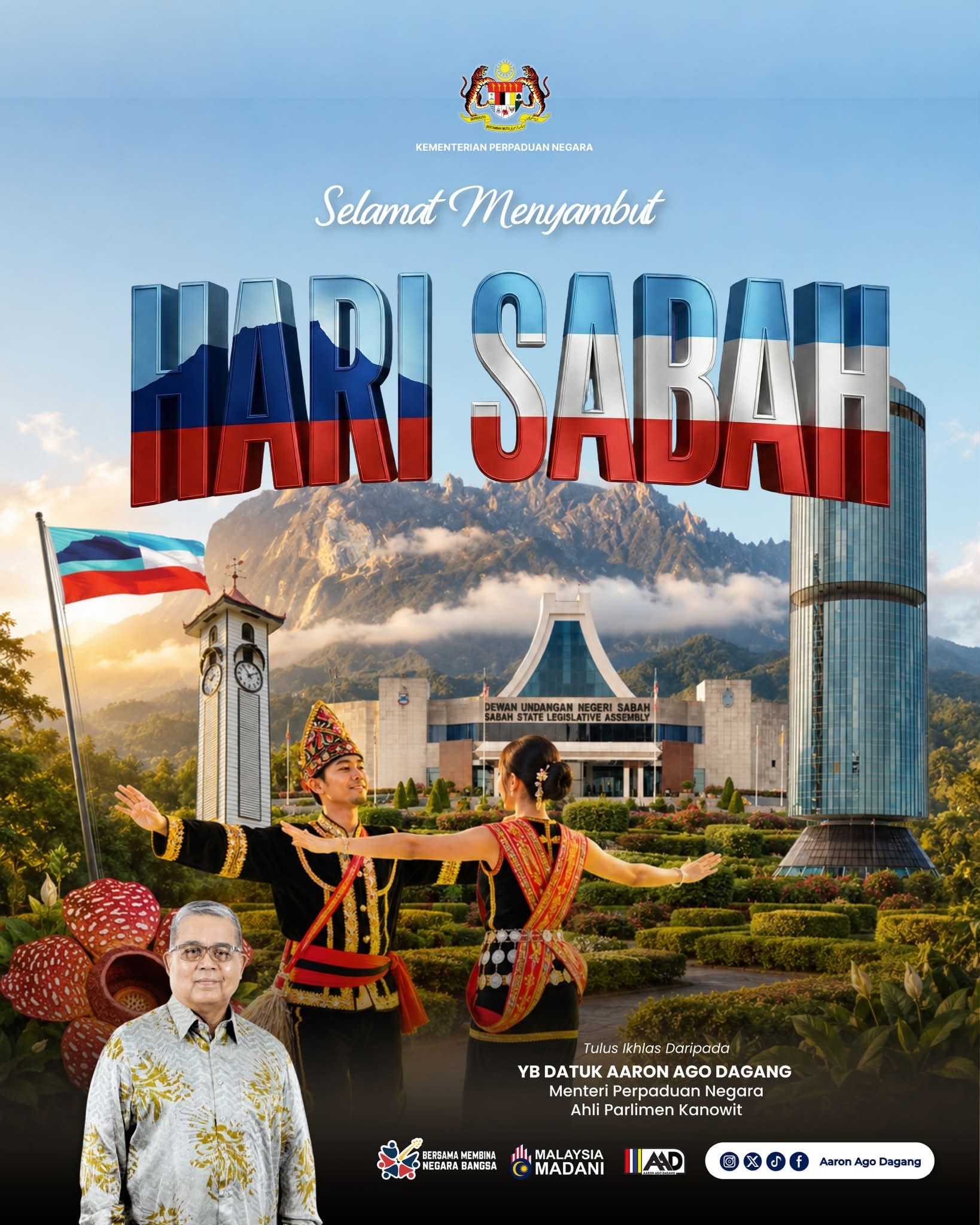
Sabah's remarkable ethnic composition, encompassing 35 distinct ethnic groups and 217 sub-groups, represents not merely a demographic fact but a defining characteristic that strengthens the broader Malaysian federation, according to National Unity Minister Datuk Aaron Ago Dagang. Speaking on the occasion of Sabah Day on August 31, the minister underscored how the state's multicultural character embodies the nation's foundational commitment to pluralism and coexistence. This observation carries particular weight in Malaysia's political discourse, where questions of national cohesion and intercommunal harmony remain perpetually relevant to policymakers and citizens alike.
The indigenous communities of Sabah—including the Kadazan, Dusun, Bajau, Murut, Rungus, Bisaya, Lotud and Lundayeh peoples—have each contributed distinct cultural practices, languages, artistic traditions and social customs that collectively form the bedrock of the state's identity. Rather than viewing these differences as potential sources of division, Datuk Aaron Ago Dagang framed them as complementary elements that, when properly nurtured, generate social resilience and mutual enrichment. Each group maintains its own linguistic heritage, ceremonial practices, traditional attire and musical traditions, creating a cultural ecosystem of remarkable complexity and historical depth.
The minister's emphasis on understanding, respect and acceptance as preconditions for harmony reflects a deliberate political message aimed at counteracting fragmentation. In a state where communal identities remain salient and competition for resources can occasionally take on ethnic dimensions, articulating diversity as a strength rather than a challenge represents an important rhetorical and substantive commitment. Sabah's experience suggests that multiethnic societies can function productively when institutional frameworks and political leadership actively promote inclusive narratives and protect minority cultural rights.
Sabah Day itself commemorates August 31, a date freighted with historical significance extending back through multiple administrations and sovereignty arrangements. The state's journey encompasses the colonial era under the British North Borneo Company, the period of Japanese occupation during the Second World War, the subsequent restoration of British administration, and the achievement of self-governance in 1963. This layered historical trajectory distinguishes Sabah from other Malaysian states and shapes contemporary identity formation among its residents. The subsequent merger with the Federation of Malaysia on September 16, 1963—marked by the formation of Malaysia itself—represented a pivotal moment when Sabah chose to align itself with the emerging nation-state rather than pursuing alternative political arrangements.
For Malaysian policymakers, Sabah's diversity carries implications extending beyond symbolic or cultural considerations. The state functions as a practical demonstration of how federal structures can accommodate substantial differences in ethnic composition, religious affiliation, historical experience and developmental priorities while maintaining overall political stability. The success or challenges in managing Sabah's intercommunal relations thus inform broader discussions about federalism, devolved governance and the balance between central authority and state autonomy throughout Malaysia. Questions about education policy, economic opportunity distribution, cultural preservation and representation in government all manifest distinctively in Sabah's context, reflecting its unique demographic and institutional circumstances.
The minister's invocation of past generations' contributions serves a dual purpose: honouring historical actors while simultaneously establishing intergenerational obligation. By characterizing the present generation as the custodian of Sabah's future, Datuk Aaron Ago Dagang implicitly argues that contemporary Sabahans inherit both opportunities and responsibilities grounded in previous sacrifice and vision. This framing attempts to inspire forward momentum while maintaining continuity with historical consciousness and cultural preservation. The emphasis on pursuing advancement in education, technological capacity and economic development, while simultaneously protecting historical memory and cultural identity, reflects a common aspiration across Malaysian states seeking to modernise without sacrificing distinctiveness.
Education emerges as a particularly significant domain in this framework, as it simultaneously serves nation-building, economic development and cultural transmission functions. In Sabah specifically, educational institutions bear responsibility for preparing students to participate in a complex, multicultural society whilst maintaining connection to their communities' heritage. The balance between emphasising shared Malaysian citizenship and acknowledging distinctive state and ethnic identities within the curriculum represents an ongoing negotiation. Technology integration and economic diversification, meanwhile, position Sabah within broader regional and global developmental trajectories, requiring adaptation to rapidly changing labour markets and technological capabilities whilst maintaining social cohesion.
The declaration of Sabah Day as an official observance by the state government in 2024 represents an institutionalisation of these commemorative and identity-formation practices. By establishing a formal day of remembrance and celebration, Sabah's leadership creates recurring opportunities for public reflection on collective history, cultural affirmation and renewed commitment to shared governance. Such observances function as temporal markers within the national calendar, signalling the state's particular place within the Malaysian federation while affirming parallel loyalty to the national project.
For Southeast Asian observers more broadly, Sabah's multicultural framework offers instructive lessons about managing ethnic diversity across borders and within federal systems. The region contains numerous states grappling with similar questions about accommodating minority rights, preserving indigenous cultures and achieving economic development whilst maintaining political stability. Sabah's approach—emphasising mutual respect, institutional protections and inclusive narratives—represents one regional model among others, with both documented successes and acknowledged challenges. The ongoing work of translating these principles into sustained policy implementation and behavioural change remains the test of their practical efficacy.

