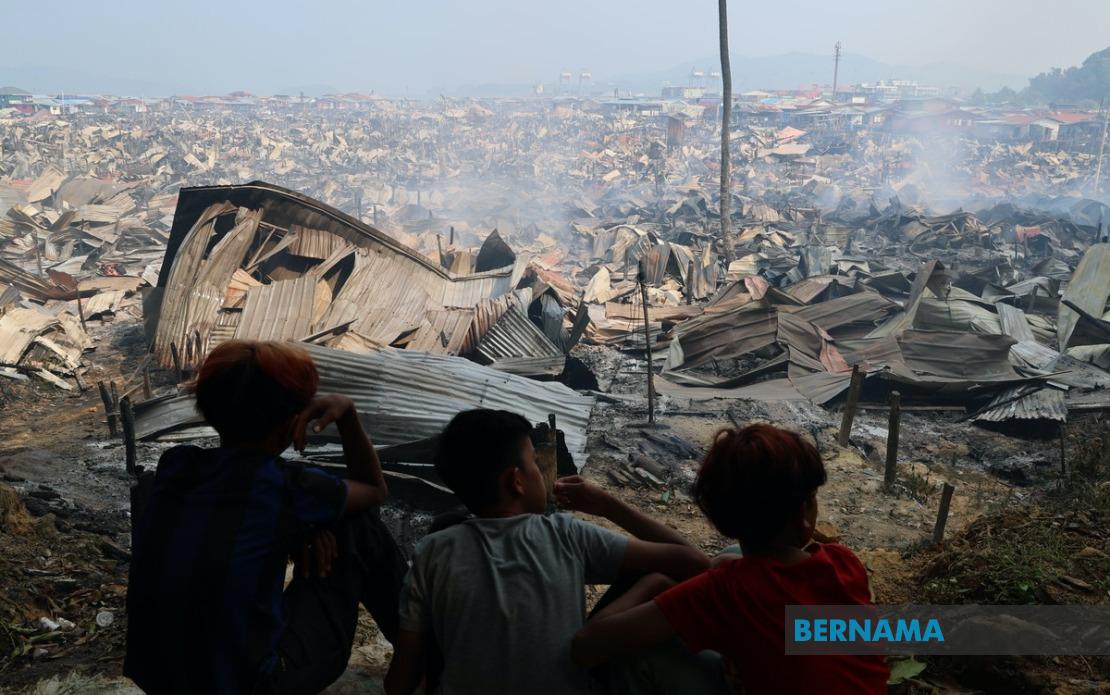
The Sabah government has committed to providing RM3,000 in financial assistance to every Malaysian household head impacted by the devastating fire that swept through Kampung Lok Buta in Numbak, Kota Kinabalu, early yesterday morning. The blaze, which erupted around 1.40 am, razed more than 200 residences and left a trail of destruction in one of the capital's residential areas. Chief Minister Datuk Seri Hajiji Noor made the announcement following a visit to affected residents at the Likas Multipurpose Hall temporary relief centre, where displaced families have gathered in the aftermath of the calamity.
The relief package represents a coordinated effort across multiple government tiers and charitable institutions. The RM3,000 figure comprises equal contributions of RM1,000 each from three sources: the Sabah state government, the federal government, and the Yayasan Kebajikan Sabah. This tripartite structure reflects the scale of the disaster and the need for rapid, comprehensive response across administrative levels. Hajiji emphasised that the immediate cash assistance aimed to ease the financial burden faced by families who lost virtually all their possessions in the conflagration, providing them with crucial liquidity during this critical phase of recovery.
Beyond immediate cash relief, the state government has outlined a broader support framework encompassing shelter reconstruction. The Chief Minister indicated that collaboration between the State Secretary's Office and Majlis Amanah Rakyat (MARA) would coordinate rebuilding efforts for destroyed homes. Decisions regarding whether homes will be reconstructed at their original locations or relocated to alternative sites will be made after careful assessment of land suitability and safety considerations. This measured approach suggests that authorities may be evaluating the structural integrity of the affected zone and potential environmental factors that contributed to the fire's rapid spread.
Non-Malaysian residents whose household heads were affected by the fire will receive separate consideration under humanitarian principles. The state government committed to providing RM1,000 in aid to each non-citizen household head impacted by the disaster. This inclusive approach acknowledges the multinational composition of many urban Malaysian communities and ensures that vulnerable populations regardless of citizenship status receive basic relief support. Such provisions are increasingly important in Sabah's diverse urban centres, where migrant workers and their families often lack formal social safety nets.
Immediate humanitarian assistance extends beyond financial transfers. The government is distributing essential supplies including food items and household necessities to displaced families currently sheltering at relief centres. These provisions address urgent needs in the hours and days following displacement, when access to basic goods becomes critical for survival and dignity. The coordination of such logistics, typically managed through local government and community organisations, requires substantial mobilisation of resources and personnel.
The human toll of the disaster has been particularly tragic. Three children perished in the flames: four-year-old Nana Abdullah, her six-year-old brother Mohd Asrul, and their eight-year-old cousin Nurfarahdilah Mohd Tajihah. These deaths highlight the vulnerability of young children in fire emergencies and raise questions about fire safety infrastructure, building code compliance, and emergency response capabilities in informal or densely packed residential areas. The loss of life underscores the distinction between material recovery and the irreplaceable human dimension of disaster management.
The incident illuminates broader vulnerabilities within Sabah's urban housing landscape. Kampung Lok Buta represents the type of compact, low-income residential settlement common throughout Malaysian cities, where wooden structures, limited space between buildings, and often inadequate fire safety infrastructure create conditions conducive to rapid fire spread. The destruction of over 200 homes in a single incident indicates not merely the scale of individual tragedy but systemic risks affecting entire communities. Fire management and prevention strategies in such areas deserve heightened policy attention and resource allocation.
The government's response framework, while substantial, also raises questions about longer-term reconstruction and resilience-building. Immediate relief addresses survival needs, but sustainable recovery requires attention to permanent housing solutions, livelihood restoration for displaced workers, and possible relocation planning. The involvement of MARA, a development-focused agency, suggests that reconstruction may incorporate skills training or entrepreneurship support alongside shelter provision, potentially positioning recovery as an opportunity for community upgrading rather than mere restoration.
For Malaysian readers and policymakers, this incident serves as a timely reminder of disaster preparedness imperatives in urbanising regions. The rapid announcement of relief measures demonstrates administrative capacity, yet the tragedy itself raises preventive questions. How adequately are informal and low-income residential areas inspected for fire hazards? Are emergency response times and capabilities proportionate to population density? Do building standards and enforcement mechanisms protect vulnerable communities? These questions transcend Kampung Lok Buta and carry relevance for similar settlements across Malaysian cities from Kuala Lumpur to Johor Bahru.
Regional context also matters. Southeast Asian cities face comparable challenges in managing rapid urbanisation alongside fire safety. The Sabah government's approach—combining immediate cash relief with government-led reconstruction coordination—represents one model for disaster response. Whether such measures prove sufficient and whether they catalyse systematic improvements in fire prevention and urban planning will become apparent only through sustained monitoring and evaluation of recovery outcomes over coming months.

